
AI Answering Service for Fire and Security Firms
It’s ten to three and four activations have come in. Two are the same warehouse, which has done this on every windy night this month. One is a shop with a broken pane. One is a care home panel showing a fault rather than a fire. Only one of those is worth a keyholder getting dressed.
We build an AI answering service for fire and security installers and keyholding firms that tells them apart and keeps your clients’ police response where it belongs.
We build an AI answering service for fire and security installers and keyholding firms that tells them apart and keeps your clients’ police response where it belongs.
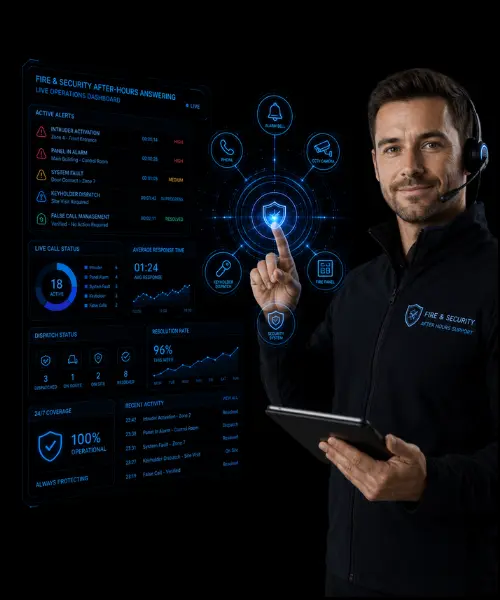
An AI answering service for fire and security firms answers activations and client calls outside working hours and works out which ones need a keyholder or an engineer tonight. Confirmed intrusions, panels in alarm on life-safety systems and anything with a person on site reach your on-call team with the site, the zone and what the panel is actually showing. The rest of the night’s traffic is logged for the morning. The point is not answering the phone. It is not spending a client’s police response on a windy night. See how our AI answering service works across every sector.
Which activations are worth a callout?
Every out-of-hours activation asks the same question: is this a real event, or is it the third false call this year?
In this sector that question has a price attached, and it isn’t a metaphor. Under the NPCC’s Police Requirements for Security Systems, an intruder alarm holding a Unique Reference Number gets Level 1 police response until it produces three false calls in a rolling twelve months.
Two false calls and your client gets a warning letter. Three and response is withdrawn at Level 3, no police attendance, keyholder only, not less than fourteen days from the date of that letter. The Alarm Receiving Centre is then instructed to stop passing activations to the police at all.
So the cost of a bad decision at 3am isn’t an hour of somebody’s night. It is one of the three chances your client gets in a year, and when they’re gone, it’s your name on the system that lost them.
Most firms handle this with a keyholder rota and whoever is holding the out-of-hours phone. At three in the morning, on a windy night, with four activations queued, that person is guessing.
That isn’t triage. It’s a judgement call taken at the worst possible hour on the thinnest possible information.
In this sector that question has a price attached, and it isn’t a metaphor. Under the NPCC’s Police Requirements for Security Systems, an intruder alarm holding a Unique Reference Number gets Level 1 police response until it produces three false calls in a rolling twelve months.
Two false calls and your client gets a warning letter. Three and response is withdrawn at Level 3, no police attendance, keyholder only, not less than fourteen days from the date of that letter. The Alarm Receiving Centre is then instructed to stop passing activations to the police at all.
So the cost of a bad decision at 3am isn’t an hour of somebody’s night. It is one of the three chances your client gets in a year, and when they’re gone, it’s your name on the system that lost them.
Most firms handle this with a keyholder rota and whoever is holding the out-of-hours phone. At three in the morning, on a windy night, with four activations queued, that person is guessing.
That isn’t triage. It’s a judgement call taken at the worst possible hour on the thinnest possible information.
What lands on the out-of-hours line
Activations worth attending
A confirmed intrusion, glass break with sequential confirmation, a panel in alarm on a life-safety system, anything with a person on site. The agent recognises these, reaches your on-call keyholder or engineer with the site, the zone and what the panel is actually showing, and confirms the handover landed rather than assuming it did.
Faults that wait for daylight
A panel showing a battery fault, a detector in trouble, a door contact that keeps dropping out. Logged as first job in the morning with the client told when an engineer is coming, because a fault at 2am is the same fault at 9am, and nobody is safer for a van at three.
Clients, keyholders and new sites
A client who has forgotten a code, a keyholder change, a facilities manager asking about adding a site, somebody chasing a service visit. Answered or logged from your own records rather than a generic script.
The rest of the night’s traffic
Suppliers, subcontractors, an ARC confirming details, a wrong number. Captured properly: which site, who called, what they wanted, what happens next. At 8am rather than as eleven missed calls on an engineer’s mobile.
Built From Your Sites, Not Our Template
Where your response rules come from
Not from us. We start with your last twelve months of activations, and with which of them turned out to be worth attending.
Your Activation History
Most firms have a rough sense of their false call rate and are wrong about it, usually low.
Before we build anything we go through what actually happened, the activations, the attendances, and the sites that keep generating both.
That review is worth having on its own. It usually finds the handful of sites producing most of the false calls, which is a conversation worth having with those clients whatever you do next.
Before we build anything we go through what actually happened, the activations, the attendances, and the sites that keep generating both.
That review is worth having on its own. It usually finds the handful of sites producing most of the false calls, which is a conversation worth having with those clients whatever you do next.
What We Check
What You Set
What it won’t decide
It won’t decide a false alarm is real
Confirmation is a matter for your rules and the signals the panel is sending, not a judgement made on a phone call. The agent applies what you’ve set, sequential confirmation, zone logic, whether anyone is on site, and where the rules don’t cover it, it escalates rather than absorbing it.
It won’t gamble with a client’s URN
Where it’s genuinely unsure, it escalates to a person rather than deciding not to. That means occasional callouts you’d rather it had held. Given three false calls costs your client police response for a year, waking somebody is the cheaper mistake.
It won’t manage a client who’s just been burgled
Somebody standing in their own premises at 4am with the door off its hinges. It recognises that and hands over fast. It doesn’t try to reassure them and it doesn’t take a statement.
It won’t fix a site that keeps crying wolf
If one warehouse generates half your activations, this tells you so faster and in writing rather than solving it. More than one client has found the answering was never the real problem, a detector pointed at a roller door was.
How we get it running
Week one: mapping
We go through your last twelve months of activations with whoever owns service: what came in, what you attended, which sites keep generating it. This usually surfaces things you didn’t know, like how close some sites already are to their third false call.
Week two: build and test
We build the agent, connect it to your monitoring platform or job system, and test it against real activations from your own history rather than invented ones. You sign off the confirmation rules before it answers a single call.
Week three: live, watched.
It goes live with every call reviewed. We tune the confirmation rules on what actually comes in, because the first fortnight always produces an activation pattern nobody had mapped.
Weeks four to eight: optimising against real calls.
This is where the agent gets genuinely good. We listen to live calls and refine against the situations nobody predicted: the client who reports a panel fault as a fire, the keyholder who never answers the first number, the accent the agent keeps mishearing.
Thresholds get adjusted where the agent is sending keyholders out too often or not often enough. Most of the difference between an agent that works and one that frustrates people is made in this window, not at build.
Thresholds get adjusted where the agent is sending keyholders out too often or not often enough. Most of the difference between an agent that works and one that frustrates people is made in this window, not at build.
What it costs
One-off Build Fee
| Scope | GBP | USD |
|---|---|---|
| Standard: single site, 2 to 3 escalation paths, 1 to 2 integrations | £1,500 | $1,950 |
| Complex: multi-site, regulated sector, deep integrations | £2,500 to £4,000 | $3,250 to $5,200 |
One off Build Fee Waived on a 12-month commitment
Monthly
| Essential | Standard | Managed | |
|---|---|---|---|
| Per month | £349 / $449 | £599 / $769 | £999 / $1,299 |
| Included minutes | ~400 | ~1,000 | ~2,500 |
| Escalation paths | Single | Multi-path with fallbacks | Complex / regulated |
| Integrations | 1 | 3 | Unlimited |
| Review cadence | Quarterly | Monthly | Priority + tuning |
Most fire and security firms we speak to are comparing this against three things: a keyholder rota, an ARC that also takes their overflow, or the out-of-hours phone going to whoever’s turn it is.
A Keyholder Rota
Real cost if: you count retention. Replacing a qualified engineer costs more than a year of this.
A General Answering Service
Real cost if: you’re paying per call and still deciding every activation yourself.
Mapped To Your Confirmation Rules
Good fit if: your clients’ police response is worth protecting.
Frequently asked questions
How does it know which keyholder to call?
From the rules we map with you, by site, by system type, by who’s on the rota that night. If the first keyholder doesn’t answer it follows the chain rather than stopping, which is the failure most out-of-hours phones actually have.
Does it know which sites still have police response?
Yes, if you tell it. Sites that have dropped to Level 3 get handled differently, because there’s no sense routing an activation towards a police attendance that isn’t coming. It’s one of the first things we map.
Can it handle a night when everything goes off at once?
That’s the case for it. Wind, a power cut or a comms failure will queue activations faster than one person can work through them. They get answered in parallel, captured consistently, and ordered by what your rules say matters rather than by who rang first.
What about fire panel activations?
Handled on the strictest reading of your rules and never softened. A panel in alarm on a life-safety system goes to a person immediately; a fault condition is logged for an engineer. The agent doesn’t decide which one the panel is showing, it reports what it’s told and escalates when that’s unclear.
How long before it’s handling a bad night?
Around three weeks to go live and four to eight weeks of tuning against real activations. Most firms run it alongside the existing rota for that first fortnight, because a confirmation decision isn’t something you take on trust.
Do callers know they’re talking to AI?
If they ask, yes. We don’t build agents that claim to be human, and a keyholder being sent to a site at 4am is entitled to know exactly where that instruction came from.