
AI Answering Service for Facilities and Cleaning
It’s ten past two and the phone has gone three times. A cleaner can’t get into a site because the code has changed. Another has set off an alarm and doesn’t know how to clear it. A client’s building has a leak somebody spotted on a late shift. Two of those callers are your own staff, alone, in an empty building.
We build an AI answering service for facilities management and commercial cleaning firms that handles the night shift, so your people can always reach somebody and your clients’ response windows still get met.
We build an AI answering service for facilities management and commercial cleaning firms that handles the night shift, so your people can always reach somebody and your clients’ response windows still get met.
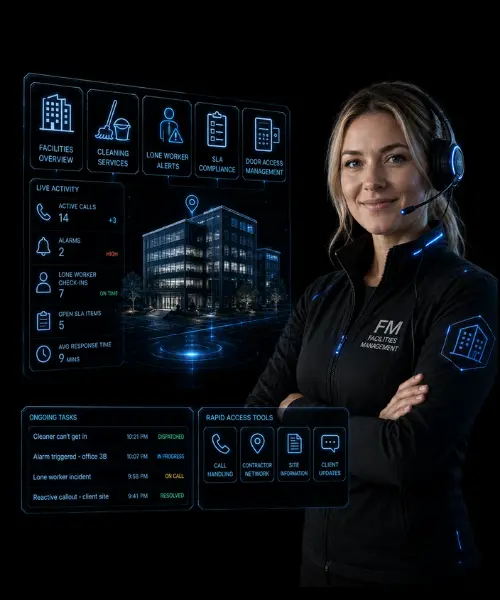
An AI answering service for facilities and cleaning firms answers the calls that come in while your night shift is working. Access failures, alarm activations and anything that puts a lone worker at risk reach your on-call supervisor immediately. Client reactive callouts are logged against the right contract and response window. Everything else the night throws up waits for the morning. The point is not answering the phone. It is that a cleaner alone in an empty building can always reach a person. See how our AI answering service works across every sector.
Who answers when your night shift calls?
Most of your out-of-hours calls aren’t clients. They’re your own people, working alone, in buildings everybody else went home from hours ago.
That changes what the phone is for. A cleaner who can’t get in has a problem you can solve in ninety seconds. A cleaner who has had an incident and can’t reach anybody has a problem that belongs to you under health and safety law.
HSE guidance on lone working is direct about it: an employer’s responsibilities for the health, safety and welfare of their people cannot be transferred to those who work alone, and the duty to assess that risk sits under the Management of Health and Safety at Work Regulations 1999. Cleaners and security staff working outside normal hours are named specifically, and keeping in touch and being able to respond to an incident is part of what’s expected.
So a phone nobody answers at 2am isn’t a service failure. It’s a control that was supposed to exist and didn’t.
The other half of the volume is contractual. Reactive callouts run against response windows with service credits behind them, and a client’s clock doesn’t pause because your duty manager was asleep. Most firms cover both ends with a mobile that rotates weekly.
That works right up until the night it matters.
That changes what the phone is for. A cleaner who can’t get in has a problem you can solve in ninety seconds. A cleaner who has had an incident and can’t reach anybody has a problem that belongs to you under health and safety law.
HSE guidance on lone working is direct about it: an employer’s responsibilities for the health, safety and welfare of their people cannot be transferred to those who work alone, and the duty to assess that risk sits under the Management of Health and Safety at Work Regulations 1999. Cleaners and security staff working outside normal hours are named specifically, and keeping in touch and being able to respond to an incident is part of what’s expected.
So a phone nobody answers at 2am isn’t a service failure. It’s a control that was supposed to exist and didn’t.
The other half of the volume is contractual. Reactive callouts run against response windows with service credits behind them, and a client’s clock doesn’t pause because your duty manager was asleep. Most firms cover both ends with a mobile that rotates weekly.
That works right up until the night it matters.
What the night shift actually rings about
Anything with a person at risk
A lone worker who has had an incident, somebody who can’t get out of a building, an activation they’ve triggered and can’t clear, a member of staff who hasn’t checked in when they should have. The agent recognises these, reaches your on-call supervisor with the site, the person and what’s happened, and confirms the handover landed rather than assuming it did.
Access and site problems
A code that’s changed, a key that won’t turn, a room that’s locked, a machine that’s failed mid-shift. Solved from your own site notes where it can be and escalated to whoever holds the answer where it can’t, because a cleaner stood outside for forty minutes is a shift you’ve paid for and not delivered.
Client reactive callouts
A leak found on a late shift, a washroom out of service, a door that won’t secure. Logged against the right contract and the right response window, with the client told what happens next rather than left to chase it in the morning.
Everything else the night throws up
Staff ringing in sick for the early shift, a supplier, a security guard checking something, a wrong number. Captured properly: which site, which contract, who called, what happens next. At 7am rather than as nine missed calls.
Built From Your Contracts, Not Our Template
Where your night rules come from
Not from us. We start with your last six to twelve months of night calls, your lone working procedure, and the response windows you’ve actually signed up to.
Your Night Call Log
Most firms have a rough sense of how much their night shift rings and are wrong about it, usually low.
Before we build anything we go through what actually happened, the calls that reached a duty phone, the ones that reached voicemail, and the incidents that got written up afterwards.
That review is worth having on its own. It usually shows a handful of sites generating most of the access problems, and that they’re fixable with a written note rather than a phone call.
Before we build anything we go through what actually happened, the calls that reached a duty phone, the ones that reached voicemail, and the incidents that got written up afterwards.
That review is worth having on its own. It usually shows a handful of sites generating most of the access problems, and that they’re fixable with a written note rather than a phone call.
What We Work Through
What You Set
What it won’t take on
It won’t be your lone worker system
If you run check-in software or panic alarms, this sits alongside them and does not replace them. The agent answers a phone and reaches a person fast. It doesn’t monitor, it doesn’t track, and it won’t know somebody is in trouble unless they ring. Your risk assessment still has to stand up on its own.
It won’t decide an SLA was met
It logs what came in and when, against the contract you’ve told it about. It doesn’t decide whether a response window was hit and it never tells a client it was. That’s your record and your conversation, and an agent guessing at it is worse than useless in a contract review.
It won’t calm down a frightened member of staff
Somebody alone in a building who has heard something, or who has been confronted. It recognises that and gets a person on the line fast. It doesn’t try to talk them through it, because at that moment they need a colleague and not a system.
It won’t fix site notes that live in one head
Half the night calls we see are access problems answerable from something one supervisor happens to know. Where it isn’t written down, the agent escalates and that supervisor gets rung anyway. More than one client has found the first month’s work was writing it down, not building the agent.
How the rollout runs
Week one: mapping
We go through your night calls with whoever owns operations: what comes in, which sites generate it, what your lone working procedure actually says. This usually surfaces things you didn’t know, like how many access problems come from the same three sites.
Week two: build and test
We build the agent, connect it to your CAFM or job system, and load your site access notes and contracted response windows. It’s tested against real night calls from your own history rather than invented ones.
Week three: live, watched.
It goes live with every call reviewed. We tune against what your night shift actually rings about, because the first fortnight always turns up a site nobody flagged.
Weeks four to eight: optimising against real calls.
This is where the agent gets genuinely good. We listen to live calls and refine against the situations nobody predicted: the cleaner whose first language isn’t English describing a fault, the caller ringing from a basement with two bars of signal, the site everybody calls by a different name.
Thresholds get adjusted where the agent is waking a supervisor too often or not often enough. Most of the difference between an agent that works and one that frustrates people is made in this window, not at build.
Thresholds get adjusted where the agent is waking a supervisor too often or not often enough. Most of the difference between an agent that works and one that frustrates people is made in this window, not at build.
What it costs
One-off Build Fee
| Scope | GBP | USD |
|---|---|---|
| Standard: single site, 2 to 3 escalation paths, 1 to 2 integrations | £1,500 | $1,950 |
| Complex: multi-site, regulated sector, deep integrations | £2,500 to £4,000 | $3,250 to $5,200 |
One off Build Fee Waived on a 12-month commitment
Monthly
| Essential | Standard | Managed | |
|---|---|---|---|
| Per month | £349 / $449 | £599 / $769 | £999 / $1,299 |
| Included minutes | ~400 | ~1,000 | ~2,500 |
| Escalation paths | Single | Multi-path with fallbacks | Complex / regulated |
| Integrations | 1 | 3 | Unlimited |
| Review cadence | Quarterly | Monthly | Priority + tuning |
Most facilities and cleaning firms we speak to are comparing this against three things: a duty phone on rotation, a general answering service, or nothing after six.
A Duty Phone On Rotation
Real cost if: you count retention. Replacing an experienced supervisor costs more than a year of this.
A General Answering Service
Real cost if: you’re paying per call and your lone worker still couldn’t reach anybody.
Mapped To Your Contracts
Good fit if: your people work alone and your contracts have response windows.
Frequently asked questions
How does it know which supervisor to call?
From the rules we map with you, by site, by contract, by who’s on call that night. If the first supervisor doesn’t answer it follows the chain rather than stopping, which for a lone worker call is the part that actually matters.
Does this replace our lone worker alarm?
No, and be wary of anyone who tells you otherwise. It answers a phone and reaches a person quickly. It doesn’t monitor, track or detect anything. If your risk assessment relies on a device or a check-in system, keep it, this sits alongside.
Can it give a cleaner a door code?
If you’ve told it to, for that site, and only to somebody it can verify. Most firms let it handle access for the majority of sites and hold back the ones with client restrictions. That split is yours, and it’s usually the part that pays for itself first.
Can it log against different clients’ SLAs?
Yes. Reactive callouts are logged against the contract, the site and the response window you’ve given it, so the morning starts with a queue that’s already prioritised rather than a list somebody has to sort out first.
How long before the night shift can rely on it?
Around three weeks to go live and four to eight weeks of tuning. Most firms tell their night staff on day one and keep the duty phone running in parallel for the first fortnight, trust in a number your people ring alone at 2am is earned rather than announced.
Do callers know they’re talking to AI?
If they ask, yes. We don’t build agents that claim to be human, and a member of staff alone in a building at 3am should never be in any doubt about who they’ve got on the line.