
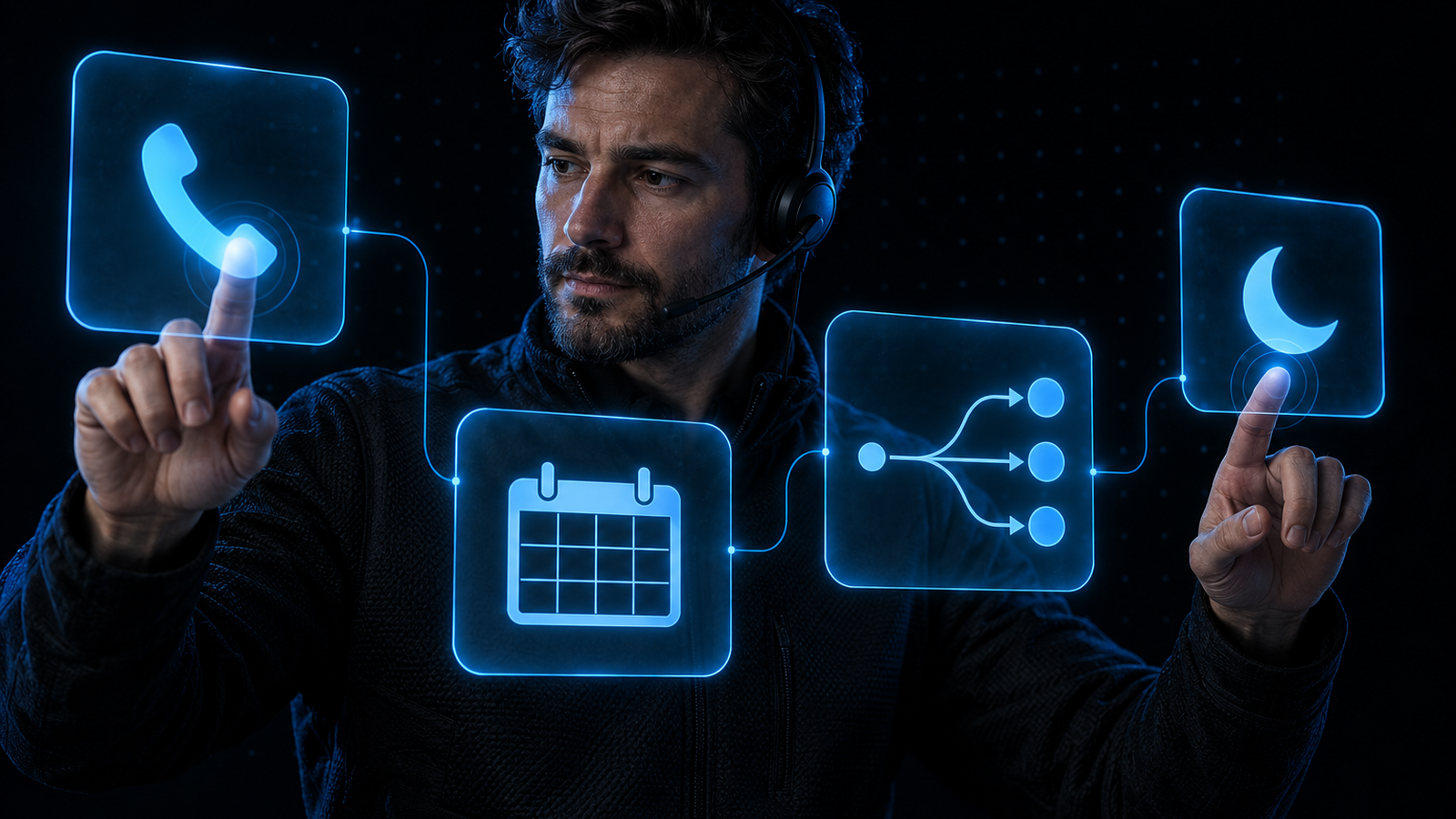
The main benefits of using an AI virtual receptionist for small businesses are 24/7 availability, faster responses, bookings logged in your calendar or CRM, less admin for your team, and evening and weekend cover without paying extra salaries, though you pay setup and running costs.
What is an AI receptionist and how can it help my business?
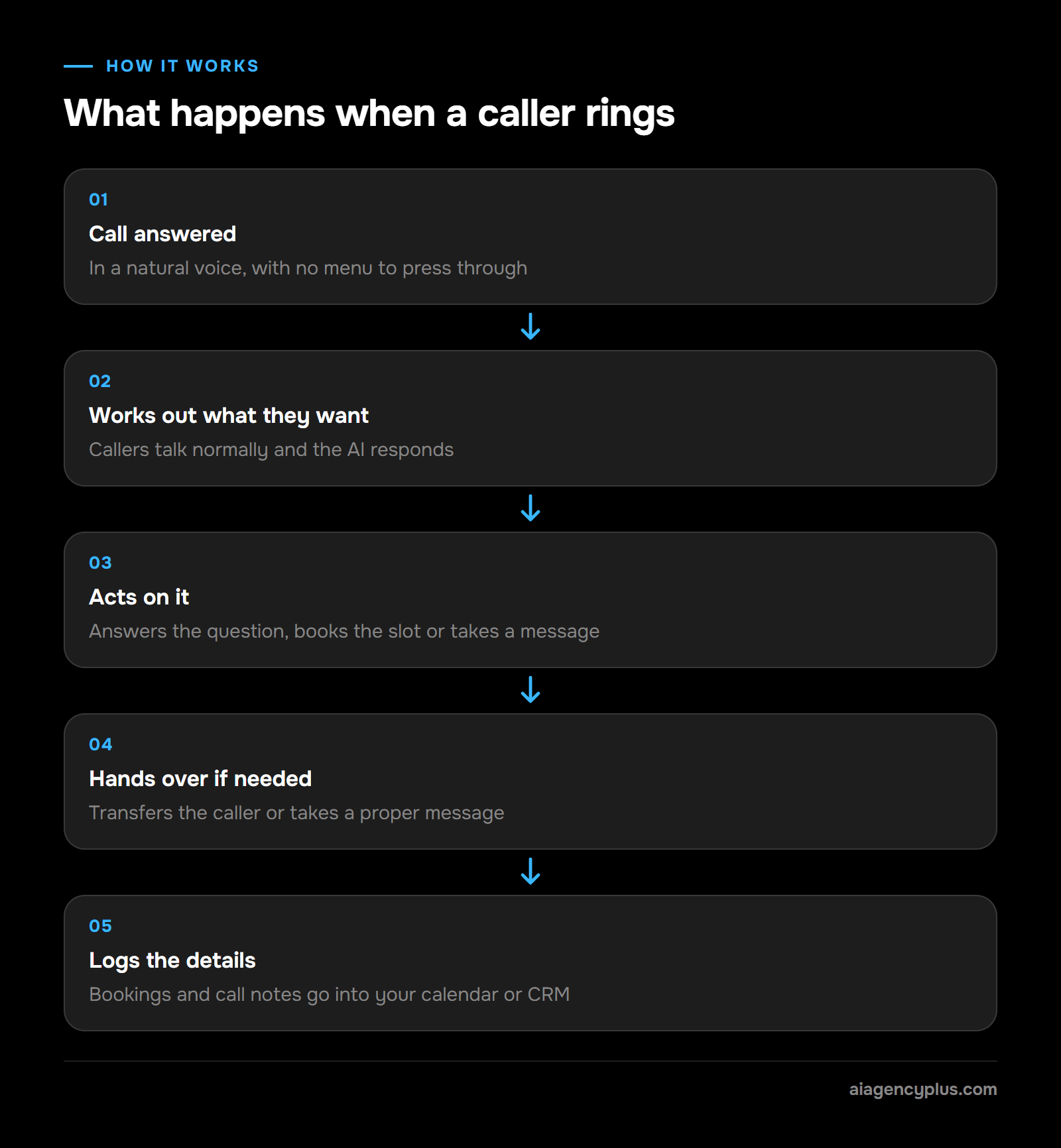
An AI receptionist is software that answers your business phone line in a natural voice. It works out what the caller wants and then acts on it. It can answer a question, book an appointment, take a message or pass the call to a person. I cover the basics in more depth in What is an AI Virtual Receptionist?.
The day-to-day jobs it takes on:
- Answering calls and common questions, such as opening hours, prices and the areas you cover
- Routing calls to the right person or team
- Booking, moving and cancelling appointments
- Taking messages and logging the caller's details
Callers don't press 1 for sales. They talk normally, and the AI responds. Routine calls can finish without a person getting involved. When a call needs a human, a well-built setup hands it over or takes a proper message. That handover is designed in from day one.
What are the main benefits of using an AI virtual receptionist for small businesses?
There are five main benefits. They all aim at two things: missing fewer calls and spending less of your team's time on the phone. How much of each you get depends on your call mix.
| Benefit | What it means day to day | Who notices it most |
|---|---|---|
| 1. 24/7 availability | Calls are answered in the evenings, at weekends and on bank holidays | Clinics, trades, hotels, holiday lets |
| 2. Faster responses | No hold music and no voicemail for routine questions, and a second caller doesn't hit the engaged tone | Any business with busy peaks, and seasonal or campaign-driven businesses |
| 3. Bookings logged in your systems | Bookings, messages and call notes go straight into your calendar or CRM | Businesses that take bookings by phone |
| 4. Less admin | Your team spends less time booking, writing up messages and answering repeat questions | Owners who answer the phone themselves |
| 5. No extra salaries for out-of-hours cover | No extra salaries for evening and weekend cover, though you pay setup and per-minute running costs | Businesses that need more than office-hours cover |
Each benefit comes with a caveat, and I cover them below. An AI receptionist is only as good as the information and instructions you give it. It also earns its keep on routine calls, not on every call.
To find out which of these benefits apply to your own calls, Book a Discovery Call and I'll go through them with you.
Does 24/7 call answering really matter for a small business?
It matters if your customers ring when nobody can answer, and opening hours alone show the gap. One full-time receptionist covers office hours, which leaves evenings, nights and weekends, the larger part of the week, without anyone on the phone. Calls in those hours go to voicemail, to a mobile in someone's pocket or nowhere.
An AI receptionist answers those out-of-hours calls. It answers the question, books the slot or takes a message you can act on in the morning.
Dental practices and clinics
Some patients ring to book or rearrange appointments outside surgery hours. The AI can handle routine bookings and give out your opening times. For anything urgent, it gives the caller the route you have chosen, such as your emergency line or NHS 111. Clinical triage stays with your clinical team.
Hotels and holiday lets
Guests call late about check-in, parking, Wi-Fi or availability. For hotel staff, the benefit is that the front desk stops being pulled to the phone in the middle of a check-in. For owner-run holiday lets, guest questions get answered without the owner's phone going off at 11pm.
Professional services
Solicitors, accountants and consultants can take new enquiries and do basic client intake after hours. The AI collects the name, the matter type and a callback time, then sends it to the right person.
Trades and home services
A plumber on a job can't answer the phone. The AI takes the enquiry, captures the postcode and the problem, and books a callback or a visit slot.
Customers in other time zones
If you sell abroad, the phone keeps working while the UK sleeps, and you don't need overnight staff.
The caveat: the AI answers the phone, but it doesn't do the work. If a caller needs a person at 3am, decide in advance what happens. That might be an on-call number, a promised callback or an emergency route.
How can an AI receptionist improve call handling for a small or midsize business?
It answers straight away, it can take more than one call at a time, and it passes on calls it can't handle with the details already captured. That should mean fewer abandoned calls and fewer callbacks that start with "sorry, who was this?", though I can't give you a figure until we've measured your own calls.
It answers immediately
Callers with routine questions get an answer straight away, with no queue. Speed matters because a caller who reaches voicemail can simply ring the next business on the list.
It handles several calls at once
A person can take one call at a time. Many AI voice platforms can take several in parallel, up to the concurrency limit on your plan. That limit matters if you run campaigns or have a seasonal rush, so check it before you choose a platform.
It routes calls with context
For calls that need a person, the AI works out the reason for the call first. It then transfers the caller or takes a message. Your team picks up knowing who is calling and why, so the caller doesn't have to repeat themselves.
It looks things up in your systems
When it's connected to your calendar or CRM, the AI can check availability, find an existing booking or log a new enquiry during the call. Nobody has to retype a sticky note later.
It gives consistent answers
The AI gives the same answer to the same question, whether it's a Monday morning or a Sunday night. That consistency depends on the information behind it, so keeping prices and hours up to date is part of running it. The quality of the prompt decides most of this, which is why I wrote up the best AI voice receptionist prompt for UK businesses.
How much admin can an AI receptionist take off your team?
It takes over the phone admin that sits around each call: booking, rescheduling, writing up messages and logging enquiries. How many hours that saves depends on your call volume. I won't give you a generic figure. You should measure your own.
The jobs that typically move from your team to the AI:
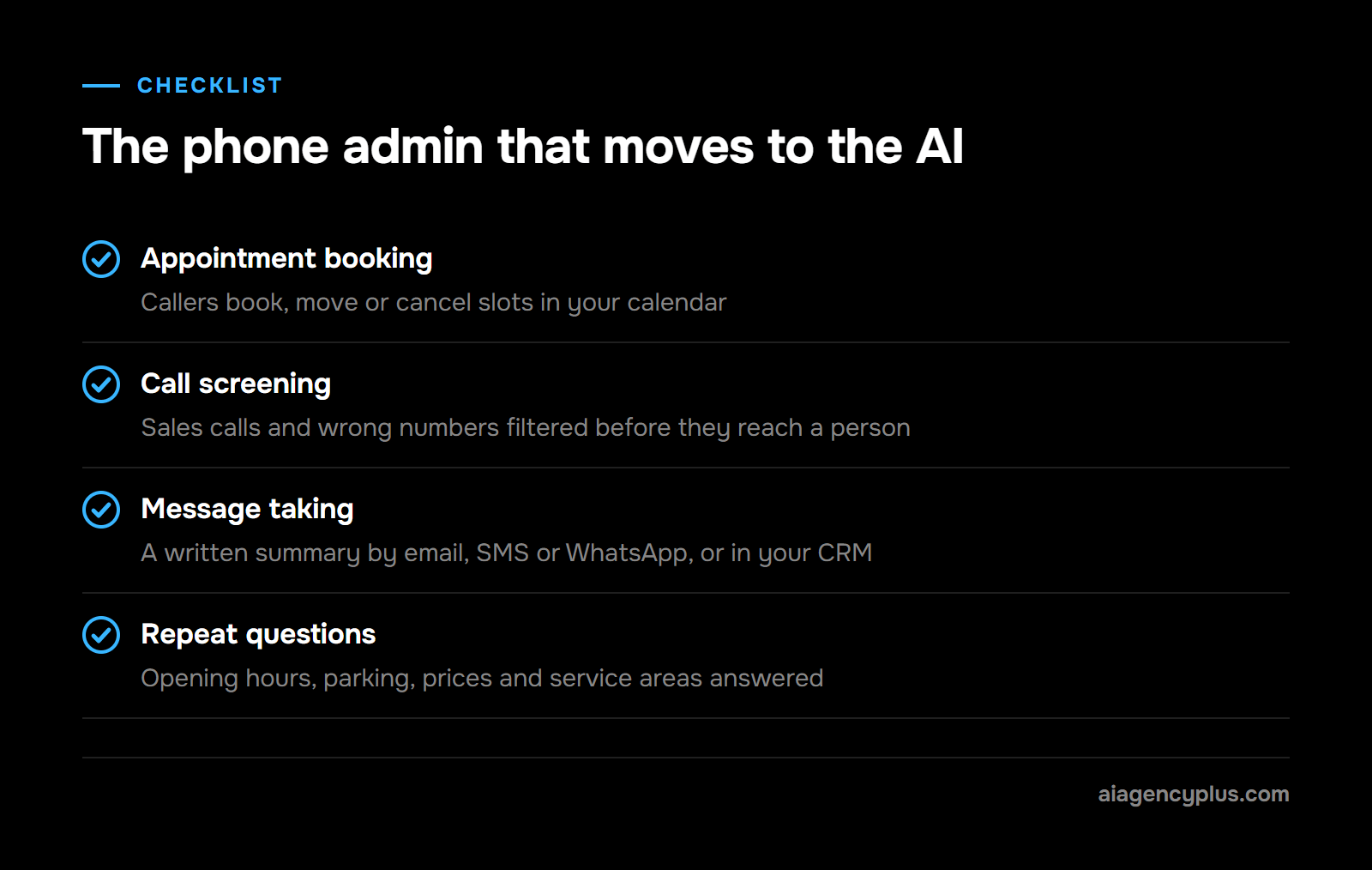
- Appointment booking. Callers book, move or cancel slots directly in your calendar, with no back-and-forth.
- Call screening. Sales calls and wrong numbers get filtered before they reach a person.
- Message taking. Each call ends with a written summary sent by email, SMS or WhatsApp, or logged in your CRM.
- Repeat questions. Opening hours, parking, prices and service areas get answered without anyone stopping work.
In a hotel, this frees the front desk to look after the guests standing in front of them. In a dental practice, reception staff can deal with patients in the waiting room instead of the ringing phone.
A simple way to size the benefit: for two weeks, count your calls by type and note roughly how long each takes. The AI can absorb the calls that are routine, frequent and follow a script.
Is an AI receptionist cheaper than hiring a receptionist?
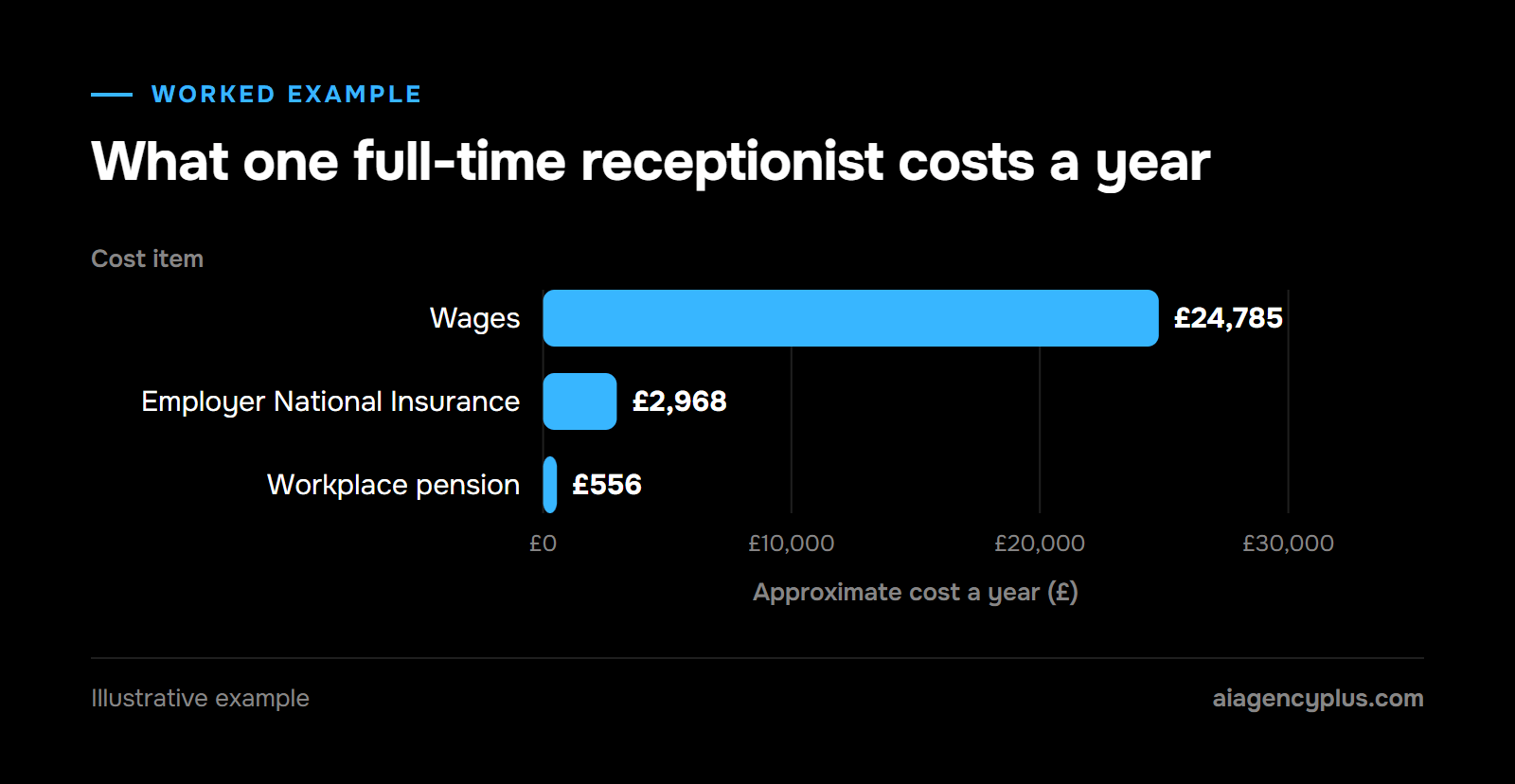
Whether it costs less depends on the quote for your call volume. Staffing evenings and weekends with people means extra salaries, so set the figures below against that quote. For a business that only needs the phone answered 9 to 5 on a quiet line, a receptionist may be the better buy, so compare like for like before deciding. Here is the cost of one full-time receptionist at 37.5 hours a week on the National Living Wage, before any Employment Allowance, worked out from GOV.UK rates for the 2026 to 2027 tax year, which starts on 06/04/2026.
| Cost item | Basis | Approximate annual cost |
|---|---|---|
| Wages | National Living Wage from 01/04/2026 (GOV.UK), 37.5 hours a week x 52 weeks (1,950 hours at £12.71) | about £24,785 |
| Employer National Insurance | Employer rate of 15% on earnings above the £5,000 secondary threshold (GOV.UK, 2026 to 2027) | about £2,968 |
| Workplace pension | Employer minimum contribution on qualifying earnings above £6,240 (GOV.UK) | £556 |
| Total | Before recruitment, training, equipment, holiday cover or any Employment Allowance | about £28,309 |
A full-time receptionist on the National Living Wage, at 37.5 hours a week, costs about £28,309 a year with employer National Insurance and pension, before any Employment Allowance. From 01/04/2027 the National Living Wage rises to £13.21 (GOV.UK, 28/10/2026), about £29,460 on the same basis, assuming current employer National Insurance rates and thresholds.
The caveats, in both directions:
- Many receptionists are paid above the National Living Wage, which raises the wage line.
- Eligible employers can claim the Employment Allowance (up to £10,500 a year since 06/04/2025), which reduces the National Insurance line.
- That figure covers office hours only. Staff take 5.6 weeks of statutory paid holiday, and the phone still rings during those weeks.
- Covering evenings and weekends with people means a second and third salary, or paying an answering service.
An AI receptionist usually costs a one-off setup fee plus monthly running costs that rise with call minutes. The real figure depends on your call volume and on which systems it connects to. I break down per-minute running costs for voice agents in How Much Does AI Automation Cost in the UK?.
The cost comparison works best call type by call type: decide which calls the AI handles and which stay with your receptionist, so they can focus on the calls that need a person.
How does AI Agency Plus set up an AI receptionist for a UK SME?
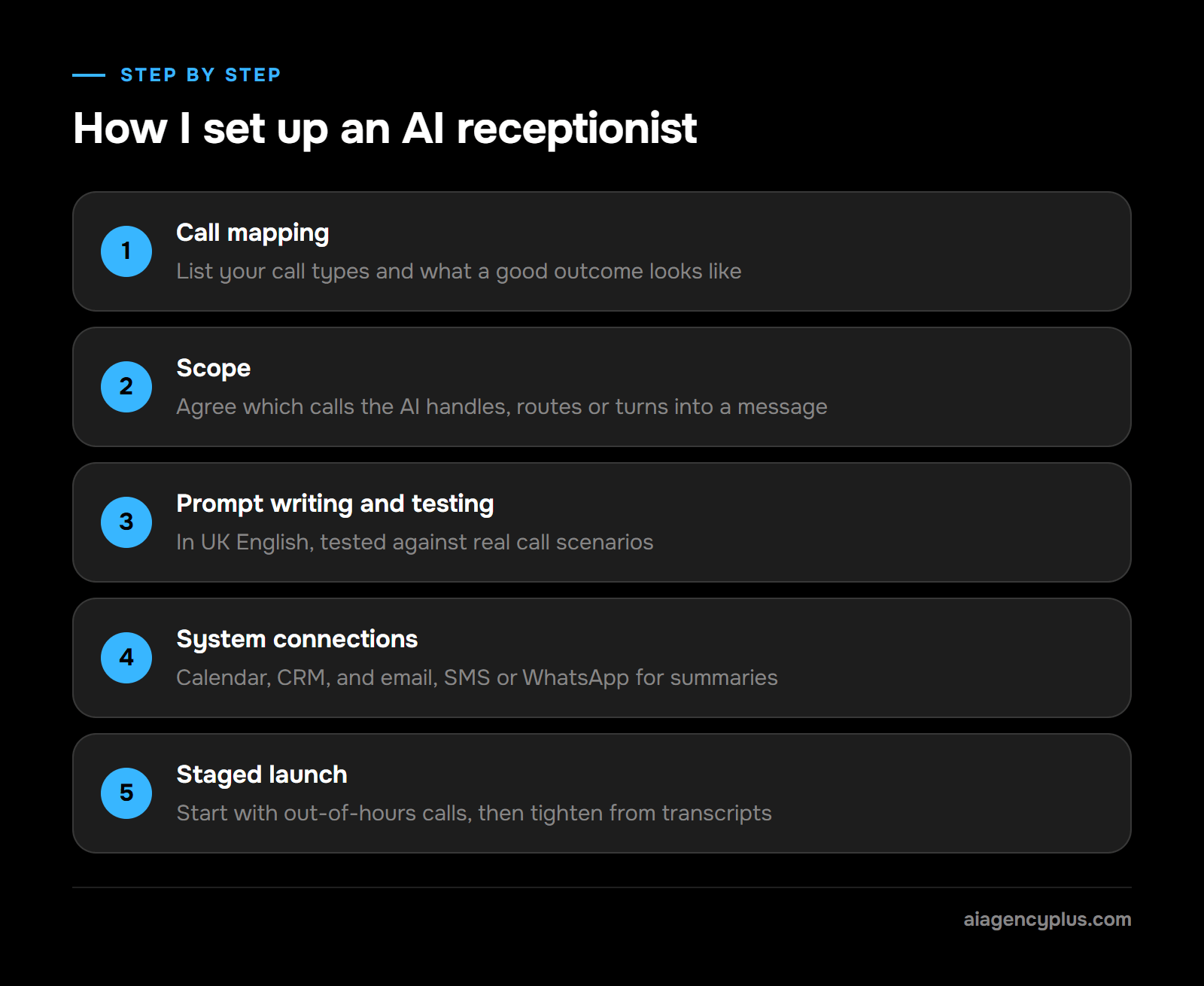
I build each receptionist from your actual calls rather than from a template. Here is the process.
- Call mapping. I list your call types with you, how often each comes in and what a good outcome looks like for each.
- Scope. We agree which calls the AI handles from start to finish, which it routes to a person and which it turns into a message.
- Prompt writing and testing. I write the prompt in UK English, using your prices, your opening hours and your tone. I test it against real call scenarios, including awkward ones, before any customer hears it.
- System connections. That means your calendar for bookings, your CRM for enquiries, and email, SMS or WhatsApp for call summaries.
- Staged launch. You can start with out-of-hours calls only. I then review transcripts and tighten the prompt using what callers actually say.
I also cover the compliance and trust basics: telling callers they are speaking to an AI, recording calls lawfully and handling personal data under UK GDPR. If you're unsure about any of these, read Is It Legal to Have AI Answer Your Business Calls in the UK?.
Is an AI virtual receptionist worth it for your business?
It's worth it if you miss calls outside your hours or at busy times, and if most of those calls are routine. It's the wrong choice in a few cases, and I'd rather tell you now.
- Very low call volume. If the phone rings a few times a week and you always answer it, there's little to gain.
- Mostly sensitive or complex calls. Complaints, bereavement and calls that need judgement should go to a person. The AI can still help by routing these calls quickly and capturing the details.
- No system to connect to yet. If bookings live in a paper diary, put a calendar in place first. Then the AI has somewhere to book into.
- Callers who expect a named person. Some relationship-led businesses are better off using AI for out-of-hours calls only.
It does routine calls well and passes the rest to your team with the details already captured.
If you'd like to know whether it fits your calls, Book a Discovery Call. I'll tell you honestly if it doesn't.
Frequently asked questions
Will an AI receptionist replace my human receptionist?
It usually makes sense to run it alongside them. The AI takes routine questions, bookings and out-of-hours calls. Your receptionist handles visitors, complaints and anything that needs judgement. Out-of-hours cover on its own is a sensible place to start.
Do I have to tell callers they are speaking to an AI?
Tell them at the start of the call. It is good practice and avoids complaints. UK law has no specific statute that says you must, but if you take calls from people in the EU, Article 50(1) of the EU AI Act has applied since 02/08/2026. That duty falls on the provider of the AI system, which must design it so people are told they are dealing with an AI unless that is obvious. In practice, the AI should announce itself at the start of the call. Wherever the caller is, the AI should never claim to be human when asked. The transparency duties under UK GDPR also apply. If you record calls or store caller details, tell callers the call is recorded and why, and your privacy information should explain it. See the ICO's UK GDPR guidance. My guide to the UK law on AI call answering covers call recording and data protection.
Can an AI receptionist understand regional UK accents?
Quality varies between platforms and drops on poor phone lines, so don't take it on trust. Test it with real recordings or test calls from people who sound like your customers before you go live. When the AI isn't sure, it should confirm details back to the caller rather than guess.
What are the benefits of an AI receptionist for hotels and holiday lets?
Guests get answers about check-in, parking, Wi-Fi and availability at any hour. Front desk staff aren't pulled away from guests who are standing in front of them. Owner-run holiday lets stop getting late-night calls about routine questions, and urgent issues are routed to whoever is on call.
How much does an AI receptionist cost in the UK?
It usually means a setup fee plus monthly running costs that rise with call minutes and the number of system integrations. A full-time receptionist on the National Living Wage, at 37.5 hours a week, costs about £28,309 a year with employer National Insurance and pension, before any Employment Allowance. From 01/04/2027 the National Living Wage rises to £13.21 (GOV.UK, 28/10/2026), about £29,460 on the same basis, assuming current employer National Insurance rates and thresholds. My UK AI automation cost guide covers per-minute running costs for voice agents.