
After Hours Legal Answering Service For Law Firms
It’s twenty past nine on a Thursday. Someone has been arrested and their partner is trying to find a solicitor. Someone else was injured three years ago next month. And a client who exchanges on Friday cannot sleep. One of those is a crisis, one is a case, and one is a two-minute phone call.
We build after-hours answering and legal intake for law firms that tells them apart — and captures the matter properly instead of taking a name and a number.
We build after-hours answering and legal intake for law firms that tells them apart — and captures the matter properly instead of taking a name and a number.
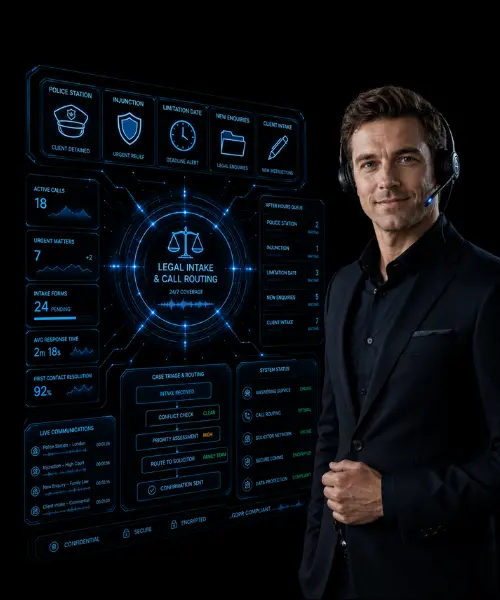
A legal answering service answers your firm’s phone outside office hours and treats every new caller as an intake rather than a message. Urgent matters — a client detained at a police station, an injunction that cannot wait until Monday, a limitation date weeks away — reach your on-call solicitor. Every other enquiry is captured in full: what happened, when, who else is involved, and whether they have instructed anyone. It is in your case management system by morning. The point is not answering the phone. It is not losing the instruction. See how our after hours answering service works across every sector.
What happens to a new enquiry that rings at 9pm?
Every call to a law firm after six is one of two things: a client who is worried, or an instruction you have not won yet.
The instruction is the expensive one. Someone who has just been injured, or arrested, or served with something rings three firms and instructs whoever picks up and sounds like they know what they are doing. They do not leave a voicemail and wait.
Getting it wrong the other way costs you as well. Wake a partner at midnight for a conveyancing question that could have waited until nine, and you will do it twice before the on-call rota quietly stops being volunteered for.
The worried client is not a small problem either. The Legal Ombudsman received 14,259 new complaints in the year to 31 March 2026, up 37% on the previous year, and found that communication and delay together accounted for 46% of complaint types — poor communication in 24% and delay or failure to progress in 22%. Nearly half of what consumers complain about is nobody telling them what is happening.
Most firms handle all of it with a voicemail greeting and a mobile number for the duty solicitor. The voicemail takes a name. The mobile takes whoever happens to be nearest to it.
The instruction is the expensive one. Someone who has just been injured, or arrested, or served with something rings three firms and instructs whoever picks up and sounds like they know what they are doing. They do not leave a voicemail and wait.
Getting it wrong the other way costs you as well. Wake a partner at midnight for a conveyancing question that could have waited until nine, and you will do it twice before the on-call rota quietly stops being volunteered for.
The worried client is not a small problem either. The Legal Ombudsman received 14,259 new complaints in the year to 31 March 2026, up 37% on the previous year, and found that communication and delay together accounted for 46% of complaint types — poor communication in 24% and delay or failure to progress in 22%. Nearly half of what consumers complain about is nobody telling them what is happening.
Most firms handle all of it with a voicemail greeting and a mobile number for the duty solicitor. The voicemail takes a name. The mobile takes whoever happens to be nearest to it.
What comes through after hours
Matters that cannot wait
A client detained at a police station, a without-notice injunction, a hearing in the morning, a limitation date about to run. The agent recognises these, reaches your on-call solicitor with the client, the matter and the deadline, and confirms the handover landed rather than assuming it did.
Important, but not tonight
A client anxious about an exchange, a court date that has moved, a form nobody explained. Logged as priority for first thing, with the client told exactly when they will hear — which is the cheapest thing any firm can do about its complaints record.
New enquiries and legal intake
A personal injury, a family law matter, an employment dispute. Captured as a full intake: what happened and when, who else is involved, whether they have instructed anyone else, and the dates that matter. In your case management system before you are in. This is the call that pays for the service.
The rest of the call volume
Existing clients chasing, other firms, agents, someone who has the wrong number. Captured properly: who called, which matter, what they wanted, what happens next. In the inbox at 8am rather than as eleven voicemails a paralegal works through.
Built From Your Enquiries, Not Our Template
Where your intake rules come from
Not from us. We start with the calls your firm actually took out of hours over the last six to twelve months, and which of them turned into matters.
Your Enquiry Log
Most firms have a rough sense of how many enquiries come in after six and are wrong about it, usually low.
Before we build anything we go through what actually happened — the voicemails, the calls that reached a mobile, and the enquiries that rang out and never rang back.
That review is worth having on its own. It usually shows how many potential clients rang once, got a voicemail, and instructed somebody else by Monday.
Before we build anything we go through what actually happened — the voicemails, the calls that reached a mobile, and the enquiries that rang out and never rang back.
That review is worth having on its own. It usually shows how many potential clients rang once, got a voicemail, and instructed somebody else by Monday.
What We Read
What Your Firm Sets
The lines it won’t cross
It won’t give legal advice
It takes instructions and it captures facts. It does not tell a caller whether they have a claim, what they should do next, or how long they have to bring it. That is advice, it is reserved work, and an answering service that drifts into it creates a problem for your firm rather than for us.
It won’t decide what is confidential
Paragraph 6.3 of the SRA Code of Conduct requires you to keep the affairs of current and former clients confidential unless disclosure is required or permitted by law or the client consents. The agent works to a script your firm signs off — what it may confirm, what it may never confirm, and to whom. Where the script is silent it says nothing, which occasionally frustrates a caller. That is the correct failure direction here.
It won’t handle a caller in real distress well
Someone who has just been arrested, a parent whose child has been taken, a person who is frightened of going home. It recognises these and hands over fast. It does not try to reassure them and it does not keep them talking, because both make things worse.
It won’t fix an intake that dies in the inbox
If the enquiry is captured perfectly at 10pm and nobody rings back until Thursday, this tells you that faster rather than solving it. More than one client has found the answering was never the problem — what happened to the enquiry afterwards was.
How we build it
Week one – mapping
We go through your out-of-hours calls with whoever owns new business: what comes in, what became a matter, who currently picks it up. This usually surfaces things you didn’t know, like how many enquiries arrived at the weekend and were never called back.
Week two – build and test
We build the agent, connect it to your case management system or CRM, and test it against real enquiries from your own history rather than invented ones. Your firm signs off the intake questions and the confidentiality script before it answers a single call.
Week three – live, watched.
It goes live with every call reviewed. We tune against what actually comes in, because the first fortnight always turns up an enquiry nobody anticipated.
Weeks four to eight – optimising against real calls.
This is where the agent gets genuinely good. We listen to live calls and refine against the situations nobody predicted: the caller who buries the important date in the third sentence, the relative ringing on someone else’s behalf, the accent the agent keeps mishearing.
Thresholds get adjusted where they’re waking a solicitor too often or not often enough. Most of the difference between an agent that works and one that frustrates people is made in this window, not at build.
Thresholds get adjusted where they’re waking a solicitor too often or not often enough. Most of the difference between an agent that works and one that frustrates people is made in this window, not at build.
What it costs
One-off Build Fee
| Scope | GBP | USD |
|---|---|---|
| Standard — single site, 2–3 escalation paths, 1–2 integrations | £1,500 | $1,950 |
| Complex: multi-site, regulated sector, deep integrations | £2,500–4,000 | $3,250–5,200 |
One off Build Fee Waived on a 12-month commitment
Monthly
| Essential | Standard | Managed | |
|---|---|---|---|
| Per month | £349 / $449 | £599 / $769 | £999 / $1,299 |
| Included minutes | ~400 | ~1,000 | ~2,500 |
| Escalation paths | Single | Multi-path with fallbacks | Complex / regulated |
| Integrations | 1 | 3 | Unlimited |
| Review cadence | Quarterly | Monthly | Priority + tuning |
Most firms we speak to are comparing this against three things: the duty mobile, a general answering service, or voicemail.
The Duty Mobile
Real cost if: you count fee earner time. It is the only thing the firm actually sells.
A General Answering Service
Real cost if: you’re paying per call and still losing the instruction.
Intake Mapped To Your Firm
Good fit if: one instruction a month covers this several times over.
Frequently asked questions
How does it know which solicitor to call?
From the rules we map with you — by practice area, by matter type, by who is on call that night, however your firm actually runs it. If the first solicitor doesn’t answer, it follows the fallback chain rather than stopping.
Does it give legal advice?
No, and it is built so it cannot. It captures facts and takes instructions. It will not tell a caller whether they have a claim, what they should do, or how long they have to bring it. If a caller pushes for an answer, it says a solicitor will come back to them and logs the question so somebody actually does.
How does it handle client confidentiality?
To a script your firm signs off before build. Paragraph 6.3 of the SRA Code of Conduct requires client affairs to be kept confidential, so the agent is told exactly what it may confirm, what it may never confirm, and to whom. Call recording, retention and who can read transcripts are agreed with you and written into the data processing agreement.
What does it actually capture on a new enquiry?
Whatever your intake form asks for, by practice area. Typically: what happened and when, who else is involved, whether they have instructed another firm, the dates that matter, and the conflict-check questions you want asked before anything else. It lands in your case management system, not as a note saying to ring somebody back.
How long before it’s taking intake properly?
Around three weeks to go live, then four to eight weeks of tuning. Expect the first fortnight’s intakes to need a fee earner’s eye — by week six they read like something your own team took, which is the point at which it starts earning.
Do callers know they’re talking to AI?
If they ask, yes. We don’t build agents that claim to be human — and in a regulated profession, an agent that misleads a prospective client on first contact is a problem you’d be answering for, not us.