

AI automation cost in the UK for an SME in 2026: on my working bands, a first workflow is £1,500 to £5,000 plus VAT and a departmental build £5,000 to £20,000 plus VAT. Add £40 to £400 a month in running costs, and only build if payback lands inside 12 months.
How much does AI automation cost in the UK?
A UK SME should budget £1,500 to £5,000 plus VAT for a first AI automation, live in one to three weeks. Departmental builds run £5,000 to £20,000 plus VAT. Running costs come on top, and the full first-year picture is in the small business budget section below. These are the bands I quote and see quoted in 2026.
- First automation: live in one to three weeks, at the lower end if it only connects tools you already use.
- Departmental build: four to ten weeks across a whole function.
- Running costs: £40 to £400 a month for tools and usage, depending on volume. Support is extra.
- First-year budget: about £5,000 to £8,000 plus VAT for one well-chosen workflow, before any support retainer.
- Payback: should land inside 12 months. If the maths doesn't get there, don't build it.
The most common budgeting mistake I see is pricing the build and forgetting everything after it.
A disclosure before the detail. I run an AI automation agency, so I have an interest in you deciding this is worth paying for. That is why this guide includes the running costs that tend to appear late, and a section on when you shouldn't spend the money.
If you'd rather have a number for your own process, Book a Discovery Call and I'll map it with you.
What are you actually paying for?
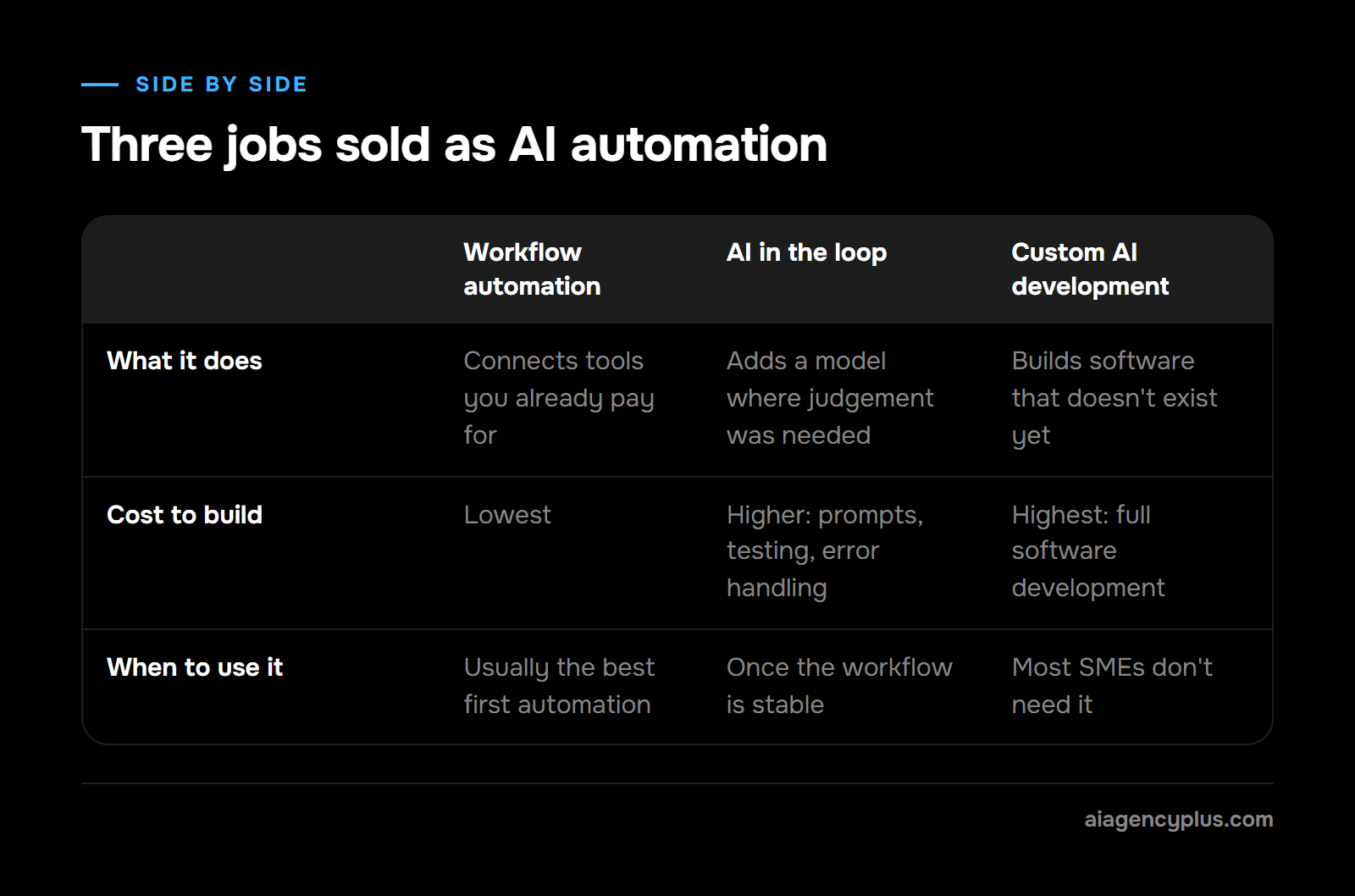
You are paying for one of three different jobs: workflow automation, AI-in-the-loop process work or custom AI development. They cost very different amounts. Most confusing quotes come from comparing one job against another, so check which job each quote covers before you compare the prices.
Workflow automation
Workflow automation connects systems you already pay for so a repetitive task happens without a person. An enquiry arrives, gets logged in your CRM, gets a reply and the follow-up is scheduled. No model is needed.
For a small retail or e-commerce business, the same idea keeps stock levels in step between the online shop and the inventory sheet. In my experience it is usually the least expensive kind of build and a sensible first automation.
If the term is new, the guide to business process automation covers the basics.
It usually falls in the first-automation band of £1,500 to £5,000 plus VAT, towards the lower end when it only connects tools you already use.
AI-in-the-loop process work
This adds a language model where judgement used to be needed. An AI agent reads the enquiry, works out what it's about, checks order history through an API (the connection one system uses to talk to another) and drafts a reply a person approves. It costs more because it needs prompt design, testing and a plan for the day it gets something wrong.
It works best once the underlying workflow is stable.
On my working figures, a single agent-assisted workflow usually sits towards the top of the first-automation band (£1,500 to £5,000 plus VAT), and moves into the departmental band once it spans several workflows. As an independent reference point, the TrustedAIAgencies review reported by IT Brief UK found a median of £4,000 for an AI agent or chatbot (27 agencies). That is an advertised starting price, not what clients actually paid.
Custom AI development
Custom AI development builds software that doesn't exist off the shelf. It carries the full cost of software development, and in my experience most SMEs don't need it.
It falls in the custom AI development band, from £50,000 plus VAT over four months or more.
Two things that inflate quotes
Marketing automation (email sequences, lead scoring, campaign triggers in HubSpot or similar) is a mature category with its own specialists. Some agencies file it under AI automation and price it at AI rates. If what you need is better email nurture, it should cost less.
An AI chatbot added to a website is usually a product subscription rather than a process automation project. Price it as a subscription, not as a build.
How many UK businesses use AI, and how deeply?
AI adoption among UK businesses has roughly tripled since late 2023, but it is shallow. Around a third of businesses with ten or more staff use at least one AI technology, yet only one in ten of those using AI describe that use as extensive. That comes from Office for National Statistics data published on 20/07/2026.
The Office for National Statistics found use of at least one AI technology among businesses with ten or more employees has climbed from roughly 12% in late 2023 to around 35%. Among firms with fewer than ten staff it is 28%.
The use is shallow. The average adopting business uses about 1.6 AI technologies, and only 10% of businesses using AI describe that use as extensive.
Projects also stall. Gartner predicted on 25/06/2025 that "Over 40% of agentic AI projects will be canceled by the end of 2027, due to escalating costs, unclear business value or inadequate risk controls."
Read together, those figures point to wide adoption, shallow use and projects that stall on cost and unclear value. In my view, that is why one dull, high-volume workflow done properly usually beats the ambitious one.
What are the UK AI automation cost bands for 2026?
UK AI automation costs fall into six bands, from a £500 to £2,000 discovery to custom development above £50,000. These are my working bands for 2026, all plus VAT. The cost follows the scope of what you automate, so compare every quote against the same scope.
| Engagement | Typical UK cost (plus VAT) | Timeline | What you get |
|---|---|---|---|
| Discovery or audit | £500 to £2,000 | 1 to 2 weeks | Process map, shortlist and costed proposal, often credited against the build |
| First automation | £1,500 to £5,000 | 1 to 3 weeks | One workflow, live, with monitoring |
| Departmental build | £5,000 to £20,000 | 4 to 10 weeks | Several connected workflows across a function |
| Multi-system programme | £20,000 to £50,000+ | 3 to 6 months | Cross-department work, custom integrations, AI agents |
| Custom AI development | £50,000+ | 4 months+ | Bespoke software and bespoke risk |
| Ongoing support | £350 to £3,000 a month | Continuous | Monitoring, fixes, changes and improvements |
In the support row, £350 a month covers one live workflow, £400 to £1,200 covers several workflows in production, and the top of the range covers larger programmes.
Independent price data is thin. TrustedAIAgencies reviewed the websites of all 277 agencies in its UK directory, in a study reported by IT Brief UK on 04/11/2026, and 113 publish a price. It measures advertised starting prices, not what clients actually paid.
The medians were £1,500 for a one-off project, £750 for an audit (47 agencies), £1,500 for a workflow (29 agencies), £4,000 for an AI agent or chatbot (27 agencies) and £250 a month for a retainer (43 agencies). The medians mix prices with and without VAT, so they are not like-for-like with my plus-VAT bands.
Against my bands, the audit median sits inside my discovery range, the workflow median matches the bottom of my first-automation range and the agent or chatbot median falls inside it. The £250 retainer median sits below my £350 single-workflow support figure. Treat any published range, including these, as a working guide.
On hourly rates, the automation delivery quotes I see usually sit between £75 and £150 an hour plus VAT. If you are charged a senior strategy rate to build a simple Zapier workflow, you are paying for the wrong seniority.
What is a realistic AI automation cost for a small business?
A realistic first-year budget for a UK small business automating one well-chosen workflow is about £5,000 to £8,000 plus VAT, before any support retainer. That assumes a build of £3,500 to £5,000 plus VAT and £125 to £250 a month in tools and usage. A simple rule-based workflow can come in well under that.
| Scenario | Build (plus VAT) | Tools and usage, 12 months | First-year total (plus VAT) |
|---|---|---|---|
| Simple rule-based workflow | £1,500 | £480 (£40 a month) | About £2,000 |
| One well-chosen workflow | £3,500 to £5,000 | £1,500 to £3,000 | £5,000 to £8,000 |
| The same, with a support retainer | £3,500 to £5,000 | £1,500 to £3,000, plus £4,200 support | £9,200 to £12,200 |
The support row uses the £350 a month figure for one live workflow from the bands above. Whether you need a retainer depends on how many workflows you run and how often they change.
In the proposals I see, AI automation pricing for UK small businesses is often quoted as the build alone. Ask for the first-year total laid out like this, so the ongoing costs are on the page before you sign.
Which row fits depends on your automation needs: how many systems the workflow touches, how often it runs and whether a language model is involved. The next section covers each of those.
What factors push AI automation costs up?
Six factors drive the cost of AI automation: how many systems it connects, the state of your data, the cost of a mistake, whether a language model is involved, custom code versus configured tools, and volume. In my experience, integration count matters most, so start there when you read a quote.
1. Integration count
Two systems is straightforward. Six is a different job, because every connection is a point of failure and a thing to test. In the quotes I write, price tracks integrations more closely than hours.
2. Data quality
If your CRM has three spellings of the same client and half your invoice data lives in a hand-kept spreadsheet, the cleanup is the project. Budget for it honestly or the automation will produce confident nonsense.
3. The cost of being wrong
Automating internal reporting is low stakes. Anything touching regulated advice or client money needs audit trails, human sign-off and more testing.
4. Whether a model is involved
Rules are cheap and predictable. Language models need prompt engineering, evaluation and a plan for the day the output drifts.
5. Custom versus configured
On my working bands, a configured build on n8n, Make or Zapier starts well below bespoke development (from £1,500 against from £50,000, both plus VAT). In my experience, most SMEs never need to cross that line.
6. Volume
A workflow running fifty times a month is a different engineering problem from one running fifty thousand times.
Are there ongoing monthly costs after the build?
Yes. After the build you keep paying for the automation platform, AI model usage, messaging and maintenance. These ongoing costs typically add £40 to £400 a month for tools and usage, depending on volume, plus support: from £350 a month plus VAT for one live workflow, or £400 to £1,200 a month plus VAT once several workflows run in production. They are often missing from a first proposal.
| Cost | How it's billed | What to budget |
|---|---|---|
| Automation platform | Per step (Zapier, Make) or per workflow run (n8n) | Model it at your real volume |
| AI model usage | Per token, input and output | £5 to £100 a month for a few small automations |
| SMS and WhatsApp | Per message, plus number or platform fees | Scales directly with volume |
| Voice | Per minute | Ask for a 1,000-call estimate |
| Maintenance and support | Monthly | £400 to £1,200 a month plus VAT for several live workflows |
The automation platform
Zapier, Make and n8n count usage differently, and this is where I see buyers go wrong most often. Zapier counts each action step in a workflow as a task, and Make also counts usage step by step through a scenario. n8n counts a whole workflow run once, however many steps it has.
The difference compounds. Every run of a ten-step workflow uses up to ten tasks on Zapier, similar step-level usage on Make, and one execution on n8n, so the gap widens with every run. Ask for the bill modelled at your real volume against each vendor's current pricing page.
n8n also has a free self-hosted community edition that runs on a small cloud server. Self-hosting moves the cost from a subscription to maintenance, because someone has to patch, back up and update it.
AI model usage
Model providers such as OpenAI, Anthropic and Google bill per token, split between what you send and what the model returns. On the pricing pages I've checked, output usually costs more than input, and caching a long, repeated prompt can cut the bill. Rule-based automation carries no model cost at all.
I don't print per-model rates because they have fallen repeatedly and any figure goes stale within a quarter. Ask your agency to model your volume against current rates. For a small business running a few automations, I budget £5 to £100 a month.
Messaging and telephony
SMS is billed per message, so the same reminder workflow costs ten times as much at 5,000 messages a month as at 500. Add a monthly fee per phone number. Each line is small, which is why budgets drift here.
Meta bills WhatsApp Business template messages per message, at a rate set by the customer's country, and your provider adds its own fee. Meta has changed this pricing model recently, so ask for current rates in writing.
Voice usually costs the most per interaction in the builds I price, because an AI voice agent adds speech recognition, a model and a synthetic voice to every minute. A hundred calls a month goes unnoticed. A thousand is real money that belongs in the proposal.
Maintenance
APIs change, credentials expire, prompts drift and edge cases surface. Over a year, maintenance can exceed the build cost.
Work out total cost of ownership across 24 months rather than fixating on the build price. That number decides whether your cost savings are real or deferred.
What pricing models do AI automation services use?
AI automation pricing comes in four common models: fixed scope, hourly, monthly retainer and outcome share. In my view, fixed scope suits a defined build, because the agency carries the overrun risk. Use hourly only for exploratory work, and a retainer only for ongoing support.
| Model | Best for | Watch for |
|---|---|---|
| Fixed scope | Defined builds | Vague scope documents that let extras creep in |
| Hourly | Genuinely exploratory work | The agency earns more by taking longer |
| Monthly retainer | Support and iteration | Retainers that continue after the work stops |
| Outcome share | Rarely a good fit | Arguments over attribution: whose lead was it? |
If scope can't be defined yet, buy a short paid discovery to define it, then a fixed price to build it. Don't sign an open-ended hourly engagement because nobody wanted to do the scoping.
Should you use an agency, freelancer, in-house hire or DIY?
Choose by how often you will automate. DIY suits simple rule-based work and a freelancer suits one well-defined build. An agency suits scoping, build and maintenance without a hire, and an in-house engineer suits automation that is continuous and core to how you operate. Year-one costs run from about £100 to over £50,000.
| Option | Year-one cost | Choose it when |
|---|---|---|
| DIY | £100 to £1,000 | The work is simple and rule-based, and you have someone technical and patient |
| Freelancer | £2,000 to £15,000, plus VAT only if the freelancer is VAT-registered | It's one well-defined build and you can absorb key-person risk |
| Agency | £5,000 to £30,000 plus VAT | You need scoping, build and maintenance and can't justify a hire |
| In-house hire | About £52,200 at a £45,000 salary | Automation is continuous and core to how you operate |
The first three rows are my working figures. The in-house row is a worked example, because in my experience buyers often underestimate the cost of a hire.
What a hire really costs
For 2026/27, employer National Insurance is 15% on earnings above £5,000 a year. Auto-enrolment requires an employer pension contribution of at least 3% on qualifying earnings, which start at £6,240.
Take an illustrative £45,000 salary. Employer NI adds £6,000 and minimum pension about £1,163. That puts the loaded cost at roughly £52,200 before recruitment fees, equipment or management time.
The Employment Allowance of £10,500 offsets employer NI for many smaller businesses, which narrows the gap. On my working figures above, an agency build of £5,000 to £30,000 plus VAT costs less in year one than the roughly £52,200 loaded cost of this example hire, before training.
How do you work out the ROI of AI automation?
To calculate the return on investment (ROI) of AI automation, multiply the hours saved per week by the loaded hourly cost of the person doing the work, then by 52. Subtract the annual running costs. Divide the build cost by the monthly net saving to get your payback period, and aim for payback in under 12 months.
- Annual return = (hours saved per week × loaded hourly cost × 52) − annual running cost
- Payback in months = build cost ÷ monthly net saving
A worked example
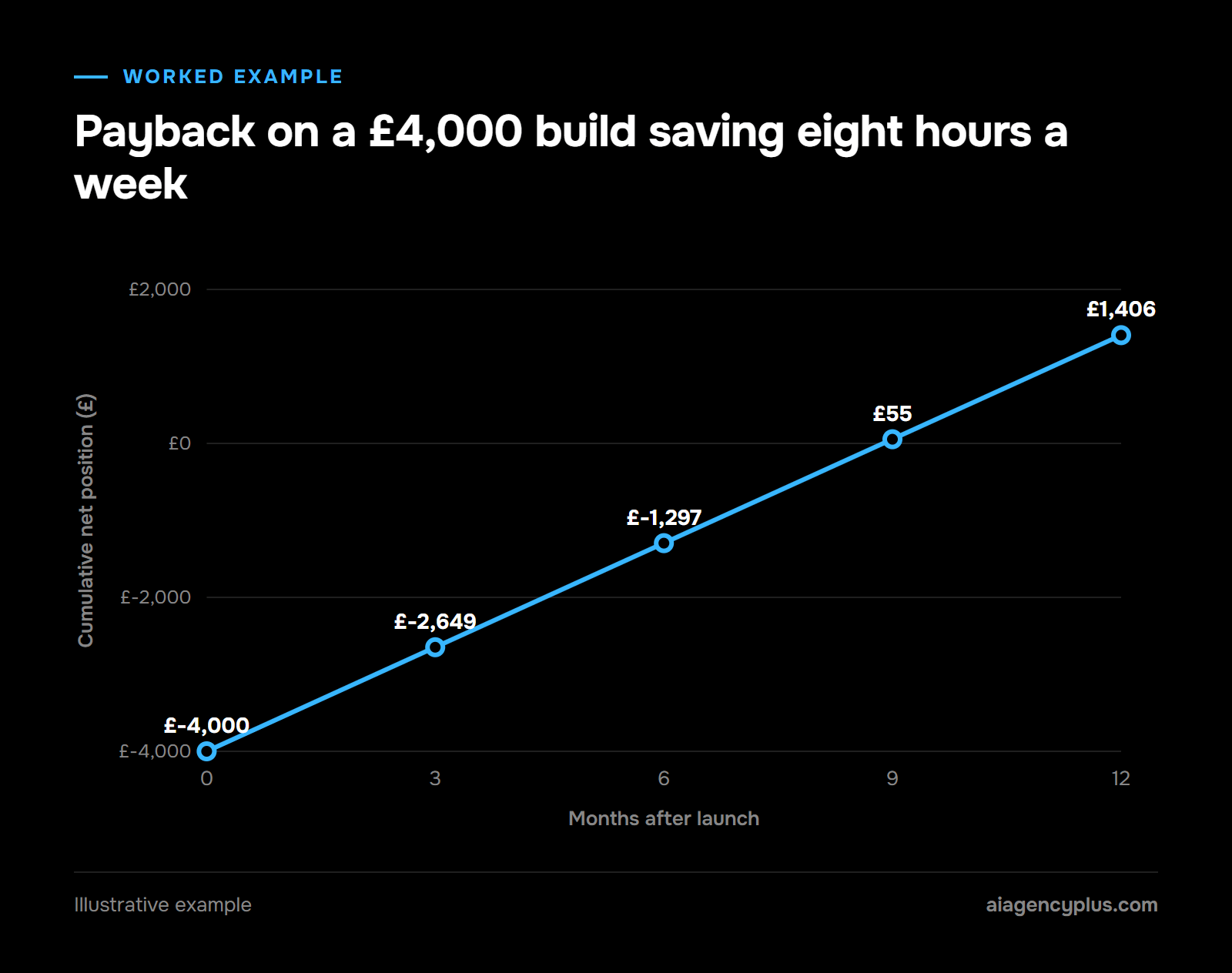
Say enquiry triage takes eight hours a week of front-desk admin. Indeed puts the average receptionist salary in Birmingham at £25,420 a year (287 salaries reported, updated 27/10/2026). I've used it rather than central London, where Indeed's average for WC1V is £30,185 (around 2,000 salaries reported, updated 02/11/2026), to keep the example conservative.
Employer NI adds £3,063 and minimum pension about £575, so the loaded cost is roughly £29,058.
Across about 1,750 productive hours a year (my working assumption after holidays and breaks), that is about £16.60 an hour. Eight hours a week is £6,906 a year. Take off £1,500 of running costs (£125 a month, the bottom of the realistic band above) and you keep £5,406, or about £450.50 a month.
Against a £4,000 build, payback lands in about 8.9 months. The build is still about £2,649 short after three months and about £1,297 short after six.
By month nine you are about £55 ahead, and at month 12 about £1,406 ahead. From then on you are around £5,400 a year better off.
That example assumes no support retainer, with fixes paid for as they come up. Add a £350 a month retainer and the net saving falls to about £1,206 a year, stretching payback to around 40 months. For a single workflow this size, pay for fixes as needed or automate a bigger workload.
Cut the workload to two hours a week and the net saving falls to about £227 a year. That takes more than 17 years to repay the same build, so don't build it. Automate the frequent repetitive task, not the interesting rare one.
Labour costs are rising too. The National Living Wage is £12.71 an hour from 01/04/2026. Per the government's announcement on 28/10/2026, it "will rise by 3.9 per cent to £13.21" from April 2027.
Two cautions
Hours saved only count if the time gets redeployed. If someone simply has a quieter Tuesday, the saving never reaches your accounts.
Don't build the business case on cutting headcount either. The ONS found around half of AI-adopting businesses report no change in workforce size. In my experience, the return shows up as capacity, error reduction and faster cycle times.
When should you not spend the money?
There are five cases where I'd hold off on AI automation:
- the process changes every quarter
- the data is a mess
- the volume is under a couple of hours a week
- the business case is a headcount cut
- you are buying because competitors have bought
I'd rather say this now than have you find out in month three.
Unstable process. If it changes every quarter or lives in one person's head, document it first. You cannot automate something you can't describe.
Messy data. Fix the CRM first. In my experience that usually costs less than automating around bad data.
Low volume. Anything under a couple of hours a week rarely clears a four-figure build inside a year.
A headcount target. The evidence above doesn't support it as a business case.
Following competitors. That is how projects end up among the more than 40% of agentic AI projects Gartner expects to be cancelled.
What should you ask an agency before you sign?
Ask twelve questions across money, delivery, ownership, compliance and evidence before you sign. The answers tell you what month two will cost, who owns the work and whether the agency has thought about your data. An agency that can't answer them clearly isn't ready to build for you.
On money
- Is this fixed price or hourly, and what happens if it overruns?
- What will I pay in month two, itemised: platform, model usage, messaging and support?
- Can I see software costs separated from your fees?
On delivery
- Who actually builds this? Is it the person on this call?
- When does the first workflow go live in production?
On ownership
- Who owns the workflows, the accounts and the API keys?
- Is this on my infrastructure or yours, and can I take it in-house?
- If you stop trading tomorrow, what do I still have?
On compliance
- For my data, are you a controller or a processor, and where is the data processing agreement?
- Which model provider processes my data, and in which region?
- If this makes decisions about people (screening, pricing, eligibility), how does it handle the UK GDPR rules on automated decision-making as amended by the Data (Use and Access) Act 2025?
On evidence
- Show me a workflow you built and the number it moved.
What are the red flags in an AI automation quote?
The clearest red flags are a refusal to give a price range before a sales call, a proposal with no running costs, and builds that live on the agency's own accounts. Any one of them means you would carry risk the agency should be carrying. Walk away, or ask for the answer in writing.
- Won't give a range before a sales call.
- Never mentions running costs.
- Builds everything on their own accounts.
- The only demo is a website chatbot.
- Sells an AI strategy retainer with no shipped workflow.
- Quotes a headcount reduction as the business case.
- Started a few weeks ago off the back of a course.
On that last point, much of the loudest content about AI automation agency pricing and income is written for people who want to start an agency. It answers a different question from the one a buyer has.
How do you run the first project so it works?
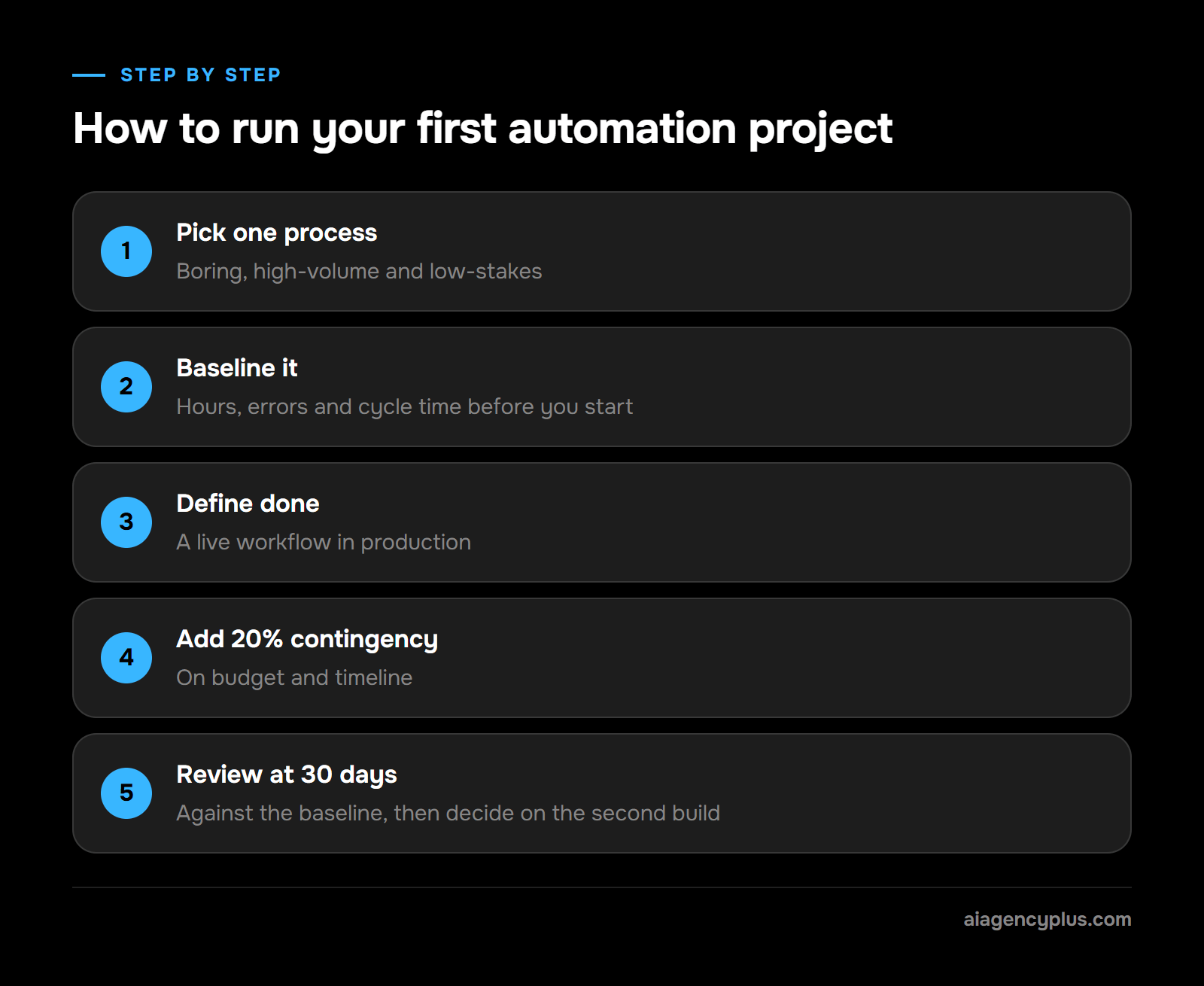
Run your first automation on one boring, high-volume, low-stakes process. Measure it before you start, define done as a live workflow in production, add contingency and review at 30 days against your baseline. Only then decide whether to build the second one.
In my experience, document-heavy work, enquiry triage and reporting reconciliation make good first projects. Accounts payable automation is a common starting point, and the list of business processes you can automate with AI has more.
Baseline the number before you start: hours, errors and cycle time. You cannot prove a return against a number you never measured.
Define done as a live workflow in production, not a document. Add contingency to both budget and timeline. Review at 30 days against the baseline, then decide on the second build.
If the first one pays back, its savings can help fund the second.
Frequently asked questions
What is the 30% rule for AI?
There is no official rule by that name for AI from a regulator, a standards body or the UK government. The phrase circulates online as an informal rule of thumb, and the versions I've seen don't agree on what the percentage measures. I'd base a budget on the hours and volume of the task you want to automate instead.
Is AI automation free, or are there hidden costs?
AI automation is rarely free. Zapier and Make have free tiers and n8n's community edition is free to self-host. You still pay for hosting, model usage, messaging and someone's time to build and maintain it. Across a year these running costs can exceed the build, so ask for them itemised.
How much does it cost to develop custom AI software in the UK?
Custom AI development in the UK typically starts at around £50,000 plus VAT and takes four months or more, because it is full software development. In my experience, most SMEs get the result they need from configured tools such as n8n, Make or Zapier, which on my bands start from £1,500 plus VAT.
What is the cost difference between off-the-shelf AI tools and custom AI automation?
Off-the-shelf AI solutions, such as a ChatGPT or Copilot licence, cost a monthly subscription per user and work straight away, but they don't connect your systems or run a process end to end. Configured automation builds start from £1,500 plus VAT, plus running costs, and handle a specific workflow without a person. Fully bespoke AI software starts at around £50,000 plus VAT.
How much does an AI automation agency typically charge in the UK?
On my working bands, a first workflow is £1,500 to £5,000 plus VAT and a departmental build £5,000 to £20,000 plus VAT. Ongoing support starts from about £350 a month plus VAT for one live workflow.A TrustedAIAgencies review of 277 UK agency websites, reported by IT Brief UK on 04/11/2026, found median advertised starting prices of £1,500 for a workflow and £250 a month for a retainer. Those medians mix prices with and without VAT, so they are not like-for-like with plus-VAT figures. Those are starting prices, not what clients paid, so treat every published range as a guide.