

Call handling is how your business answers, routes, records and follows up every incoming call. For a UK small business, good call handling means the phone is picked up quickly by someone (or something) that can identify the caller, deal with or log the request, and agree a clear next step, including out of hours.
What is call handling, and what does good call handling look like?
Call handling is everything that happens to a phone call from the first ring to the follow-up: who answers, how the call is routed, what gets recorded and who acts on it. Good call handling means a quick answer, a caller who is identified and understood, and a next step both sides agree on.
Calls are one part of how a business communicates with customers, alongside email, web forms and chat. They are often where urgent requests arrive, so they need the clearest rules of all your customer interactions.
How does call handling work?
A call reaches your number and the phone system routes it by rules you set: time of day, which number was dialled or a menu choice. Someone answers, the details are captured, and a record goes where the team works.
In a call centre or contact centre this is a department with a queue, ACD (automatic call distribution, which shares calls between agents by who is free or by their skills) and a supervisor. In a firm of eight people it is usually one landline, two mobiles and whoever is nearest. The principles are the same at both sizes.
What good looks like in practice
- The call is answered, by a person or a system, within a few rings.
- The caller hears the business name and who they are speaking to.
- The handler gets name, number, reason and urgency before anything else.
- If the request can be sorted on the call (a booking, a price, a simple question), it is, rather than becoming another callback.
- The caller leaves knowing what happens next and roughly when.
- A written record lands somewhere the team will see it, the same day.
If you would rather talk through your own setup with me, Book a Discovery Call.
None of this needs a full-time receptionist. Good call handling is a process, and who or what runs it is a separate decision, which I cover further down.
Why does call handling matter for a UK small business?
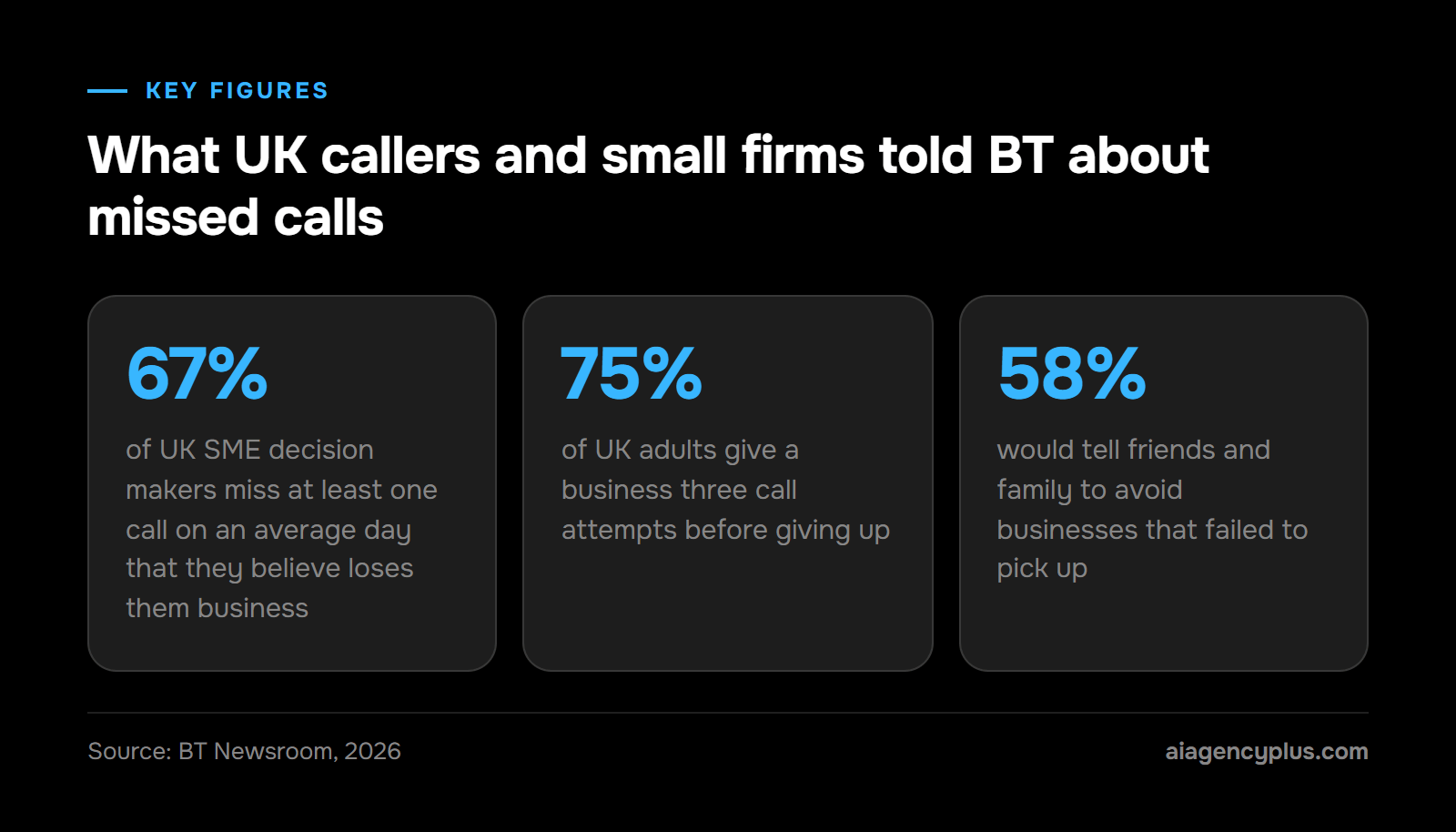
Call handling matters because a missed call is often a missed job, and callers do not wait long. In a BT Business/Censuswide survey of 1,500 decision makers at UK firms with fewer than 250 staff (23 to 28/09/2026), 67% said they miss at least one call on an average day that they believe loses them business.
The same research asked 2,000 UK adults, surveyed from 23 to 25/09/2026, what they do when a business doesn't answer. 75% said they give a business three call attempts before giving up, and 58% said they would tell friends and family to avoid businesses that failed to pick up (BT Business/Censuswide, September 2026).
One caveat. The SME figure measures what owners believe, not money anyone counted.
A worked example
Here is the arithmetic, with illustrative figures. Say a heating engineer misses six calls a week after 5pm, and one in three would have become a job worth £180 on average.
That is two jobs a week, or £360 of work. Over 48 working weeks it comes to £17,280 a year. These are illustrative figures, not client results: the point is to put your own numbers in, counting only the missed calls that were new leads.
How do you set up call handling, step by step?
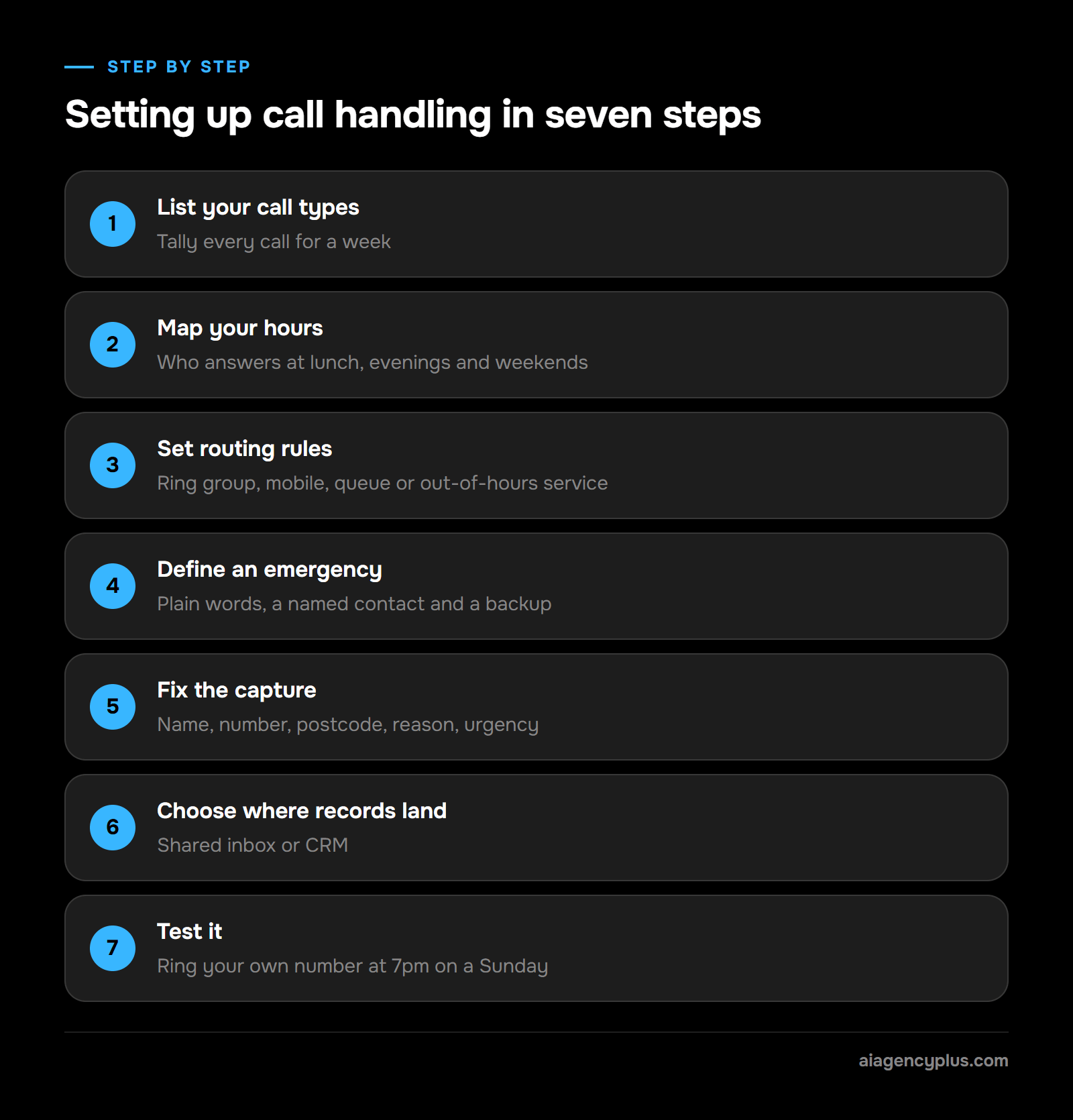
Set up call handling by deciding which calls matter, who answers them in each hour of the week, what gets captured and where the record goes. Do it on paper first. The phone system only carries out the rules you write; it cannot invent them.
- Call types: tally every call for a week: new enquiry, existing customer, supplier, emergency, sales pitch. In my experience four or five types cover nearly everything.
- Hours: write down who answers in office hours, at lunch, after 5pm, at weekends and on bank holidays. Any blank slot is where calls go to voicemail.
- Routing rules: call routing decides where each call goes: a ring group, a mobile, a queue or an out-of-hours service. Keep the hops to a minimum.
- Emergencies: define one in plain words, such as "no heating and a vulnerable person in the house", and name who gets called, plus a backup.
- Capture: agree the details every call must produce: name, number, postcode, reason and urgency.
- Records: send them to one shared inbox or your CRM, never someone's personal mobile. Managing callbacks from one place is far easier than chasing them across phones.
- Testing: ring your own number at 7pm on a Sunday and see what happens.
Repeat the test after any change to staff, hours or phone provider. Rules drift quietly, and the first person to notice is usually a customer.
What should a call handling script include?
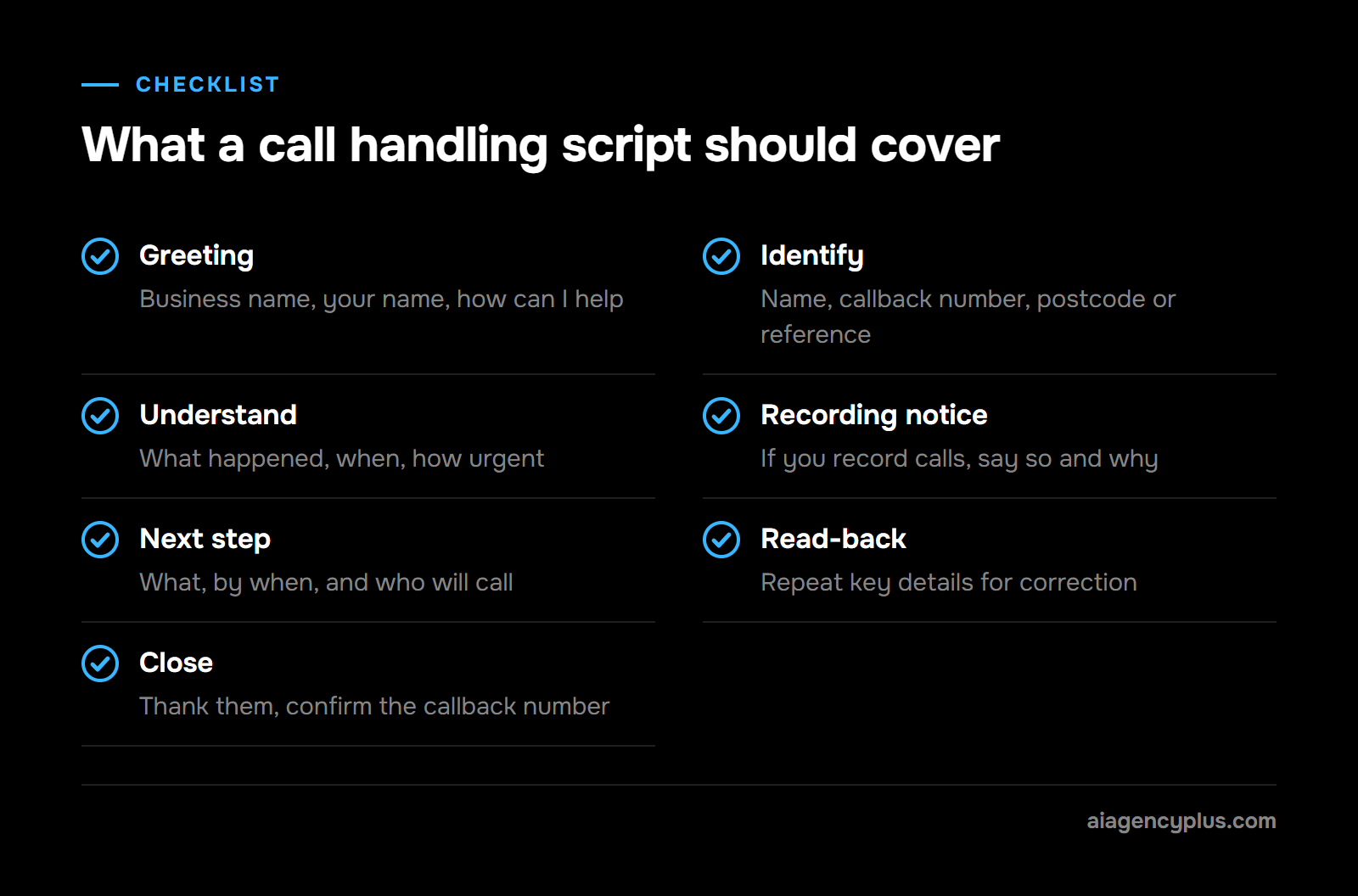
A call handling script should cover the greeting, a short set of questions that identify the caller and their need, an agreed follow-up and a polite close. Its job is to make sure nothing is missed, and it should sound like your business, in your own words.
The parts of a good script
- Greeting: business name, your name, "how can I help?"
- Identify: name, best callback number, postcode or account reference.
- Understand: what happened, when, and how urgent it is to them.
- Recording notice: if you record calls (see below).
- Next step: what you will do, by when, and who will call.
- Read-back: repeat the key details so the caller can correct them.
- Close: thank them and confirm the callback number.
If an AI system will read your script, the wording matters more, because it follows instructions literally. I have published the AI receptionist prompt I use for UK businesses if you want a starting point.
The skills behind the script
A script sets what to cover. How the handler listens decides the quality of the call, and that comes from practice.
- Active listening: let the caller explain without interrupting, then ask your questions.
- Notes as you go: write down names, numbers and times while the caller talks.
- Check understanding: sum up the problem before moving on.
- Tone: calm and unhurried, even when other lines are ringing.
These are ordinary customer service skills. Written down, they give a new starter, or an AI system, something clear to follow.
Handling an angry caller
Handle an angry caller by letting them finish, acknowledging the problem in one sentence, then moving to facts and a next step. Do not argue the detail on the call.
Write down what they say, tell them what you will check, and give a callback time you can keep. If a call turns abusive, the script should say what the handler may do: warn once, then end the call and log it.
Recording calls
If you record calls, tell callers at the start. The ICO's guidance says organisations should "tell these people that you are recording the call and why. A recorded message is good practice." The rest of your privacy information can sit in a privacy notice on your website.
Keep recordings secure. Limit who can play them back, and decide how long you keep them before they are deleted.
Inbound and outbound call handling: what is the difference?
Inbound call handling deals with calls customers make to you: enquiries, bookings, support requests, complaints, emergencies. Outbound call handling covers the calls you make: callbacks, quote follow-ups, appointment reminders and chasing. Small firms usually need both, and they fail in different ways. Inbound fails when nobody picks up; outbound fails when nobody rings back.
| Inbound | Outbound | |
|---|---|---|
| Who starts the call | The customer | Your business |
| Typical calls | Enquiries, bookings, complaints, emergencies | Callbacks, quote follow-ups, reminders, chasing payment |
| Main risk | Missed or abandoned calls | Promised callbacks that never happen |
| What fixes it | Routing, a cover rota, out-of-hours answering | A callback list with an owner and a deadline |
The two connect. Every inbound call that ends with "we'll ring you back" creates an outbound task, and that task is where a lot of won enquiries quietly go cold.
If your outbound calls include sales calls to people who have not asked to hear from you, check the ICO's telephone marketing rules, including the Telephone Preference Service (TPS), before anyone dials.
Who answers when you can't? Your options compared
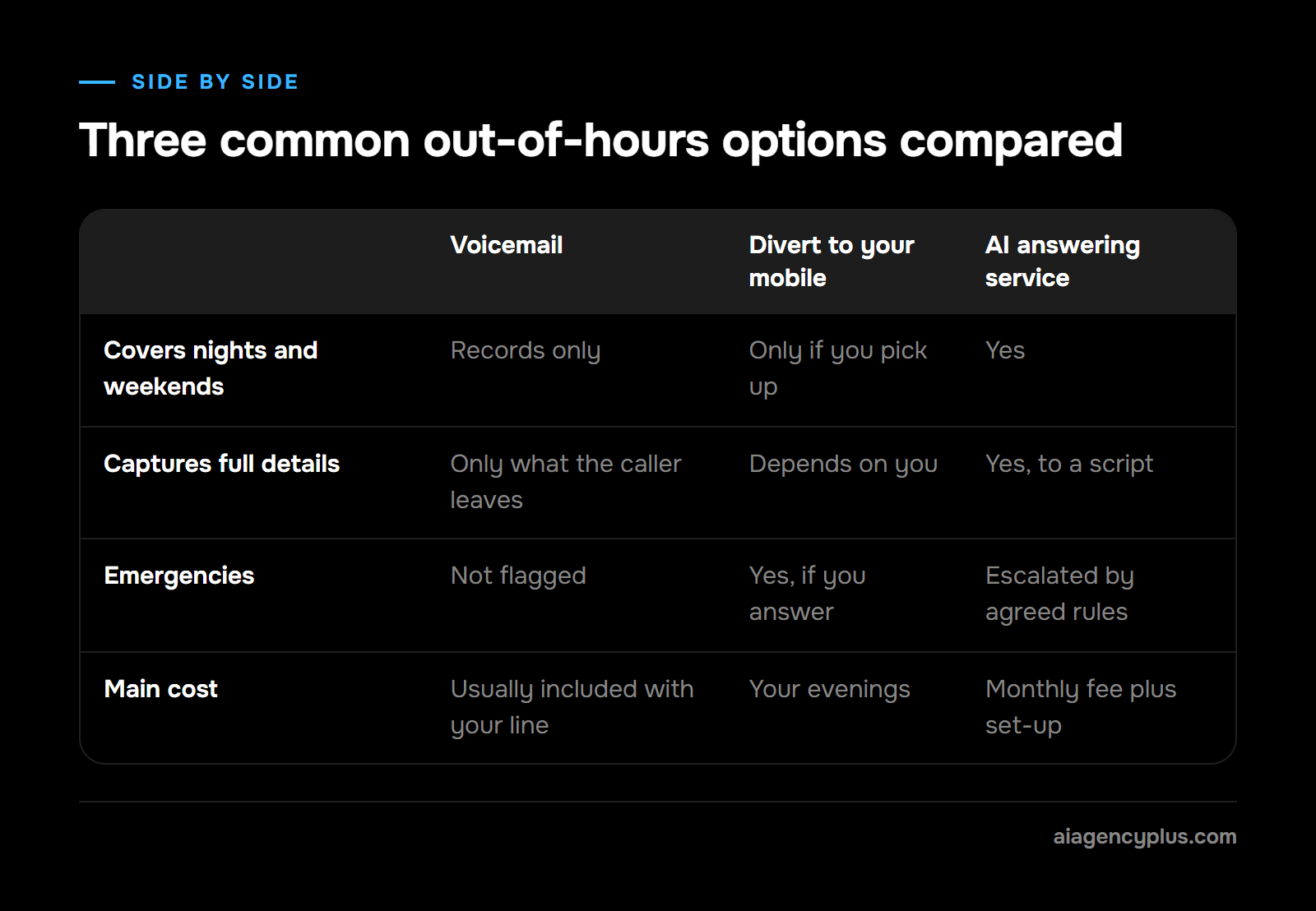
When you cannot answer, the realistic options are voicemail, diverting calls to a mobile, a staff rota, a human answering service, or an AI answering service. Each trades cost against coverage. There is no single right solution: it depends on how many calls arrive outside hours and how many are urgent.
| Option | Covers nights and weekends | Captures full details | Emergencies | Main cost |
|---|---|---|---|---|
| Voicemail | Records only | Only what the caller leaves | Not flagged | Usually included with your line |
| Divert to your mobile | Only if you pick up | Depends on you | Yes, if you answer | Your evenings |
| Staff on-call rota | Yes | Yes | Yes | Overtime or call-out pay |
| Human answering service | Depends on the plan | Yes, to a script | Depends on the plan | Varies by provider |
| AI answering service | Yes | Yes, to a script | Escalated by agreed rules | Monthly fee plus set-up |
Voicemail relies on the caller doing the work, and a message is only as useful as what they remember to say. Diverting to your mobile works until you are driving, eating or asleep.
Whichever you choose, a call handling service only works as well as the rules you give it. Hand over your call types, hours, emergency definition and capture list from the setup steps above.
When I tell people not to buy anything
If you get two or three calls a week after hours and none are urgent, a clear voicemail greeting and a rule to ring back by 9am is enough. Paying a monthly fee for that volume rarely makes sense.
Where an AI answering service fits
This is where AI Agency Plus comes in. This is the service I build; the AI answering service page lists what it does.
Here is how an evening might run for a heating firm (an illustrative scenario, not a client account). At 21:40 a caller reports water leaking near a fuse box, so the agent escalates it to the on-call contact under the emergency rule. At 22:15 someone wants a boiler service quote; that is not urgent, so it waits for the morning.
For wider context, see what AI automation costs in the UK, and if you are unsure about the rules, read whether it is legal to have AI answer your business calls.
What does the 2027 landline switch-off mean for your calls?
Openreach plans to close the UK's old analogue phone network on 31/01/2027, a date it confirmed in a briefing to providers on 25/09/2026, so traditional landlines are moving to digital lines that run over broadband. For call handling this matters twice: anything plugged into an old line needs checking, and the move is a natural moment to fix your routing.
From 01/02/2027, lines still on the old network drop to a limited, emergency-style service with fewer calling features, and Openreach says lines that cannot migrate will be ceased in planned tranches. Move before the deadline, not after it.
What to check before your line moves
- Alarm systems and lift phones that may dial out over the line.
- Card payment terminals and franking machines.
- Any fax line you still pay for.
- Phones in buildings with weak broadband.
Your migration date comes from your provider, so confirm it with them in writing. Ask what happens to your existing number and keep it: it is your public number, on your van, your invoices and your Google listing.
Use the switch to fix call handling
Digital and cloud phone systems usually let you set opening hours, ring groups, queues and out-of-hours routing from a web page. Larger teams sometimes run a VCC (virtual contact centre), also called a cloud contact centre: a system that queues and routes calls to staff wherever they sit, often with ACD built in.
For most small firms, a simple rule based on opening hours is enough. Before you commit to any system, check four things:
- Features you will use: opening hours, ring groups, a queue, voicemail to email.
- Integrations: whether it connects to your CRM or calendar, so call records land in one place.
- Interface: whether a user who is not technical can change the hours in a minute or two.
- Pricing: how the plan is charged, often per user each month, and what calls cost on top.
A VCC suits a team taking calls across several sites. For a five-person office it is usually more than you need. Write the rules from the setup steps above first, then configure the system to match them.
Which call handling mistakes cost small businesses work?
The mistakes that cost the most work are simple ones: calls that ring out, voicemail nobody checks, callbacks with no owner, and emergency rules that live in one person's head. None needs new technology to fix. Each needs a written rule and someone responsible for it.
- Calls ringing out at lunch: add a lunchtime cover rule or a divert.
- An out-of-date voicemail greeting: say when you will ring back, then do it.
- Callbacks scribbled on paper: keep one list, one owner, a same-day deadline.
- No definition of urgent: write it down, with names and a backup.
- Recording without telling callers: play a short recorded notice at the start.
- Notes kept on a personal mobile: send records to a shared inbox or CRM.
The cheapest way to improve call handling is to fix these issues before you buy anything. Most take an afternoon and a conversation with the team.
Repeat callers deserve priority. In BT Business's September 2026 survey, 75% of adults said they give a business three call attempts, so treat a second or third call from the same number as urgent.
Frequently asked questions
What is call handling time?
Call handling time is the total time a call takes to deal with: the conversation, any hold, and the notes or follow-up afterwards. Call centres track it closely. For a small firm, the more useful check is whether every call ends with an agreed action and a record.
How do you handle a call from an angry customer?
Let them finish, acknowledge the problem in one sentence, then move to facts and a next step. Write down what they say, tell them what you will check, and give a callback time you can keep. If the call turns abusive, follow your script: warn once, then end the call and log it.
Do you have to tell callers you are recording the call?
Yes. The ICO says organisations that record calls should tell callers that the call is being recorded and why, and that a recorded message is good practice. The rest of your privacy information can be given another way, such as a privacy notice on your website.
Can an AI system handle calls for a small business?
Yes. An AI system can answer calls, take details, book appointments and escalate urgent ones by rules you agree. A well-built one says it is AI when asked and passes callers to a person on request. My guide to what an AI virtual receptionist is explains how they work.
Is voicemail enough for a small business?
For a business with a few non-urgent calls a week out of hours, often yes, provided the greeting says when you will ring back and someone checks it every morning. It stops being enough once callers expect same-day bookings or emergency help.