

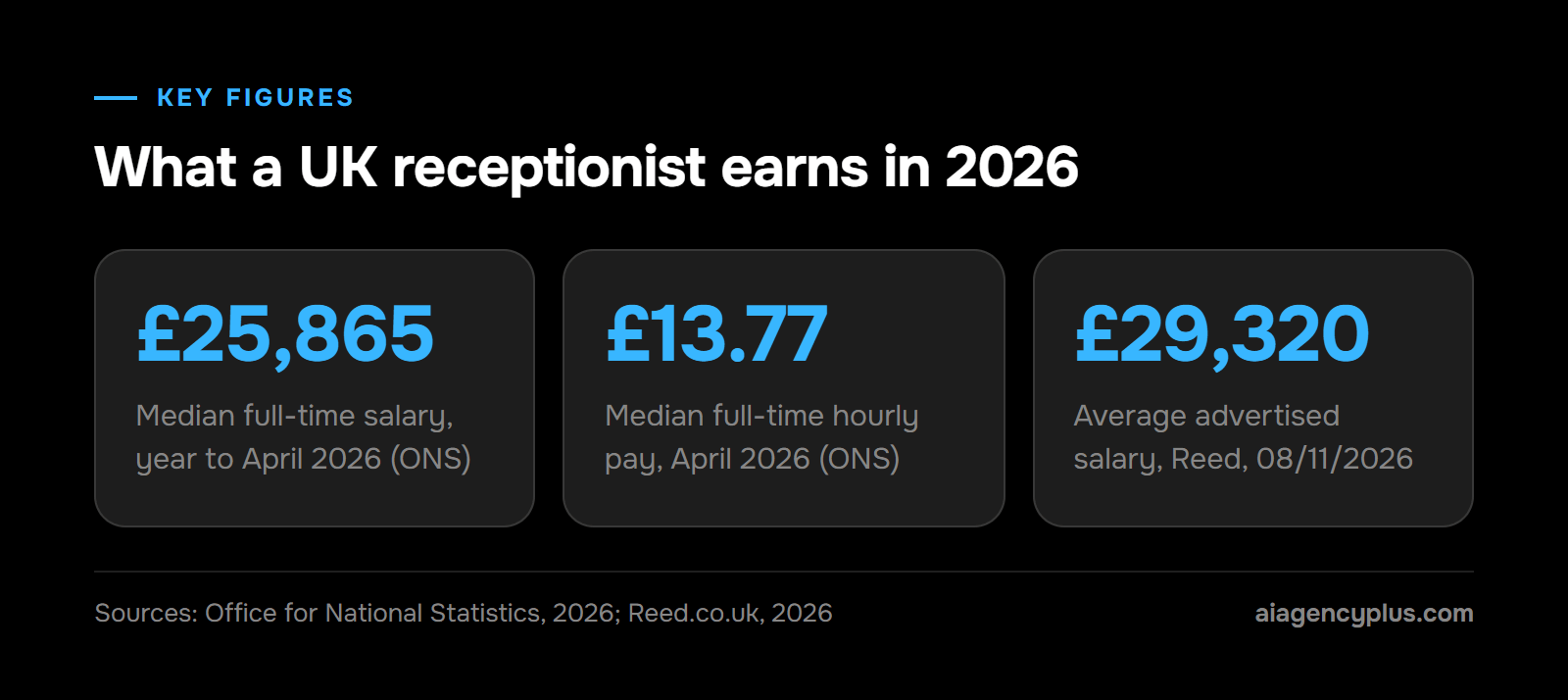
The median full-time receptionist salary in the UK was £25,865 a year (ONS, year to April 2026). In my worked example, employer National Insurance and the 3% pension minimum take the cost to about £29,584 a year. Holiday cover and recruitment take the first year to about £34,369, or £33,573 if you close on bank holidays, before any Employment Allowance.
What is the average receptionist salary in the UK in 2026?
The UK median for full-time receptionists was £25,865 a year, according to the Office for National Statistics' 2026 survey. Half earned more and half earned less. These are gross figures, before tax. Reed's advertised average runs above the ONS median, while Indeed's local averages fall either side of it, so budget from the ONS number and use adverts as a check on what you may need to offer.
ONS figures released on 22/10/2026 put that median at £25,865 for the tax year to 05/04/2026, and £13.77 an hour in April 2026. Across all receptionists, full and part-time, the median hourly rate was £13.51. These are provisional figures from the Annual Survey of Hours and Earnings (ASHE), occupation code 4216. The annual figure is rounded from £25,865.20 in Table 14.7a, Full-Time sheet, cell D315. The hourly medians are in Table 14.5a, cell D315 on the Full-Time and All sheets. Office for National Statistics.
If you are costing a receptionist because calls are being missed, check whether the gap is a whole job or a few hours a day. Book a Discovery Call and I'll go through your call pattern with you.
What job adverts say
Reed's salary checker showed an average advertised receptionist salary of £29,320 when I read it on 08/11/2026, with a range of £28,102 to £30,894. That reflects the roles advertised on one job site, so I treat it as a second view. It is useful for one question: what you might need to offer to fill a post quickly. Reed.co.uk.
Pay in your own area
Indeed's averages, based on salaries in its job postings over the past 36 months, put receptionist pay at £25,420 a year in Birmingham (typical range £25,420 to £31,678, updated 01/11/2026) and £30,180 in London WC1V (range £25,420 to £41,196, updated 02/11/2026). These are advertised salaries, not pay received. Indeed. Indeed.
For the official regional view, ONS publishes the same survey by region and occupation in ASHE Table 15, from the same 2026 provisional release. It covers the regions of England as well as Wales, Scotland and Northern Ireland. Look up occupation 4216 for your area before you fix a budget, and use local job adverts as a check.
Salary range by type of desk
Pay depends on the type of desk. NHS posts are paid on Agenda for Change bands, which NHS Pay Calculator reports for 2026/27 as £25,272 for Band 2 and £25,760 to £27,476 for Band 3. NHS Pay Calculator.
London corporate desks pay more. Front Recruitment's salary survey puts law firms (outsourced) at £33,000 to £38,000 and insurance firms (in-house) at £31,000 to £36,000 plus bonus & private health etc. Front Recruitment.
| Type of receptionist | Pay | Source |
|---|---|---|
| NHS, Band 2 | £25,272 a year | NHS Pay Calculator, 2026/27 |
| NHS, Band 3 | £25,760 to £27,476 a year | NHS Pay Calculator, 2026/27 |
| NHS reception team lead, Band 4 | £28,392 to £31,157 a year | NHS Pay Calculator, 2026/27 |
| London private members clubs | £28,000 to £35,000 | Front Recruitment |
| London insurance firms (in-house) | £31,000 to £36,000 plus bonus & private health etc | Front Recruitment |
| London law firms (outsourced) | £33,000 to £38,000 | Front Recruitment |
| London private banks, private equity, hedge funds & asset management (in-house) | £33,000 to £40,000 plus bonus & private health etc | Front Recruitment |
What the job covers
Before you fix a number, write down the duties. A typical front desk mixes customer service on the phone and in person, booking appointments, post and general administrative work such as keeping customer data up to date. In a GP practice or care home, the desk also handles patient calls and visitors.
The split matters for cost. If most of the day is administration and visitors, you need a person on site. If most of it is the phone, the gaps in their hours matter more, and I come back to that in the alternatives section.
Entry-level, experienced and senior pay
Learning Facility puts a realistic full-time starting salary for an adult (21 or older) at £24,800 to £27,000. At the senior end, an NHS Band 4 reception team lead earns £28,392 to £31,157. For a first hire at entry level, budget from the starting range rather than the median. Learning Facility.
A receptionist with experience of your systems and customers is worth keeping. If the job has no pay step and no route to a senior or team lead post, a good receptionist may leave for career progression elsewhere, and you pay recruitment again.
The legal floor
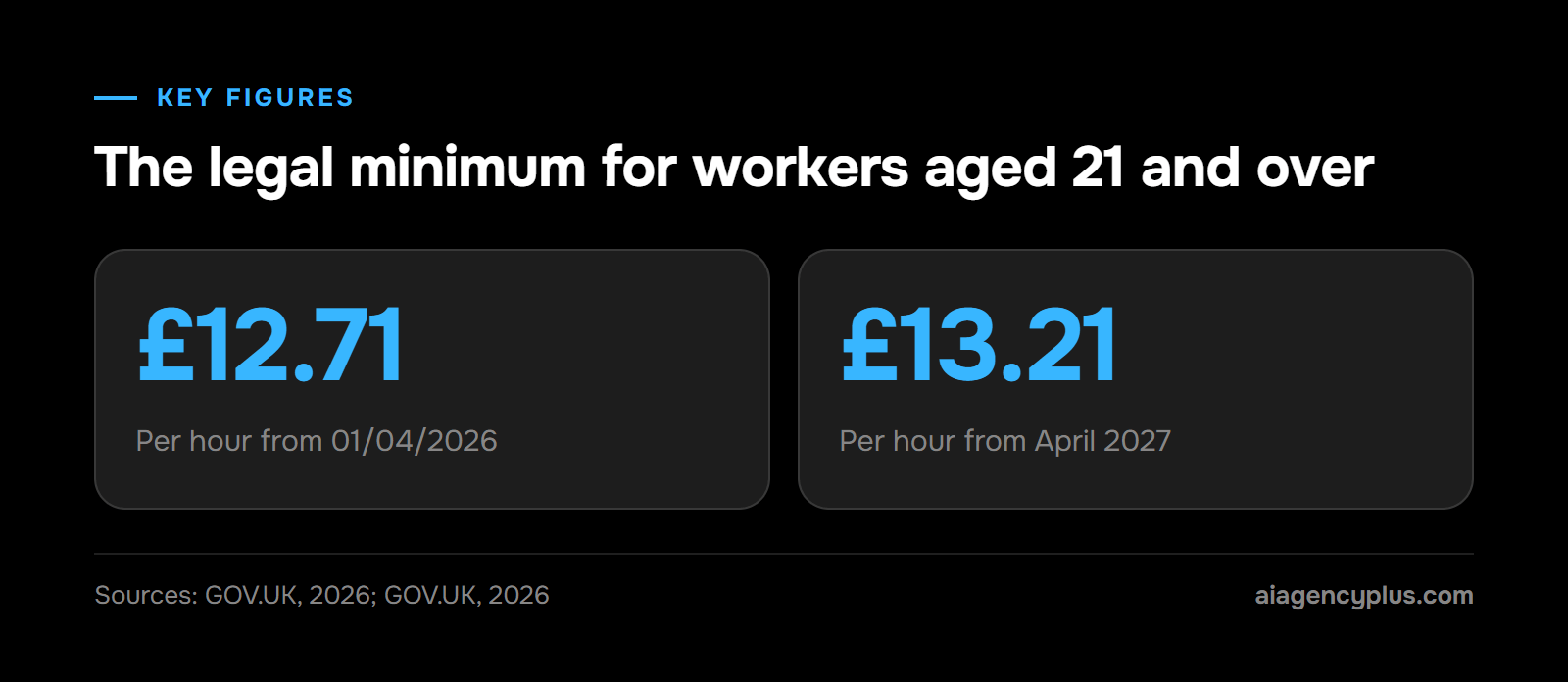
The legal minimum for a worker aged 21 or over is the National Living Wage of £12.71 an hour from 01/04/2026. For a 37.5-hour week over 52 weeks, that is £24,784.50 a year. The full-time median hourly rate of £13.77 sits £1.06 above it. GOV.UK.
What does a receptionist really cost an employer?
On top of salary, an employer pays National Insurance, a pension contribution, paid holiday and sick pay. For a receptionist on the ONS median, National Insurance and the 3% pension minimum alone add about 14%. Cover and recruitment come on top, and those are the costs that are easiest to leave out of a budget.
The on-costs, one by one
All four rules below come from GOV.UK, which I read on 08/11/2026.
- Employer National Insurance. For 2026 to 2027, employers pay National Insurance at 15% on earnings above £5,000 a year, and the Employment Allowance is £10,500. GOV.UK.
- Pension. Under auto-enrolment, the employer pays at least 3% and the total minimum contribution is 8%, worked out on qualifying earnings between £6,240 and £50,270 a year. GOV.UK.
- Holiday. Most workers on a 5-day week get at least 28 days' paid holiday, which is 5.6 weeks, and GOV.UK confirms that "An employer can include bank holidays as part of statutory annual leave". GOV.UK.
- Sick pay. Statutory Sick Pay for 2026 to 2027 is £123.25 a week or 80% of the employee's average weekly earnings, whichever is lower, for up to 28 weeks. GOV.UK.
The Employment Allowance
The Employment Allowance reduces your employer National Insurance bill across the whole payroll. If your company already employs several people, it may be used up before your receptionist is counted. Check eligibility on GOV.UK before you rely on it.
| Cost | 2026 to 2027 rule | On a £25,865 salary |
|---|---|---|
| Employer NI | 15% above £5,000 a year | £3,129.75 |
| Pension (employer) | 3% of earnings between £6,240 and £50,270 | £588.75 |
| Holiday | 28 days paid, bank holidays can count | Paid within salary; cover is extra |
| Statutory Sick Pay | £123.25 a week or 80% of average weekly earnings, whichever is lower | Depends on absence |
A worked example: what does one full-time receptionist cost for a year?
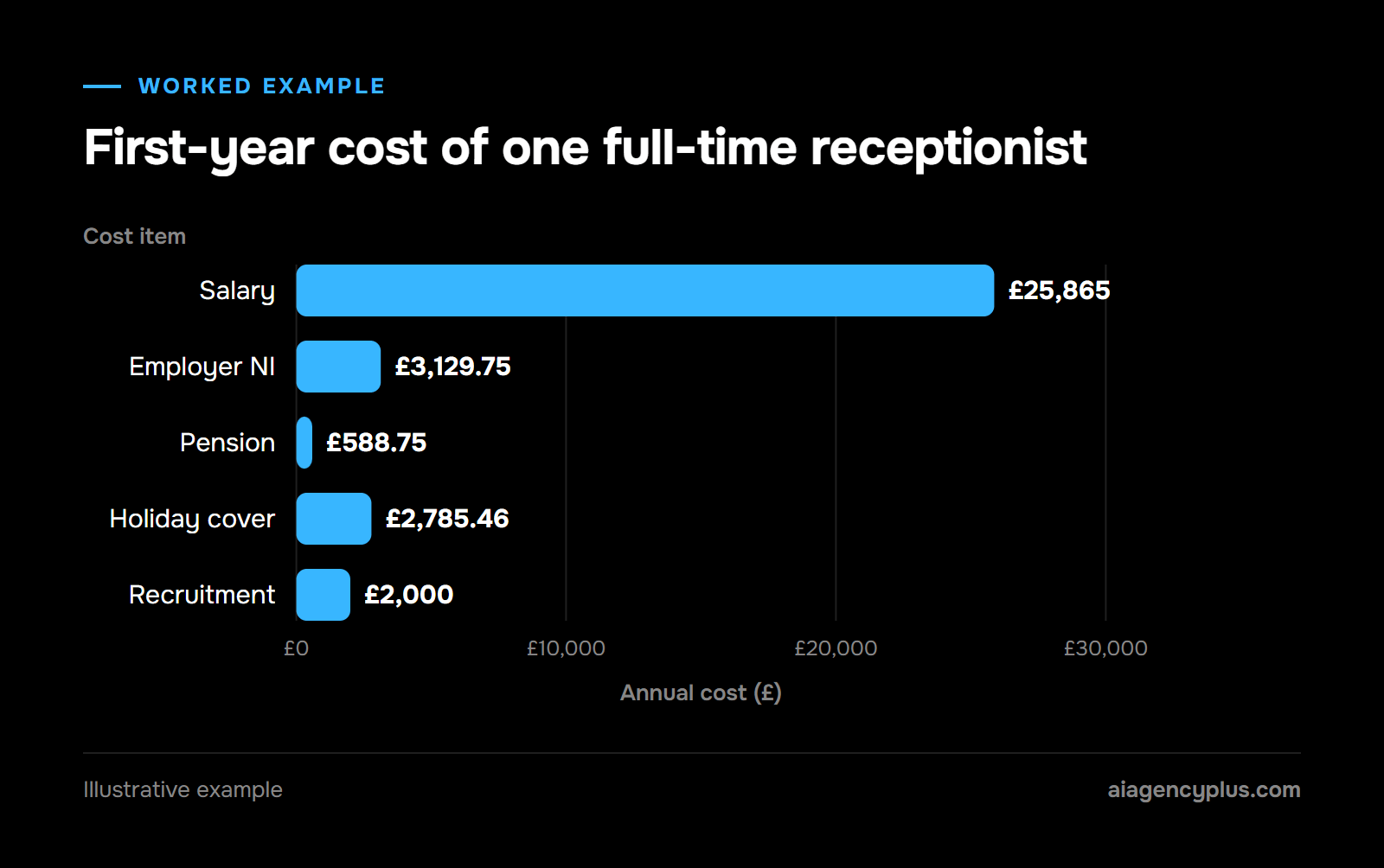
Here is an example, worked with 2026 to 2027 rates. One full-time receptionist on the ONS median of £25,865 costs £29,583.50 a year in salary, employer National Insurance and pension. Add 28 days of holiday cover and a CIPD-median recruitment cost, and the first year comes to £34,368.96. If your office closes on bank holidays, it is £33,573.12.
| Item | Sum | Annual cost |
|---|---|---|
| Salary (ONS median) | Given | £25,865.00 |
| Employer NI | (£25,865 – £5,000) x 15% | £3,129.75 |
| Employer pension | (£25,865 – £6,240) x 3% | £588.75 |
| Employment cost | £29,583.50 | |
| Holiday cover, 28 days | £25,865 / 260 working days x 28 | £2,785.46 |
| Recruitment, one-off | CIPD median, non-senior hire | £2,000.00 |
| First-year total | £34,368.96 | |
| With Employment Allowance, if eligible and unused | £34,368.96 – £3,129.75 | £31,239.21 |
| Holiday cover, office closed on bank holidays, 20 days | £25,865 / 260 working days x 20 | £1,989.62 |
| First-year total, office closed on bank holidays | £29,583.50 + £1,989.62 + £2,000 | £33,573.12 |
| With Employment Allowance, if eligible and unused | £33,573.12 – £3,129.75 | £30,443.37 |
The assumptions
This is an illustrative example, using simplified annual sums. I have taken 260 working days (52 weeks of 5 days) and costed holiday cover at the receptionist's own day rate of about £99.48. A temp's own on-costs or an agency's margin would add to that.
The 28-day rows assume you cover every day of leave. The bank-holiday rows assume 8 of the 28 days fall on bank holidays when the office is closed, leaving 20 days to cover. That is the England and Wales count; Scotland has 9 bank holidays and Northern Ireland 10, so adjust the cover days if you are there.
It leaves out sick-day cover, the desk, the phone system, training and insurance. Those vary too much between businesses for me to put a fair number on them.
What does cover for holidays, sickness and lunch add?
A single receptionist leaves the desk empty for holidays, sickness, breaks and out-of-hours, and each gap has a cost. Someone has to answer the phone in those hours, or the calls go to voicemail. Here is each gap in turn.
Holidays
Twenty-eight days is more than five working weeks a year with the desk empty unless you plan for it. If you close on bank holidays, the days left to cover are fewer. Either way, the options are a temp, a colleague pulled off their own work, or calls going to voicemail.
Sickness
Since 06/04/2026, Statutory Sick Pay is paid from the first day of sickness absence, a change made under the Employment Rights Act. On a £25,865 salary, weekly earnings are about £497.40 and 80% of that is £397.92. The lower figure, £123.25, applies. Department for Business and Trade.
What a week off adds depends on the contract. On SSP only, you pay £123.25 instead of the £497.40 salary, plus about £497.40 for cover, so about £123.25 more than budget. On full contractual sick pay, the salary continues and cover adds about £497.40. I don't have a sourced absence rate for receptionists, so use your own records for how many sick days to budget.
Lunch and breaks
Workers who work more than 6 hours a day are entitled to one uninterrupted 20-minute rest break. If your receptionist takes a one-hour lunch, that is 232 hours a year over 232 working days (260 minus 28 days of holiday). Nobody is on the desk for those hours unless someone covers it. GOV.UK.
Evenings and weekends
A 37.5-hour receptionist covers 37.5 of the 168 hours in a week. If your customers ring at 7pm or on a Saturday, a salary does not answer those calls. Overtime or a second shift does, at extra cost.
What does recruiting a receptionist cost?
The CIPD's Resourcing and talent planning report 2026 puts the median cost of recruiting a non-senior employee at £2,000, against £3,500 for senior managers. A receptionist sits in the first group. Your own time comes on top. CIPD.
The parts that don't show on an invoice
- Writing the advert or briefing an agency.
- Shortlisting and interviewing, usually by the owner or office manager.
- The gap between one receptionist leaving and the next starting.
- Training on your phone system, diary and customers.
I have no reliable figure for that time, so price it at your own hourly rate. And if a receptionist leaves, you pay the recruitment cost again.
What changes in April 2027?
The adult minimum wage rises to £13.21 an hour from April 2027. A GOV.UK announcement on 28/10/2026 says the National Living Wage "will rise by 3.9 per cent to £13.21" an hour from April 2027. On full-time hours, the annual floor goes up by £975. GOV.UK.
| Legal minimum, aged 21 and over | Hourly | 37.5 hours x 52 weeks |
|---|---|---|
| From 01/04/2026 | £12.71 | £24,784.50 |
| From April 2027 | £13.21 | £25,759.50 |
| Increase | £0.50 | £975.00 |
What it means for your pay budget
Compare like with like, using hourly rates: the full-time median of £13.77 is £1.06 above the current £12.71 and only £0.56 above the April 2027 rate of £13.21. If you pay near the median, expect pressure to keep a gap above the legal minimum. Employer NI and pension rise with the salary too.
ONS measures the annual and hourly figures separately. The annual median only counts full-time staff who were in the same job for more than a year, so the two figures don't multiply out to each other.
The same announcement takes the 18 to 20 rate to £11.27 and the 16 to 17 and apprentice rates to £8.31. I haven't verified the 2027 to 2028 National Insurance thresholds, so check them on GOV.UK before you finalise next year's budget.
Part-time, shared or AI: what are the alternatives?
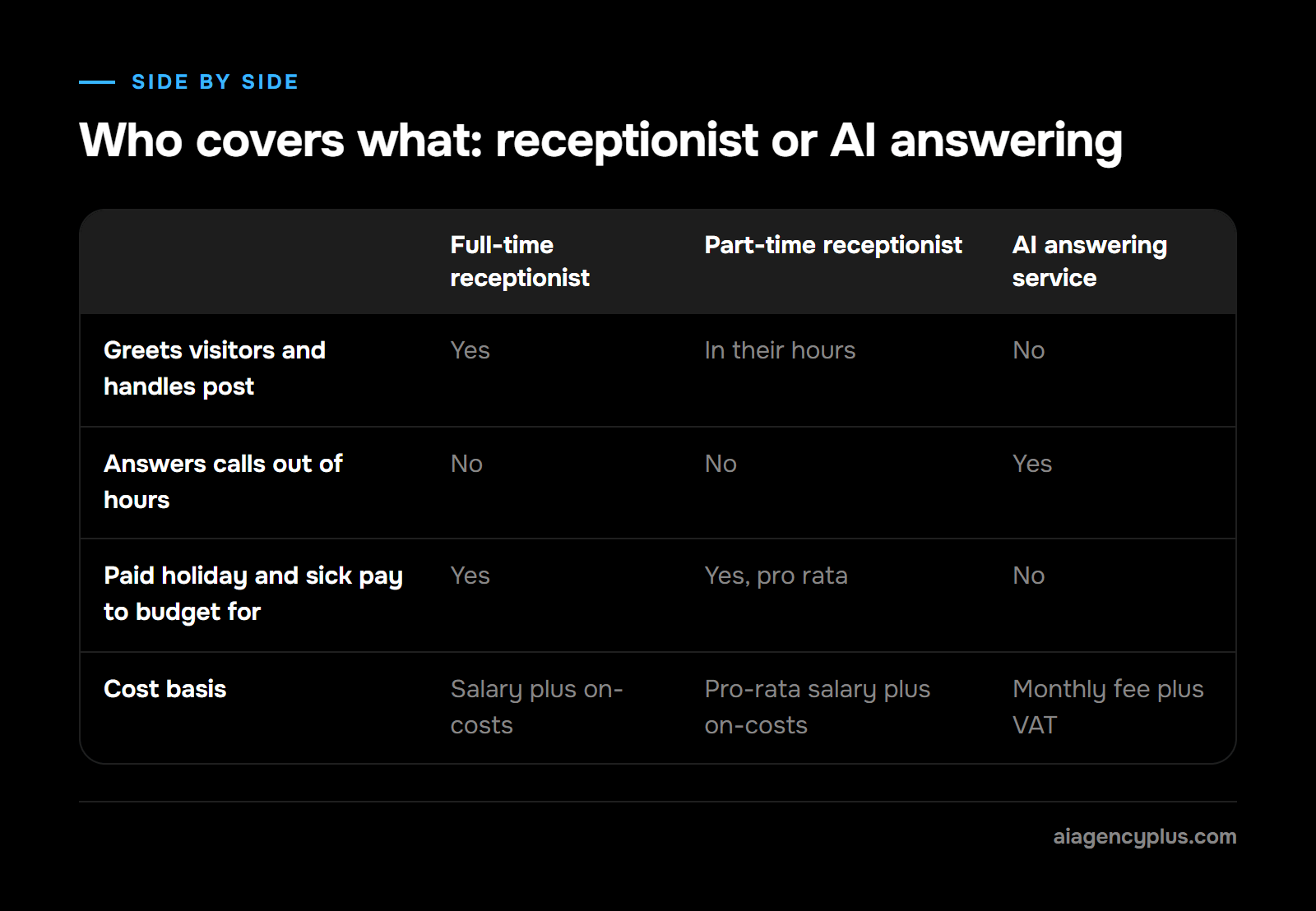
The alternatives to one full-time receptionist are a part-time receptionist, a shared or outsourced call-answering service, or an AI answering service. Which fits depends on one question: is the job mostly visitors and admin, or mostly the phone? Answer that first, then compare costs.
| Full-time receptionist | Part-time receptionist | Shared call-answering service | AI answering service | |
|---|---|---|---|---|
| Greets visitors and handles post | Yes | In their hours | No | No |
| Answers calls out of hours | No | No | Depends on the plan | Yes |
| Paid holiday and sick pay to budget for | Yes | Yes, pro rata | No | No |
| Cost basis | Salary plus on-costs | Pro-rata salary plus on-costs | Per-call or per-minute fee, or a monthly plan | Monthly fee plus a build fee |
Part-time and shared options
A part-time receptionist carries the same rules on lower pay: NI, pension, pro-rata holiday and SSP. A shared or outsourced call-answering service takes messages for you. Pricing models vary, so ask for the cost at your real call volume.
Where AI answering fits
If the gap is calls after the office closes, in the evening or at weekends, that is the job our ai answering service does. It answers out of hours, escalates emergencies by rules you agree, and logs other calls with a call summary sent to your inbox.
It can book into your calendar or job system where you want it to, says it is AI if a caller asks, and passes callers to a person on request. Going live takes about three weeks. The Essential plan costs £349 a month plus VAT and has a single escalation path. Multi-path escalation with fallbacks is included in the Standard plan at £599 a month plus VAT. The build fee starts at £1,500 plus VAT and is waived on a 12-month commitment, as set out on our AI answering service page.
For how it handles daytime calls too, see the AI virtual receptionist. For the rules, read is it legal to have AI answer calls in the UK.
When to keep a person
If your receptionist spends most of the day with visitors, post and front-desk admin, keep the person. AI answering earns its place alongside them, covering the hours a salary doesn't. For other admin you could hand to software, see how much AI automation costs in the UK.
Book a Discovery Call and I'll look at your call pattern with you, including whether you need us at all.
Frequently asked questions
What is the average receptionist salary in the UK?
ONS puts the UK median for full-time receptionists at £25,865 for the tax year to 05/04/2026 (provisional, released 22/10/2026). The median hourly rate was £13.77 for full-time receptionists in April 2026. Reed's advertised average, £29,320 on 08/11/2026, runs above it, while Indeed's local averages fall either side (Birmingham £25,420, London WC1V £30,180).
What is the minimum a receptionist can be paid in 2026?
A receptionist who is 21 or older must be paid at least £12.71 an hour, the National Living Wage from 01/04/2026. Over a full year of full-time hours (37.5 a week for 52 weeks) that is £24,784.50. Lower legal minimums apply to younger workers and apprentices, so check the GOV.UK rates before you set pay.
Do I pay employer National Insurance on a receptionist's salary?
Yes: employer National Insurance is 15% on earnings above £5,000 a year in 2026 to 2027. On a £25,865 salary that is £3,129.75. If your business qualifies for the Employment Allowance, it can cut your employer NI bill by up to £10,500 a year across all staff.
Is £30,000 a good salary for a receptionist?
Nationally, yes: £30,000 is above the ONS median of £25,865 and Reed's advertised average of £29,320. In central London it is close to Indeed's advertised average for London WC1V, £30,180. For London corporate front desks it is below market: Front Recruitment puts in-house insurance at £31,000 to £36,000 and law firms (outsourced) at £33,000 to £38,000.
Can bank holidays count towards a receptionist's holiday?
Yes. The 28 days of statutory holiday for a 5-day week can include bank holidays. If your office closes on bank holidays, the days left to cover are the ones your receptionist books at other times.