

AI for estate agents works best on repeatable jobs: answering out-of-hours calls, booking and confirming viewings, drafting property descriptions and chasing admin. AI drafts and sorts, and the agent checks. The DMCC Act's consumer rules, in force since 06/04/2025, leave listings, photos and reviews as the agency's responsibility, so a named person signs off every output.
AI for estate agents: where does it earn its keep in 2026?
AI earns its keep in an estate agency where the work is frequent, rule-based and easy to check. That means out-of-hours calls, viewing bookings, first drafts of listings and the chasing that fills a negotiator's afternoon. It does badly where judgement carries legal weight, such as what goes in a listing.
I'd start from the task, because the task decides whether AI is worth it and who checks the output. The table below is how I'd map a typical independent branch.
| Task | What AI or automation does | What the agent checks |
|---|---|---|
| Out-of-hours calls | Answers, says it is an AI, takes details, sorts sales, lettings and urgent issues | The callback list next morning, and anything flagged urgent |
| Portal and website enquiries | Sends an instant first reply, asks qualifying questions, passes qualified leads to a negotiator | Every hand-off, and the wording of each nurture message |
| Viewings | Offers free slots, books them, sends confirmations and reminders | Occupier consent, keys, access and who attends |
| Valuations | Pulls comparables and drafts the market appraisal pack | The comparables chosen, the figure and the pricing advice |
| Property descriptions | Drafts copy from the agent's own notes and data | Every fact, and that no material information is missing |
| Photos | Corrects light, colour and straight lines | That each image still shows the property as it is |
| Reviews and follow-ups | Sends review requests and drafts replies | That reviews are genuine and replies go out under a real name |
| CRM and admin | Logs calls, updates records, chases documents | The exceptions the automation flags |
One rule runs through every row. AI can be wrong in a confident tone, and the agency answers for what it publishes. Plan the check before you choose the tool.
Types of tool
Most of these jobs fall into six categories of tool. The list below is categories, not product recommendations.
- AI assistants inside your existing CRM: check what your current system already offers before buying anything new.
- General writing assistants: first drafts of descriptions and emails.
- Meeting transcription: notes from team calls and meetings.
- Design tools: flyers, brochures and social posts.
- Virtual staging tools: furnished images of empty rooms, used with the care set out in the photos section.
- AI voice agents: answering calls, covered in the next section.
Calls and enquiries: can an AI answer the ones that come in after hours?
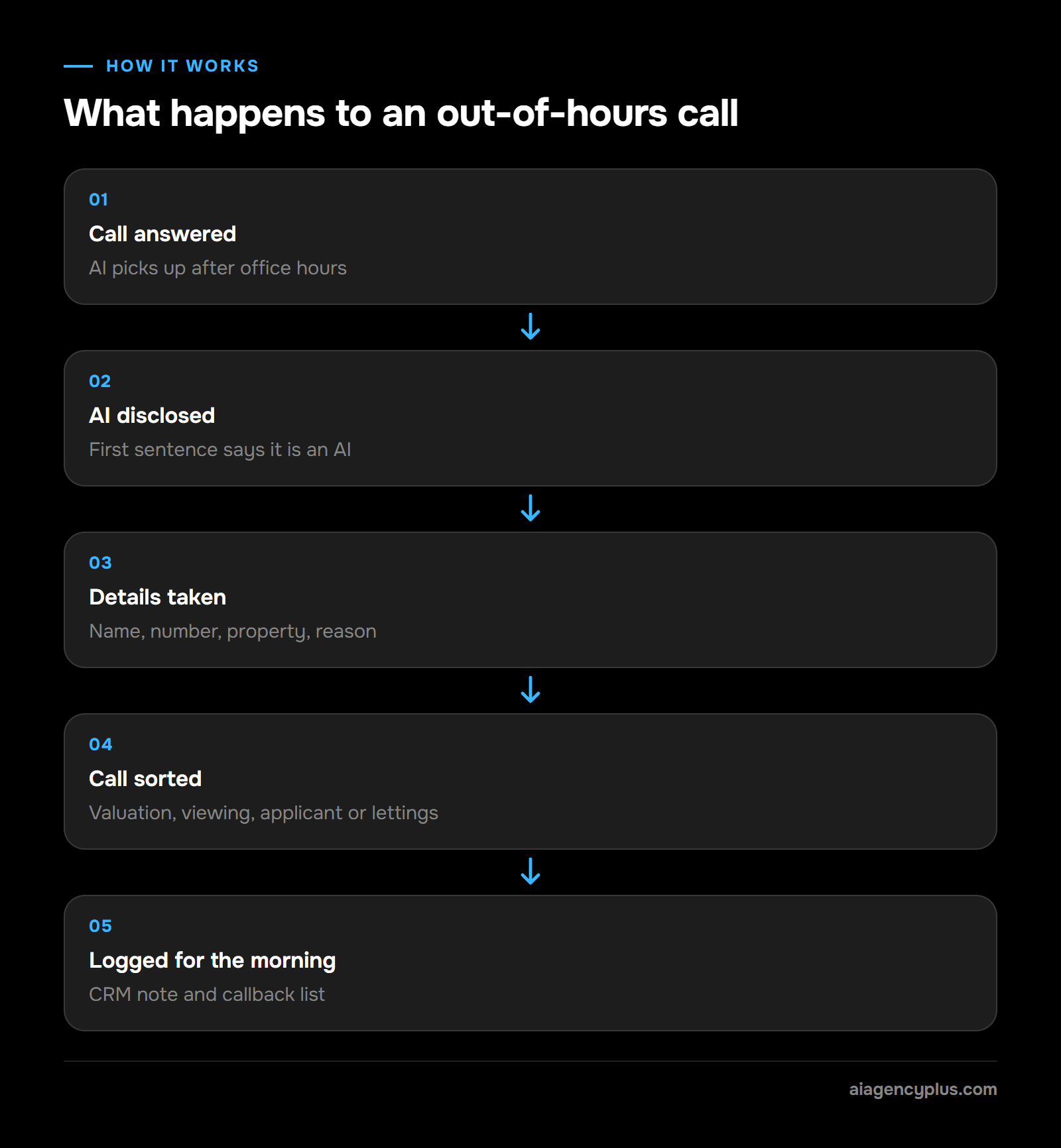
Yes. An AI voice agent can answer calls after the office closes, tell the caller it is an AI, take their details and sort the call. The usual categories are a valuation request, a viewing enquiry, an applicant question or a lettings problem. It then logs the call so your team can ring back first thing.
What it should capture
- Sellers and landlords: name, number, property address and whether they want a valuation.
- Applicants: budget, area, buying position (first-time buyer, in a chain, cash) and whether they hold a mortgage agreement in principle.
- Tenants: name, address and what has gone wrong, tested against a clear rule for what counts as urgent.
Lettings calls are where out-of-hours answering matters most, because a leak at 22:00 will not wait until morning. I've covered that in detail in AI answering for letting agents and property managers.
Say it is an AI, up front
I'd tell callers they are talking to an AI, and have the agent say so in its first sentence, every time. It's honest and it costs nothing. The UK position on AI calls is set out in is AI call answering legal in the UK?, and your agency decides how it applies.
When a cheaper fix will do
If you get a handful of evening calls a week, you may not need a voice agent at all. An automatic text to every missed caller can be enough. I compare the two in missed call text back: does it work?.
If you want to size this for your own branch, Book a Discovery Call.
How should AI handle portal and website enquiries?
AI handles portal and website enquiries well when it replies at once, asks the same qualifying questions every time and passes the qualified ones to a negotiator. Speed to lead matters, because an applicant who enquires online may have messaged other agents about similar homes. The negotiator still has the first real conversation.
An instant first reply
Within a minute of an enquiry, an automated message thanks the applicant, confirms which property they asked about and offers a next step: a viewing slot or a call back. It should come from the branch, name the negotiator who will follow up and say how to reach a person.
Qualifying questions
Reuse the applicant fields from the calls section, so every enquiry lands in the CRM in the same shape. That means budget, area, buying position (first-time buyer, in a chain, cash) and whether they hold a mortgage agreement in principle.
Ask two or three questions at a time, by message or email. If the applicant doesn't answer, stop asking and leave the enquiry for a negotiator.
Handing qualified leads to a negotiator
Set a written rule for what counts as qualified, for example a budget and buying position that fit live stock. Those enquiries go to a named negotiator with the answers attached and a task to call that day. The rest get property alerts and stay on file.
Nurture for vendors not ready to instruct
A vendor who asks about a valuation but isn't ready to sell can go into a slow sequence. That might be a short local market note every month or two and a check-in near the date they gave.
A negotiator approves every message before the sequence runs. Any reply goes straight to a person, and every message is easy to stop.
How do you book and confirm viewings with AI?
AI books viewings well when it can read a live diary and follows your rules. Those rules cover which slots are open, how long each viewing takes and which properties need the occupier asked first. The system offers a slot, books it, sends a confirmation and reminders, and asks for feedback afterwards. The negotiator keeps the decisions.
Rules to set before it books anything
- Which properties can be booked straight in, and which need the vendor or tenant to agree first. For tenanted homes, follow your tenancy terms on notice.
- Viewing length and travel time between addresses.
- Who attends: an accompanied viewing or a vendor-led one.
- What the applicant gives before a slot is confirmed: full name, phone, email and, if your policy asks, their buying position.
What the agent still checks
Keys, alarm codes and access arrangements never go through the AI. Neither does a decision about an applicant your team has concerns about. The automation books, and a person confirms anything that touches safety or the occupier's home.
Feedback after the viewing
An automated message can ask the applicant two or three questions and log the answers against the property. The negotiator reads them before sending the vendor a summary. Raw feedback never goes straight to a seller.
Valuations: can AI pull comparables and draft a market appraisal pack?
Yes, AI can pull comparable sales from the data your agency already uses and draft a market appraisal pack around them. That covers the property summary, a shortlist of comparables and notes on local stock. The valuation figure and the pricing advice stay with the agent, who has walked round the property and answers for the number.
What the AI prepares
- Property summary: built from the agent's notes and the CRM record.
- Comparables shortlist: recent sales and current listings, with the reason each one was picked.
- Draft covering note: for the vendor, with any gap marked MISSING, as in the listings prompt below.
What the agent decides
The agent removes comparables that don't fit, such as a sale with an extension the subject property lacks. They add the ones only local knowledge finds.
The figure, the asking-price advice and the fee conversation are the agent's. If an AI suggests a number, treat it as one more input to weigh.
Listings and property descriptions: can AI draft them while agents check?
Yes, AI can write a solid first draft of a property description, and it does it quickly. The risk is that it fills gaps with plausible details: a south-facing garden, a recently fitted kitchen, a quiet road. An invented or missing fact is the agency's problem, as the next part explains.
What changed on 06/04/2025
Part 4, Chapter 1 of the Digital Markets, Competition and Consumers Act came into force on 06/04/2025, replacing the Consumer Protection from Unfair Trading Regulations (CPRs). Propertymark reports that NTSELAT's Material Information guidance, Parts A, B and C, was withdrawn at the same point. The source is Propertymark's note on the withdrawn guidance.
Propertymark puts the change plainly: "omitting this information is now automatically considered an unfair commercial practice". Propertymark notes that the CMA now holds direct enforcement powers, while Trading Standards' role has not formally ended. This isn't legal advice, so read Propertymark's guidance and set your own process from it. I last checked both Propertymark pages cited here on 14/11/2026.
A prompt that only uses your facts
Here is the kind of instruction I'd give a writing model. It is illustrative, written for this article. The fields are a working list of my own, not a legal checklist, so adapt them to your CRM.
You are drafting a property description for a UK estate agency.
Use ONLY the facts in PROPERTY DATA below. Do not add features,
measurements, aspect, condition or local claims that are not listed.
If a field is blank, do not guess. Add a line at the end instead:
"MISSING: [field name]".
Write in UK English, plain and factual, 150 to 200 words.

PROPERTY DATA
Price or rent:
Tenure (and lease length if leasehold):
Council tax band:
Property type and construction:
Bedrooms / bathrooms / receptions:
Parking:
Garden and aspect:
Heating and utilities:
Known issues (flood risk, restrictions, building safety):
Agent's viewing notes:
The MISSING line is the useful part. It turns a gap into a task for the negotiator before the listing reaches a portal. Nobody publishes until those lines are cleared.
Checks before a draft goes live
These are the six checks I'd have a negotiator run on every AI draft. They are my recommendation, not a list from the guidance.
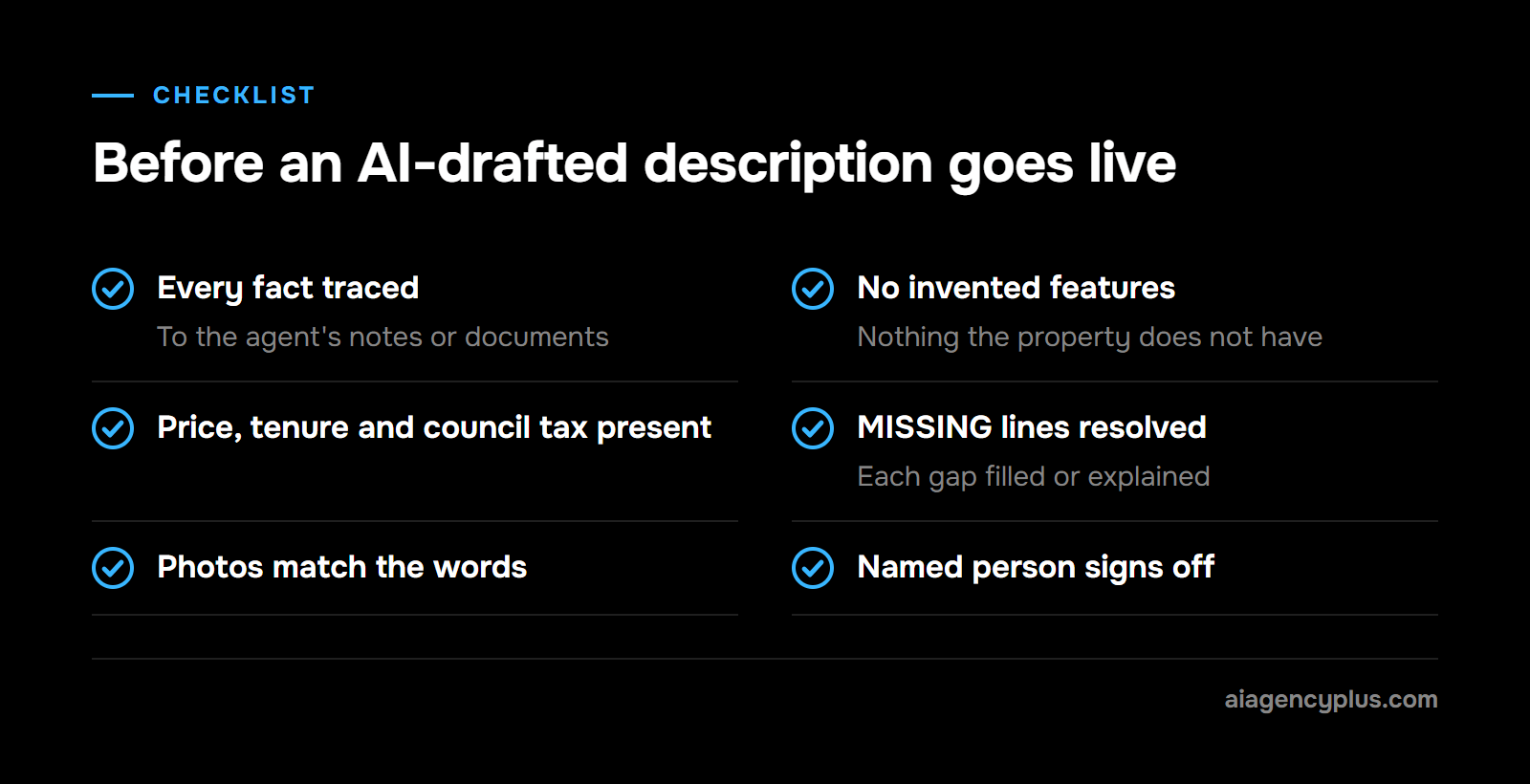
- Every fact traces back to the agent's notes or documents.
- No invented features: nothing the property does not have.
- Price, tenure and council tax band are present.
- Every MISSING line is resolved, with the gap filled or explained.
- The photos match the words.
- A named person signs the listing off.
Social posts and emails from the approved description
Once a description is signed off, AI can turn it into a short social post, a new-listing email to matched applicants and the copy for a flyer. The rule stays the same: only facts already in the approved listing, nothing added for effect.
Check every claim in the post or email against the listing before it goes out, including price and tenure. If the listing changes, the posts and emails change with it.
If you'd like to map this against your own branch, Book a Discovery Call and I'll go through it with you.
Photos and AI edits: how do you keep every image accurate?
Estate agents can use AI-edited photos when the edit keeps the image true to the property, such as correcting exposure, white balance or a leaning wall. Edits that add, remove or improve something a buyer will not find on the day are a different matter. Propertymark's assured advice sets the test: the image must accurately represent the property.
What Assured Advice 40 says
Assured Advice 40 is Primary Authority advice from Warwickshire Trading Standards with The Property Ombudsman, published by Propertymark. It says any image used in property advertising should be assessed each time it is used, and that a disclaimer cannot fix a misleading image.
Its wording is direct: "If an image / photo is not an accurate representation of the property it must no longer be used." It was written under the old CPRs, so check Propertymark for any update since the DMCC Act took over.
Where AI edits need a decision
- Light, colour and lens correction: usually fine, as long as the room looks as it does in person.
- Removing a crack, damp patch or overhead cable: I'd treat this as off-limits, because it hides something a buyer would want to know.
- Sky replacement and removing parked cars or bins: fine only if the car or bin isn't a permanent feature of the street.
- Virtual staging: a judgement call, and a label alone does not make a misleading image accurate.
Propertymark and the CMA set out the rules. Your agency decides where its line sits, writes it down and applies it to every listing.
Reuse is the one most often missed. A photo can stop being accurate after a new extension, a removed tree or a winter of wear. Recheck every image when a property is relisted.
How should AI handle reviews and follow-ups under the new consumer rules?
AI can send review requests, remind clients who haven't replied and draft replies to reviews. It must never write a review, post as a customer or decide which reviews appear. The CMA's guidance on the DMCC Act requires published reviews to be genuine, and that sets the boundary for every automated step.
The CMA's guidance on GOV.UK, last updated 03/12/2025, says businesses must not commission fake reviews or pose as consumers. It also says: "If you publish consumer reviews, you have to take appropriate steps to make sure they are genuine." Read it in full on GOV.UK: what businesses need to know about unfair commercial practices.
A follow-up flow I'd use
- Trigger on completion, or on move-in for lettings, from the CRM.
- Send one request with a direct link to the review site to every client who completed.
- Send one reminder after a week if there's no reply, then stop.
- When a review arrives, AI drafts a reply. A named member of staff edits it and posts it.
Sending the request to everyone is my recommendation, not a line from the guidance. A page built only from hand-picked happy clients is harder to defend as a fair picture. The agency sets its own policy.
Other follow-ups
The same pattern works for applicants who viewed but didn't offer, valuations that haven't turned into instructions and landlords coming up to their yearly rent review. Keep each message short, true and easy to stop.
Which admin tasks does automation handle well in an estate agency?
Automation handles admin well when the trigger is clear and the steps rarely change. Good examples are logging calls in the CRM, matching new listings to registered applicants, chasing documents, sending sales progression updates and reminding staff about certificate and rent review dates. It takes over the copying between systems that fills a negotiator's day.
Five jobs worth automating
- Call logging: every call note, from the AI or a person, lands in the right applicant or vendor record.
- Applicant matching: a new instruction prompts alerts to applicants whose criteria fit, reviewed by a negotiator before they send.
- Document chasing: ID, proof of funds and signed terms are chased on a schedule until they arrive.
- Sales progression: buyer and seller get an update when a solicitor's milestone is logged.
- Lettings compliance: gas and electrical safety certificate expiry dates, deposit protection and yearly rent review dates go to the person responsible, in good time. Since 1 May 2026, tenancies in England roll on with no fixed end date, so there are no renewals to chase.
What stays with people
Anti-money laundering checks, offers, pricing advice and any client who is upset stay with your team.
If you're new to the idea, what is business automation? explains triggers, steps and exceptions in plain terms.
Data and risk: what should you settle before you switch anything on?
Before any AI handles a call or an enquiry, settle four things. Know where recordings and lead data are stored, who processes them, what the AI does when it doesn't know an answer, and what rules your team follows. That takes one meeting and a one-page policy.
Where the data goes
Ask the supplier where call recordings, transcripts and lead details are stored, for how long, and who can see them. Get the processor named in writing, including any company it passes data to.
For the official position on AI and personal data, read the ICO's guidance on AI and data protection. I'd rather point you there than state legal conclusions for your agency.
When the AI doesn't know
Decide what the agent says when a caller asks something outside its script, such as a question about a lease or a dispute. The safe answer is to take details and promise a callback from a named team. It should never guess.
A one-page AI-use policy
- Which AI tools staff may use, and for which tasks.
- What client data must never go into a general writing assistant.
- Who signs off listings, photos and reviews.
- Who to tell when the AI gets something wrong, and how it is fixed.
What should a branch's first AI project be?
For most independent branches I'd start with the calls you miss after hours. The cost is easy to see and the output is easy to check. Count them for two weeks, sort them by type, and only then decide whether you need a voice agent, a missed-call text or nothing at all.
A two-week worksheet
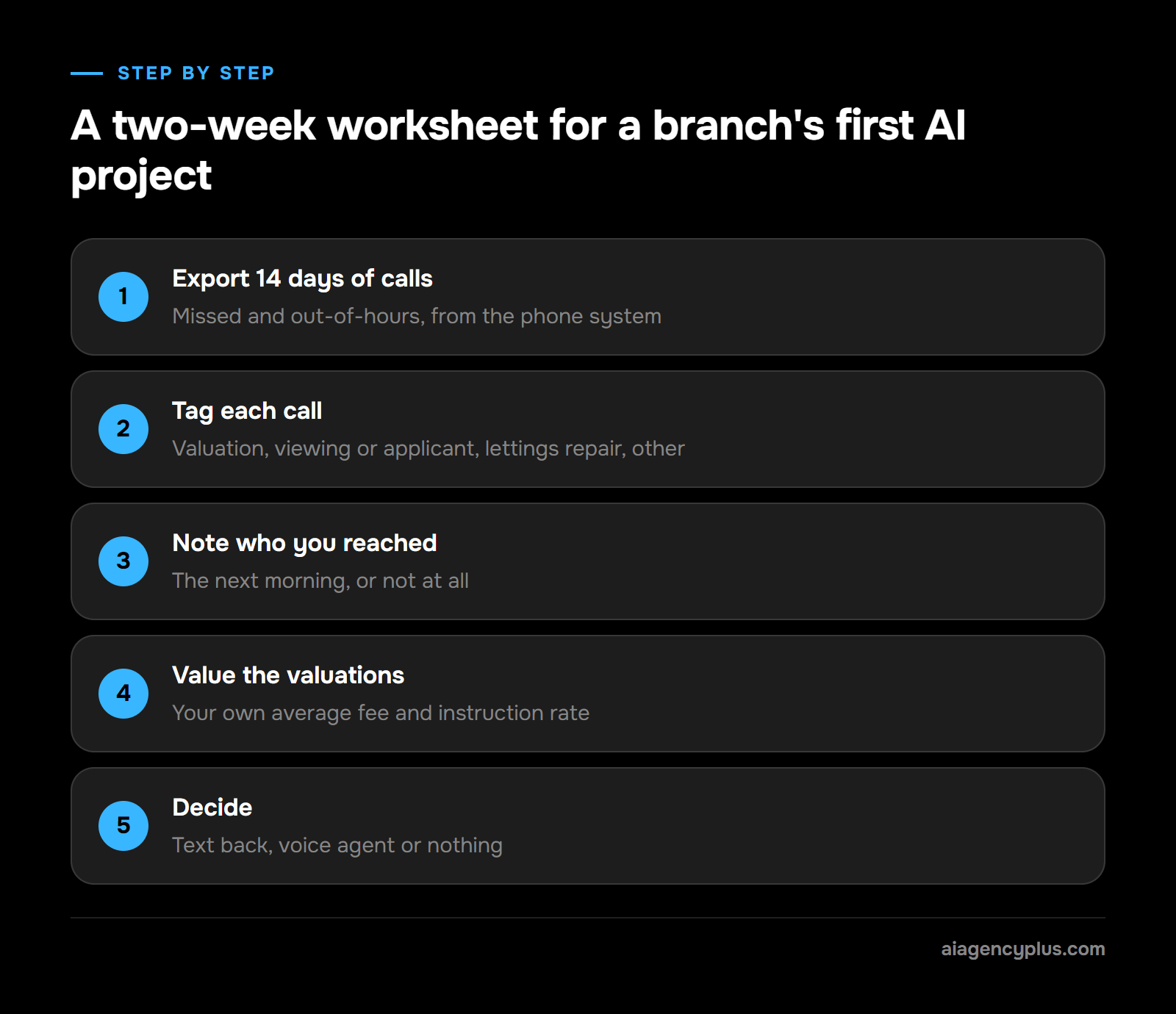
- Export missed and out-of-hours calls from your phone system for 14 days.
- Tag each one: valuation, viewing or applicant question, lettings repair, or other.
- Note which callers you reached the next morning and which you didn't.
- Put a value on the valuation requests, using your own average fee and instruction rate.
- Decide. A few calls a week points to a text back; regular valuation requests or urgent lettings calls point to a voice agent.
An illustrative example
Illustrative only: a branch logs 30 out-of-hours calls in 14 days. Six are valuation requests, 14 are viewing or applicant questions, eight are lettings repairs and two are wrong numbers. The six valuation requests are the line I'd look at first, because a caller who reaches nobody may ring the next agent on their list.
If your worksheet shows a few calls a week and no urgent lettings work, don't buy one. Set up a missed-call text and look again in six months.
Where AI Agency Plus fits
This is the work I do at AI Agency Plus, an ai automation agency in Leeds. For letting agents and property managers, we build an AI answering service. Our property management page sets out the pricing, from £349 a month plus VAT, and I'll give you a go-live date for your own phone system and rules on a discovery call. The page also explains how it decides which tenant calls justify a contractor tonight.
In short: where does AI for estate agents help?
AI for estate agents is useful where the work repeats and the check is clear: calls, viewing bookings, first drafts and admin. Keep a person on the parts the DMCC Act's consumer rules bear on most: listings, photos and reviews. To run the worksheet against your own branch, Book a Discovery Call.
Frequently asked questions
How can estate agents use AI?
Estate agents can use AI to answer out-of-hours calls, book and confirm viewings, draft property descriptions, tidy photos and handle routine admin such as CRM updates and document chasing. Listings, images and reviews need the closest check because of the DMCC Act.
What is material information under the DMCC Act?
Material information is the information a buyer or tenant needs to make an informed decision about a property, and Propertymark's reading is that leaving it out is now automatically an unfair commercial practice. That has applied since 06/04/2025, when Part 4, Chapter 1 of the DMCC Act replaced the CPRs and NTSELAT's Parts A, B and C guidance was withdrawn. Read Propertymark's note for agents before changing your process; the agent decides what each listing needs.
Can estate agents use AI-edited photos?
Yes, as long as the edited image still accurately represents the property. Propertymark's Assured Advice 40 says an inaccurate image must no longer be used and that a disclaimer cannot fix a misleading one. Light and colour correction is usually fine; hiding defects is not.
Should callers be told they are talking to an AI?
I'd say yes: have the agent say it is an AI in its first sentence, every time, because it's honest and costs nothing. Our guide to whether AI call answering is legal in the UK covers the UK position. Your agency decides how the rules apply to it.
Can AI decide which reviews go live?
No. AI can send review requests and draft replies, but a person decides what is published and posts replies under a real name. The CMA says businesses that publish consumer reviews must take appropriate steps to make sure they are genuine.