

Missed call text back is an automatic SMS sent to a caller's mobile when your phone rings out. It beats silence, but it mainly reaches mobiles, and a caller with an urgent job may ring the next firm instead. For urgent or out-of-hours calls, I'd answer the call, by a person or an AI answering service, because a text can't send help and only reaches numbers that can receive one.
What is missed call text back?
Missed call text back is an automatic text message sent to someone who rang your business and got no answer. The text tells them you missed their call, says who you are and asks them to reply or wait for a call back. It turns an unanswered call into a written conversation you can pick up later.
It goes by a few names: missed call SMS, auto reply text, missed call recovery. The idea is the same. A caller who would otherwise hear a ringing tone or a voicemail greeting gets a message on their phone shortly after hanging up.
I'll be fair to it in this guide, because it does a real job. I'll also cover what it can't reach, and what to put in place when the calls that matter are the ones a text can't save.
How does missed call text back work?
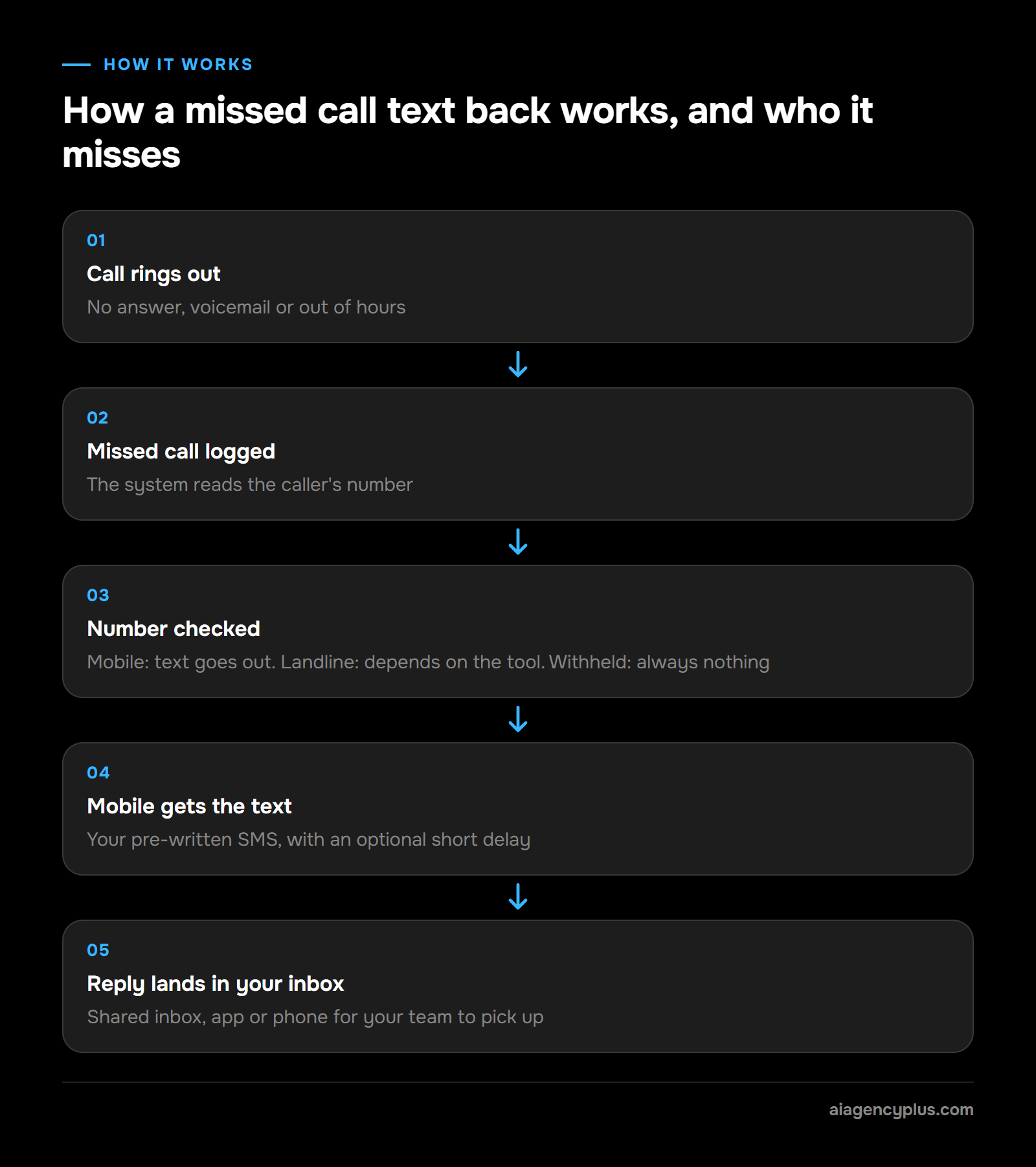
Missed call text back works off a trigger in your phone system. When a call rings out, goes to voicemail or arrives outside business hours, the system reads the caller's number and sends a pre-written SMS to it. Replies land in a shared inbox, an app or a team member's phone, where someone picks up the conversation.
What you need
- Phone system: one that can spot a missed call. Some cloud phone systems and call-handling tools have this trigger; check yours. An older landline setup may not.
- SMS sender: built into your phone system or supplied by a separate text provider.
- Reply inbox: somewhere for replies to go, and a person who checks it.
If your system has no missed-call trigger
Some standalone text-back tools give you a number of their own. You set your mobile or line to divert to that number on no answer, and the tool sends the text from there.
On a UK mobile, divert on no answer is usually a carrier setting or the GSM divert-on-no-answer code; check the exact steps with your network. Before you go live, test it with one call from a mobile and one from a landline.
The steps, in order
- The call rings out with no answer.
- The system logs it as missed and reads the caller's number.
- It checks the number can receive a text. Some text-back tools only send to mobiles, so check whether yours can reach landline callers; withheld numbers always get nothing.
- It sends your message. Some systems let you add a short delay, so it doesn't land while the caller is redialling.
- The caller replies, and the reply lands wherever you've set it to go.
A good setup lets you use different wording in business hours and out of hours. It should also stop one caller getting three texts if they ring three times. Check both settings before you switch it on.
If you'd rather talk through your own call patterns, Book a Discovery Call.
Does missed call text back actually work?
Yes, in a narrow sense: a text back is better than silence, because the caller knows you exist and has an easy way to reply. Whether it wins the job depends on how urgent the job is and how quickly someone answers the reply.
What the UK data says about missed calls
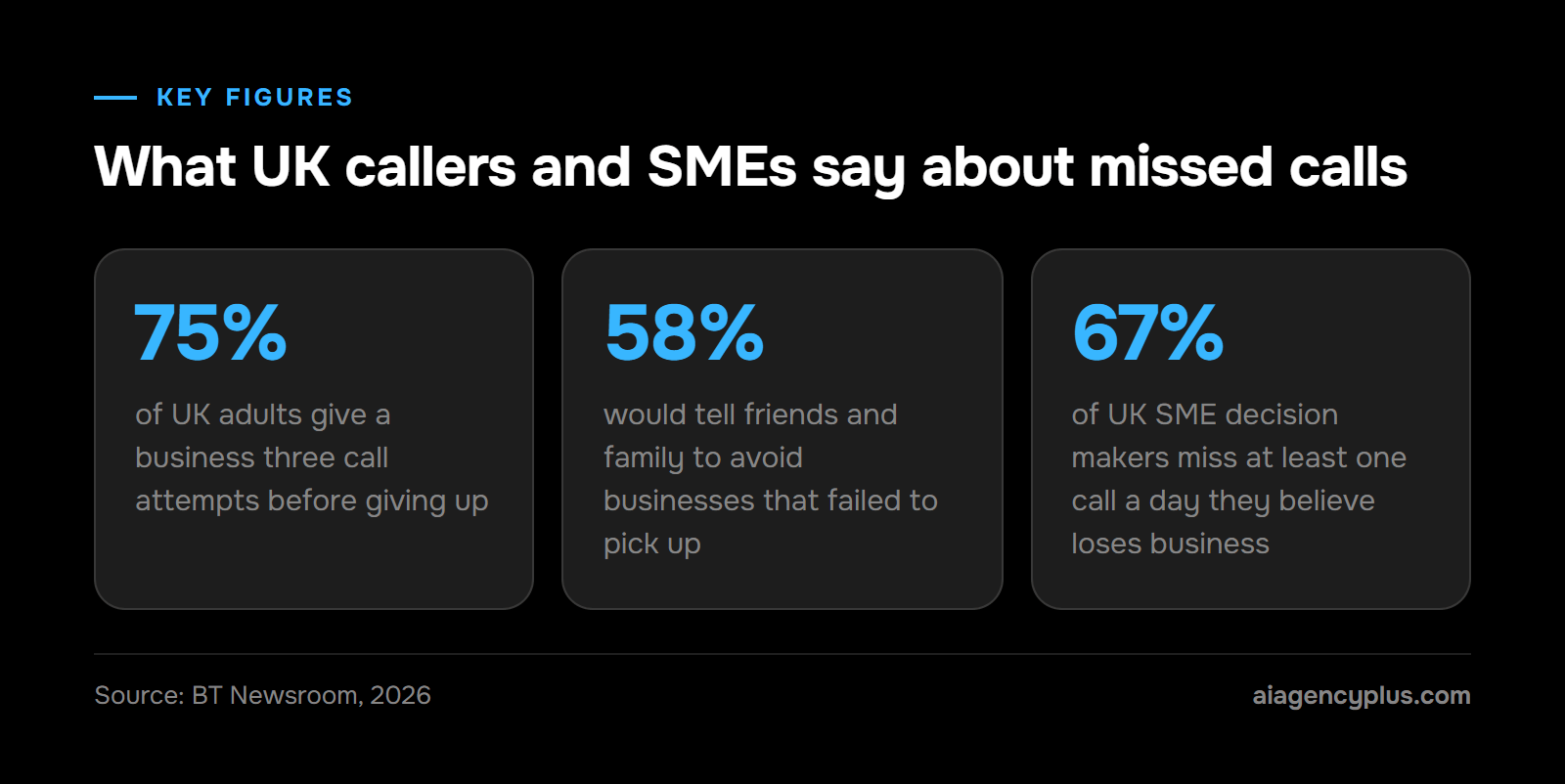
In a BT Business and Censuswide survey of 2,000 UK adults (fieldwork 23 to 25/09/2026, published 01/10/2026), 75% said they give a business three call attempts before giving up, and 58% said they would tell friends and family to avoid businesses that failed to pick up.
BT Business and Censuswide also surveyed 1,500 UK SME decision makers (fewer than 250 staff, fieldwork 23 to 28/09/2026): 67% said they miss at least one call on an average day that they believe loses them business.
Neither survey measured text backs. I haven't found independent UK figures on how many missed callers reply to a text. Treat any reply or recovery rate a vendor quotes as their own claim until you can see how it was measured.
Where a text back falls short
- Landlines: some text-back tools only send to mobiles, so check whether yours can reach callers on a landline.
- Withheld numbers: without a number, there's nowhere to send the text, so they always get nothing.
- Urgent callers: someone with a leak or a locked-out tenant may ring the next firm before they read your message.
- Replies: the reply still needs a person, unless the tool replies by AI, which still can't send help. If nobody checks the inbox until Monday, the caller waits until Monday.
Some text-back tools continue the SMS conversation with AI: they ask set questions and pass on a summary. The caller is still typing rather than talking, and the gaps above still apply.
After the reply
A text back only wins the job if someone acts on the reply. Decide these four things before you switch it on.
- Owner: name one person, or a rota, who owns replies during working hours.
- Reply time: set a target your team can keep on a busy day, and check it each week.
- Out of hours: decide whether replies wait until morning or go to whoever is on call.
- Next step: decide whether a reply turns into a call back or a booking, and who does it.
When a text back is enough
It's a sensible buy if most of your calls come from mobiles, few are urgent, and someone checks replies through the day. A quote request can usually wait a few hours. A burst pipe can't.
Is missed call text back legal in the UK?
Yes, a missed call text back is generally fine in the UK if it only deals with the caller's own enquiry. The ICO treats a message like that as a service message, not direct marketing. Add an offer, a discount or a promotional link and the same text becomes marketing, which comes with stricter rules.
Under PECR (the Privacy and Electronic Communications Regulations), texts count as electronic mail, so the electronic mail marketing rules cover marketing texts.
The ICO's guidance says service messages "do not count as direct marketing if they only provide administrative information and do not promote anything". The same guidance (read 08/11/2026) says that if you add advertising or marketing material, the message becomes direct marketing.
If you want to add marketing
Marketing texts to individual subscribers, which includes sole traders and ordinary partnerships, need the person's consent or must meet every requirement of the soft opt-in.
The ICO's soft opt-in for products and services has five conditions, and all of them must be met. Its guidance says negotiations for a sale include "requesting a quote or asking for more details about what you offer", so a caller asking for a price can count.
You must also have "provided the recipient with an opportunity to refuse or opt out when you collected their contact details", and give it again in every message. A number taken from a missed call usually comes without any opt-out offered at collection, so the soft opt-in rarely fits.
My advice: keep the missed call text to the call. It's simpler, and it keeps you clear of the marketing rules. This is my reading of the ICO guidance, not legal advice.
The new Ofcom sender checks
A text sent from a business name, rather than a number, can't be replied to. So a text back that asks the caller to reply must come from a number that can receive replies.
Ofcom's rules, published on 15/07/2026, will require mobile operators and aggregators to run Know Your Customer checks on business text senders and to corroborate alphanumeric sender IDs against what they know about the business. Ofcom's statement, Combatting mobile messaging scams, says these requirements for business (A2P) texts apply from 15/07/2027. Ofcom says the aim is to "prevent use of fake sender names".
Your text provider may run Know Your Customer checks on you as a business sender whichever way you send. The sender-name checks matter only if your texts show a business name instead of a number, and then expect your provider to ask you to prove you are that business. Pick a sender name that matches your registered or trading name.
If you're weighing up AI on the phone as well, I've covered those rules in is it legal to have AI answer your business calls in the UK.
What should a missed call text say? Examples
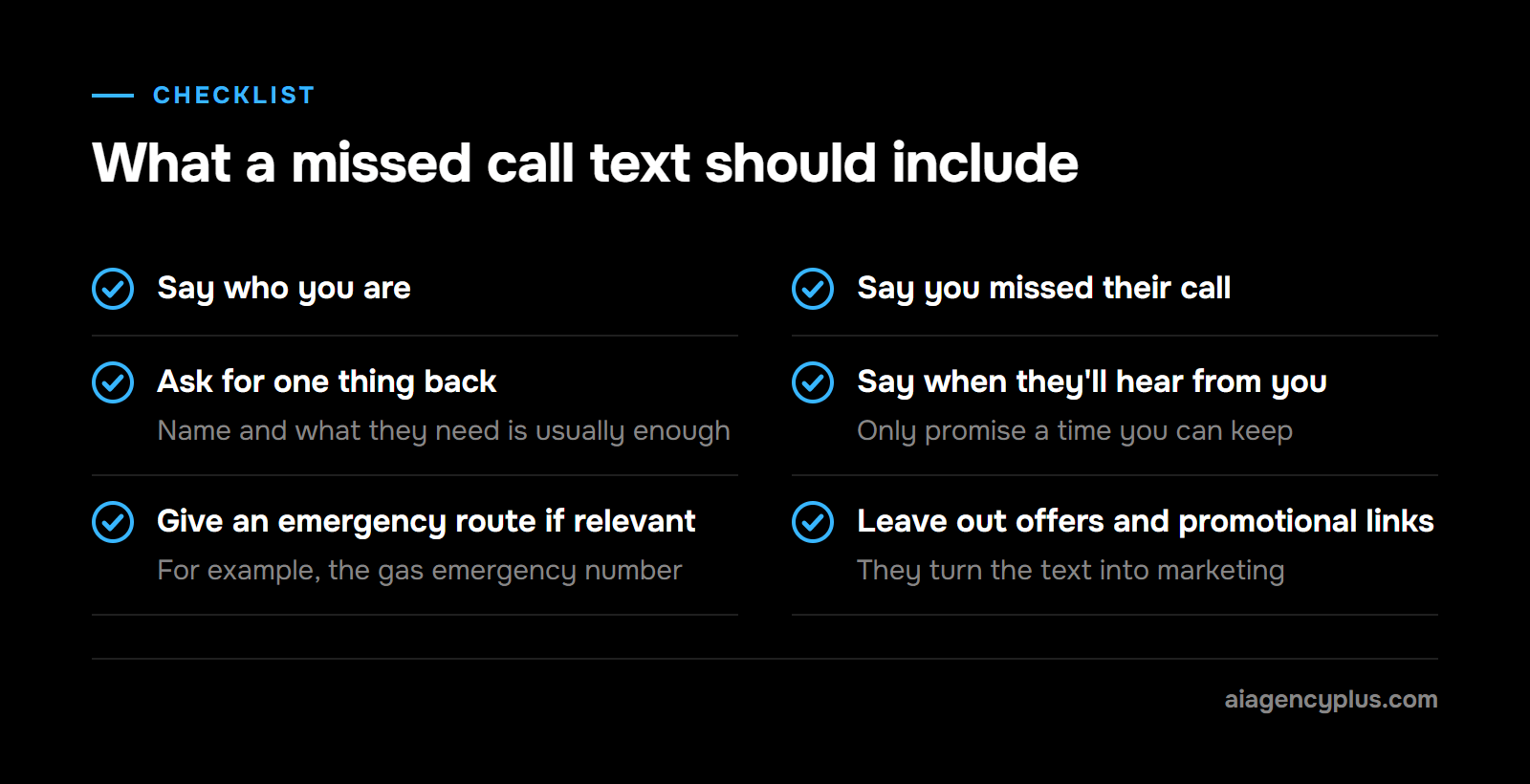
A missed call text should say who you are, that you missed their call, what you'd like them to send back and when they'll hear from you. Keep it to the length of a single standard SMS where you can, and leave out offers.
Use straight apostrophes and avoid emoji or special characters, so the text stays one standard SMS; a curly apostrophe or an emoji can split it into two or three texts. One clear request is easier to answer than three questions.
In business hours
> Hi, it's Hartley Plumbing. Sorry we missed your call, we're on a job. Reply with your name and what you need and we'll ring you back today.
Out of hours
> Hi, it's Hartley Plumbing. We're closed until 8am Monday. Reply with your name, postcode and the problem and we'll call you first thing.
When some calls are emergencies
> Hartley Plumbing: sorry we missed your call. Smell gas? Ring the National Gas Emergency Service, 0800 111 999. Anything else, reply here and we'll call back.
This template is for Great Britain. Firms in Northern Ireland should use the NI Gas Emergency Service, 0800 002 001.
If some of your calls could be emergencies, give the emergency route in the text itself. The caller shouldn't have to wait for your reply to find it.
Hartley Plumbing is a made-up example. Swap in your own name, and only promise a call back time your team can keep.
What to leave out: discount codes, links to offers and anything else that promotes. Those turn a service message into marketing.
What works better than a missed call text back?
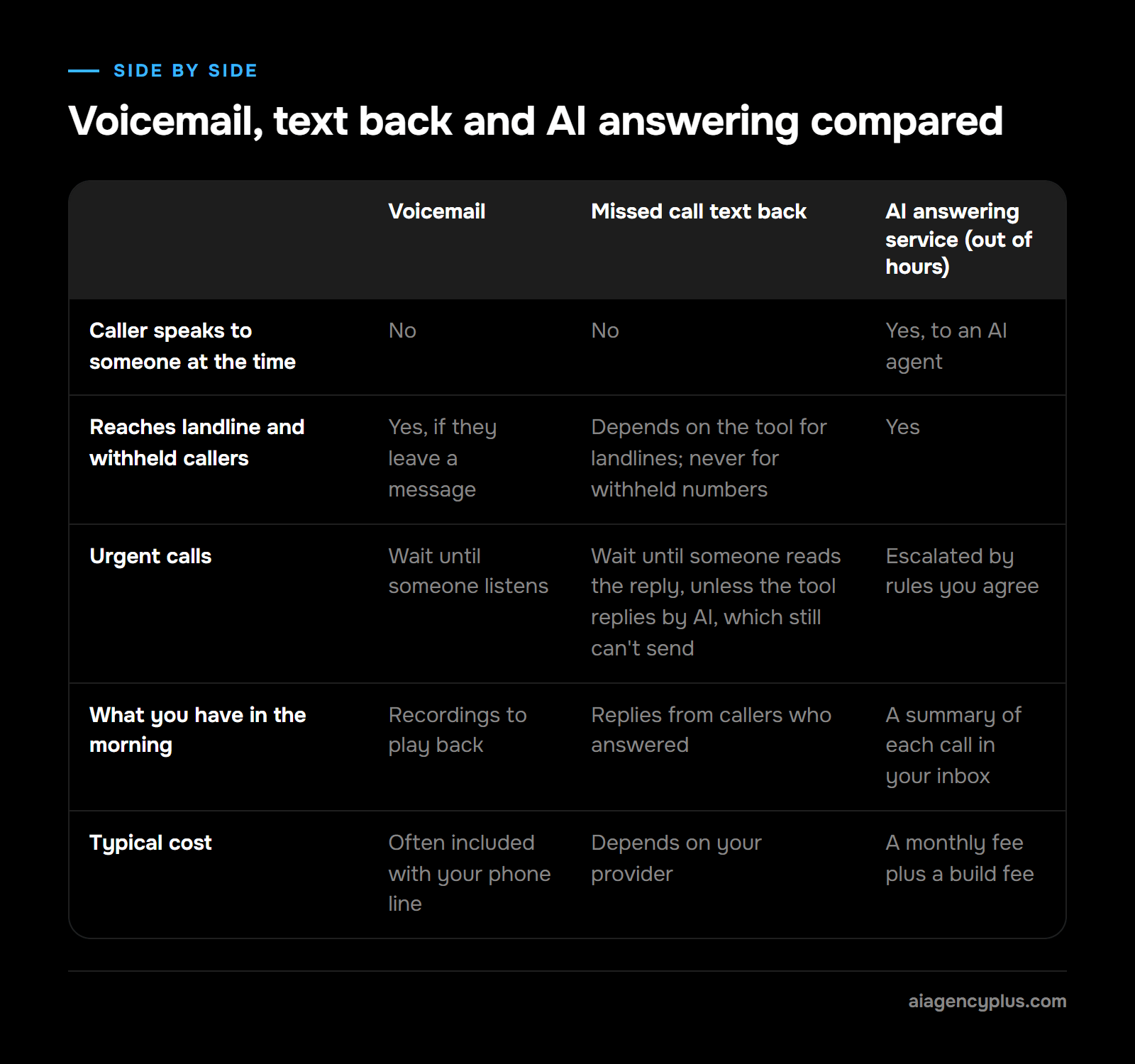
I'd rather answer the call where you can, because it gives the caller what they rang for. You can do that with staff, an on-call rota, a human call answering service or an ai answering service. A text back then becomes a backstop for the few calls that still slip through.
| Voicemail | Missed call text back | AI answering service (out of hours) | |
|---|---|---|---|
| Caller speaks to someone at the time | No | No | Yes, to an AI agent |
| Reaches landline and withheld callers | Yes, if they leave a message | Depends on the tool for landlines; never for withheld numbers | Yes |
| Urgent calls | Wait until someone listens | Wait until someone reads the reply, unless the tool replies by AI, which still can't send help | Escalated by rules you agree |
| What you have in the morning | Recordings to play back | Replies from callers who answered | A summary of each call in your inbox |
| Typical cost | Often included with your phone line | From about £37 a month for a standalone tool (Call2SMS, 08/11/2026) | From £349 a month plus VAT, and a build fee (waived on a 12-month term) |
Voicemail and a text back share one problem: both wait for you. An answering service deals with the call while the caller is still on the line. That matters most for urgent jobs out of hours.
When not to buy more than a text back
If you miss a handful of calls a week, nearly all from mobiles and none urgent, a text back from your existing phone system may be all you need. Paying to answer calls that can wait until morning is money you don't need to spend.
If you miss calls in the evening and at weekends, or some of them are emergencies, bear in mind the gaps covered above. For how AI handles calls during the working day too, see what is an AI virtual receptionist.
How does an AI answering service handle the calls a text can't reach?
The AI Agency Plus answering service is designed to answer your business phone outside working hours, including evenings, nights, weekends and holidays. A voice service answers the call itself, so it doesn't depend on the caller having a mobile. Here is how it is designed to handle three typical out-of-hours calls, step by step.
The callers below are illustrative examples, not client cases.
An urgent call at 21:15 on a Saturday
- A caller rings from a landline: no heating, an elderly parent in the house.
- The agent answers, asks the questions you've agreed, and matches the call against your emergency rules.
- It passes the call to your on-call contact with the address and the fault, and confirms the handover landed rather than assuming it.
A suspected gas leak
On the trades version, the design is that a suspected gas leak isn't booked as a job: the caller is told to leave the gas alone, ventilate, and ring the National Gas Emergency Service on 0800 111 999, and the client is told immediately. That number covers Great Britain; in Northern Ireland, the NI Gas Emergency Service number is 0800 002 001. The full setup is on the answering service for trades page.
A quote request at 22:40
A non-urgent call is captured properly: who called, what they wanted and what they expect to happen next. That summary is in your inbox in the morning, instead of a voicemail nobody transcribes.
What it does and costs
It answers calls and sends a summary to your inbox. If you want a written follow-up for missed calls during the day, keep your text back for those.
Pricing starts from £349 a month plus VAT, with a one-off build fee from £1,500 plus VAT that is waived on a 12-month commitment. For how that sits against other automation spend, see how much AI automation costs in the UK.
Should you set up a missed call text back?
Set one up if your phone system already offers it and you have nothing in place for missed calls. It beats silence for mobile callers with non-urgent questions. Don't rely on it for urgent or out-of-hours calls, given the gaps above: a caller with a burst pipe won't wait for a reply.
If those are the calls you're losing, answer them. Book a Discovery Call and I'll look at when your calls come in, and tell you straight whether a text back is enough.
Frequently asked questions
How much does missed call text back cost?
As a rule of thumb, it costs nothing extra if your phone system already has a missed-call trigger, and a monthly subscription if you need a standalone tool, sometimes with a charge per text on top. As one dated example, Call2SMS lists its Starter plan at £37 a month for 36 recovered-lead conversations (checked 08/11/2026); other providers price differently. Check what your current system already does before you buy anything new.
Does missed call text back work for landline callers?
Not always. A text needs a number that can receive it, and some text-back tools only send to mobiles, so check whether yours can reach landline callers; withheld numbers always get nothing. If many of your callers ring from home or office phones, a text back will miss them.
Can I put an offer in a missed call text?
You can, but it changes the rules. The ICO says adding advertising or marketing material turns a service message into direct marketing, which needs consent or a valid soft opt-in for individuals and sole traders. Keep the missed call text to the call, and send any marketing separately with the right permission.
Should the text go out during business hours as well?
It can, if your team can't always answer during the day. Use different wording for in hours and out of hours, so you don't promise a same-day call back at 11pm on a Friday.
Is it legal to have AI answer my calls instead?
Yes, it can be. The points to get right are how you handle callers' personal data under UK GDPR and being open that they're speaking to AI. I've set out what applies in is it legal to have AI answer your business calls in the UK.