

A good payment reminder email names the invoice number, amount, due date and how to pay, in a short, polite message with the invoice attached. Send it a few days before the due date, on the due date, then at 7 days, two to three weeks and about a month overdue. For business customers, mention statutory interest from the second overdue reminder.
When should you send a payment reminder email?
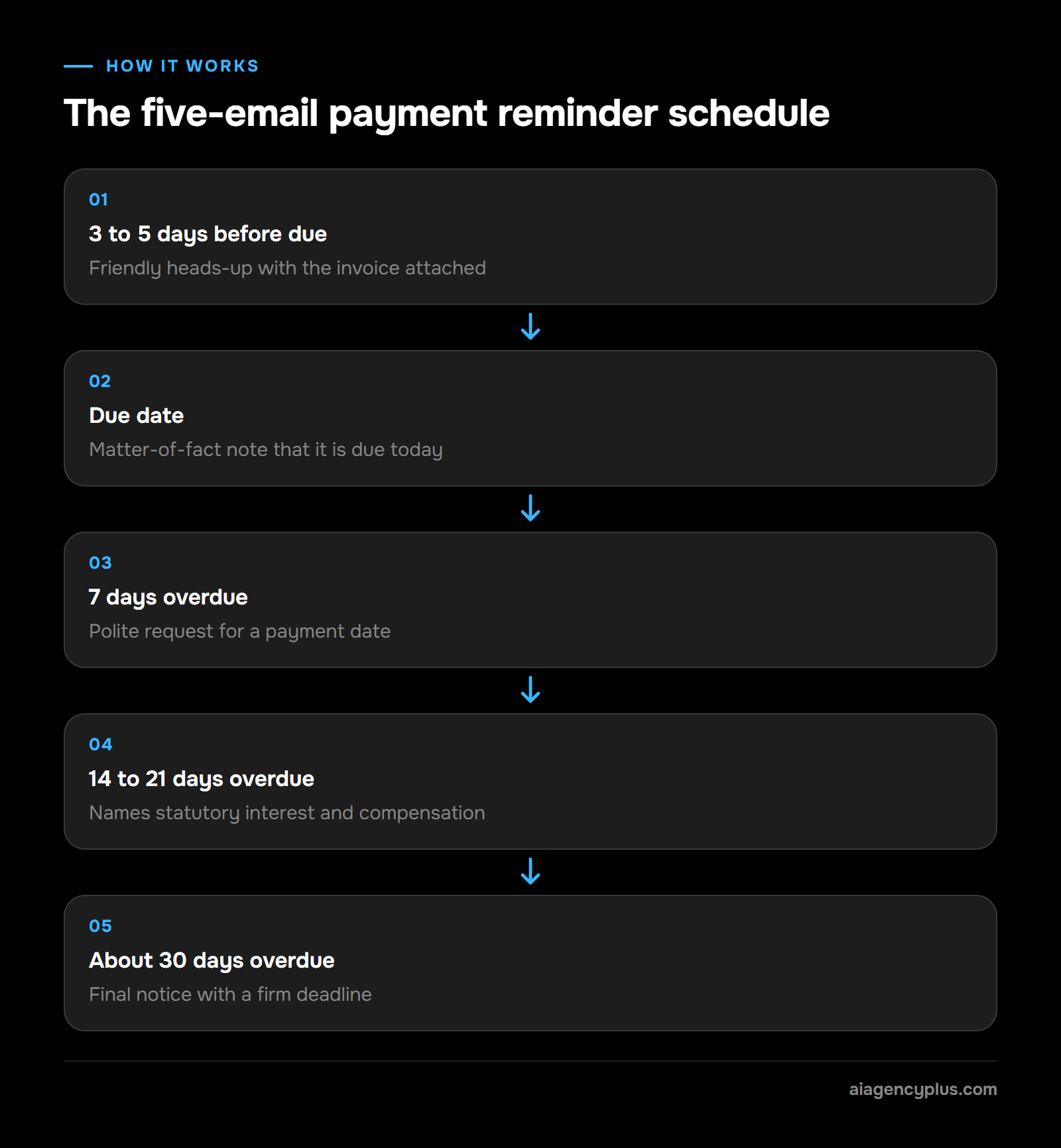
Send the first payment reminder a few days before payment falls due, the second on the day itself, and the rest at 7 days, two to three weeks and about a month overdue. That is five emails over roughly five weeks, each a step firmer than the last. After the final notice, stop emailing and pick up the phone or start formal recovery.
| When to send | Tone | |
|---|---|---|
| 1. Friendly heads-up | A few days before due | Helpful |
| 2. Due today | On the due date | Matter-of-fact |
| 3. First overdue invoice reminder | 7 days overdue | Polite, asks for a date |
| 4. Second overdue reminder | Two to three weeks overdue | Firm, names your rights |
| 5. Final notice | About a month overdue | Formal, sets a deadline |
Why send one before the invoice is due?
The pre-due email catches a common blocker in invoice chasing: the invoice never reached the person who approves it, or it is missing a purchase order number. Finding that out three days early costs nothing. Finding it out once the invoice is overdue costs you cash you were counting on.
A note on how you send the invoice
How the invoice arrives matters too. NHS Shared Business Services reports that, for invoices the NHS receives, "electronic invoices are paid 26 days faster than paper or email invoices" on average (2023 data, cited in the GOV.UK e-invoicing roadmap of 28/10/2026).
The UK government doesn't count a PDF attached to an email as an e-invoice. An e-invoice is structured data exchanged between the buyer's and the supplier's systems.
When is an invoice legally late?
If you agreed no payment date, a UK business payment is late 30 days after the customer gets the invoice or the goods or service, whichever is later. In the words of GOV.UK's late commercial payments guidance, "If you do not agree a payment date, the law says the payment is late 30 days after either" of those points.
Where you did agree terms, the invoice is late the day after that date.
GOV.UK says terms between businesses are usually capped at 60 days, unless a longer period is agreed and fair to both sides. If the customer is a public authority, payment terms are normally 30 days.
Is a 60-day payment cap coming?
The Commercial Payments Bill would cap payment terms at 60 days, make late payment interest mandatory and let the Small Business Commissioner fine persistent late payers. It completed its House of Lords stages on 20/10/2026 and was introduced in the House of Commons on 21/10/2026. As of 08/11/2026 it is not law, so the current rules above are the ones to use.
If chasing invoices takes more of your week than it should, Book a Discovery Call and I'll look at your process with you.
What should a payment reminder email include?
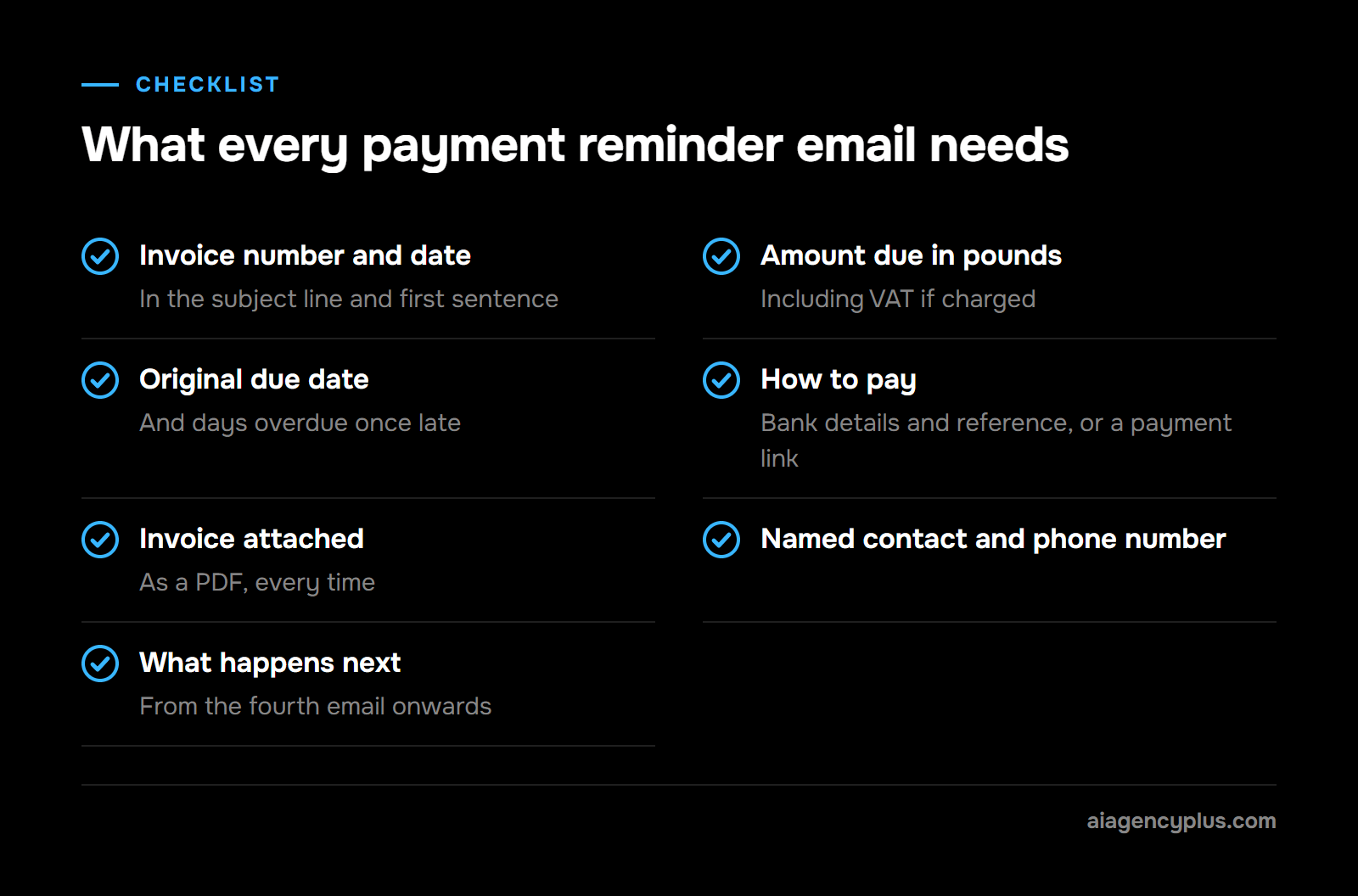
Every payment reminder email needs the invoice number, the amount due, the original due date and exactly how to pay, with the invoice attached. Add one direct question, such as when payment is scheduled, plus your name and phone number. Anything the customer has to look up is a reason to put it off.
The essentials
- The invoice number and date, in the subject line and the first sentence.
- The amount due in pounds, including VAT if you charged it.
- The original due date and, once late, how many days overdue it is.
- How to pay: account name, sort code, account number and reference, or a payment link.
- The invoice attached as a PDF, every time.
- A named contact and a direct phone number.
- From the fourth email: what happens next, and by when.
Getting the tone right
Assume a mistake until you have evidence otherwise. Plenty of late invoices are stuck in an approval queue, sent to an old address or missing a PO number.
Keep each email short enough to read at a glance. Long reminders read as anxious, and anxious reads as negotiable.
Write to a person, by first name, and copy in your day-to-day contact from the fourth email. They often know who is sitting on the invoice.
Should you offer an early payment discount?
An early payment discount, stated on the invoice itself, gives some customers a reason to pay sooner. As an example rate, Mailchimp's payment reminder guide (accessed 08/11/2026) suggests 2% for payment within 10 days. It costs you margin on every invoice it applies to, so try it on slow payers before making it standard.
Never add a discount in a reminder for an invoice that is already late. It rewards the delay.
Which payment reminder email templates can UK businesses copy?
These five payment reminder email templates follow the schedule above, from a friendly heads-up to a final notice. Copy them, replace everything in square brackets and send them from a named person's mailbox. Each one is firmer than the last, and only the fourth and fifth mention statutory interest and compensation, which apply to business customers.
1. Before the due date (a few days before)
Subject: Invoice [number] due on [date]: copy attached
> Hi [first name], > > A quick note that £[amount] on invoice [number] is due on [date]. I've attached a copy so it's to hand. > > You can pay by bank transfer to [account name], sort code [sort code], account [account number], using [invoice number] as the reference. > > If it needs a purchase order number or goes to someone else for approval, let me know and I'll reissue it today. > > Thanks, > [Your name], [phone number]
2. Due today
Subject: Due today: invoice [number], £[amount]
> Hi [first name], > > Today, [date], is the due date for invoice [number] (£[amount]). A copy is attached. The bank details are [account name], [sort code], [account number], reference [invoice number]. > > If payment is already on its way, thank you, and please ignore this email. > > Best wishes, > [Your name], [phone number]
3. 7 days overdue
Subject: Overdue: invoice [number], £[amount], due [date]
> Hi [first name], > > Invoice [number] for £[amount] was due on [date], and I can't see payment yet. Could you tell me when it's scheduled? > > If there's a problem with the invoice or the work, reply and I'll sort it straight away. A copy is attached, with the bank details at the bottom. > > Thanks, > [Your name], [phone number]
4. Two to three weeks overdue
Subject: Invoice [number]: [number] days overdue, payment needed by [date]
> Hi [first name], > > The £[amount] on invoice [number] is now [number] days past its due date of [date]. I emailed on [dates] and haven't had a reply. > > Under the Late Payment of Commercial Debts (Interest) Act 1998, we're entitled to claim statutory interest at [rate]% a year and fixed compensation of £[40, 70 or 100] on this invoice. > > I'd rather not add either. If payment reaches us by [date 7 days from now], I won't. Please reply with a payment date or call me on [phone number]. > > Regards, > [Your name] > [Job title], [business name]
5. Final notice (about 30 days overdue)
Subject: Final notice: invoice [number], £[amount], payment by [date]
> Dear [first name], > > This is our final reminder about the £[amount] owed on invoice [number], due on [date] and now [number] days overdue. > > Unless payment or an agreed payment plan reaches us by [date], we will add statutory interest, currently £[interest to date], and compensation of £[40, 70 or 100], and pass the account for formal recovery. That may include a formal letter before action and, if needed, court action. > > If there's a reason for the delay I don't know about, please call me on [phone number] before [date]. I'd much rather settle this with you directly. > > Regards, > [Your name] > [Job title], [business name]
Who should each email go to?
Send the first three to your accounts payable contact or the address on the purchase order. From the fourth, copy in the person who signed off the work. Send the final notice to the finance director or owner as well.
If you don't know who runs the business, the officers are listed free on Companies House.
If you raise more invoices than you can keep track of by hand, I cover the automated version near the end. Or Book a Discovery Call and I'll look at your process with you.
How do you write a subject line that gets opened?
A subject line that gets opened states the invoice number, the amount and the status, so the reader knows what it is before they click. Accounts teams often search their inbox by invoice number, so put it near the start. Vague subjects such as "Following up" or "Quick question" are easy to skip or lose in a busy inbox.
The table uses made-up figures for illustration only: invoice 1043 for £2,400, due on 14/11/2026.
| Stage | Vague subject | Clear subject |
|---|---|---|
| Before due | Just checking in | Invoice 1043 due on 14/11/2026: copy attached |
| Due today | Reminder | Invoice 1043 for £2,400 is due today |
| 7 days overdue | Following up | Overdue: invoice 1043, £2,400, due 14/11/2026 |
| 21 days overdue | Payment chaser | Invoice 1043: 21 days overdue, payment needed by 12/12/2026 |
| Final notice | URGENT!!! | Final notice: invoice 1043, £2,400, payment by 19/12/2026 |
Three rules for subject lines
- Keep it short where you can, so less of it is cut off on a phone.
- Change the subject at each stage. A reply buried in an old thread keeps the old, softer subject.
- Skip capitals, exclamation marks and the word "urgent". They read as panic and add nothing the invoice number and date don't already say.
How do you mention late payment interest without souring the relationship?
Mention late payment interest as a plain fact in the second overdue reminder, at 14 to 21 days, with the rate, the fixed compensation and a date. Offer to waive it if payment arrives by then. That keeps the goodwill, makes the cost of waiting clear, and leaves the final notice to confirm you will now add it.
What can you claim from a business customer?
According to GOV.UK, statutory interest is 8% a year plus the Bank of England base rate. The Late Payment of Commercial Debts (Rate of Interest) (No. 3) Order 2002 sets which base rate is used: the one in force on 30 June for payments late from 1 July, and on 31 December for payments late from 1 January.
According to GOV.UK, you can claim it when another business is late paying for goods or a service. You can't claim statutory interest if your contract sets its own late payment rate.
The Bank of England's Bank Rate history shows Bank Rate at 3.75% on 30/06/2026, so statutory interest is 11.75% a year for payments that are late between 01/07/2026 and 31/12/2026.
Any change to Bank Rate after 30/06/2026 only counts for payments that become late from 01/01/2027. Bank Rate has been 4% since 05/11/2026 (checked on 08/11/2026), so if it is unchanged on 31/12/2026, statutory interest will be 12% a year for those payments.
| Payment became late | Base rate used | Statutory interest |
|---|---|---|
| 01/07/2026 to 31/12/2026 | 3.75% (on 30/06/2026) | 11.75% a year |
| 01/01/2027 to 30/06/2027 | Bank Rate on 31/12/2026 (4% since 05/11/2026, checked on 08/11/2026) | 8% a year plus that rate (12% a year if unchanged) |
GOV.UK also lets you claim fixed compensation once per invoice: £40 on debts under £1,000, £70 on £1,000 to £9,999.99, and £100 on £10,000 or more. If recovery genuinely costs more, you can claim reasonable costs on top.
| Invoice amount | Fixed compensation |
|---|---|
| Under £1,000 | £40 |
| £1,000 to £9,999.99 | £70 |
| £10,000 or more | £100 |
GOV.UK says to send a new invoice if you decide to add interest, so once you add interest and compensation, issue a new invoice for the total.
A worked example (illustrative): £4,800, 30 days late
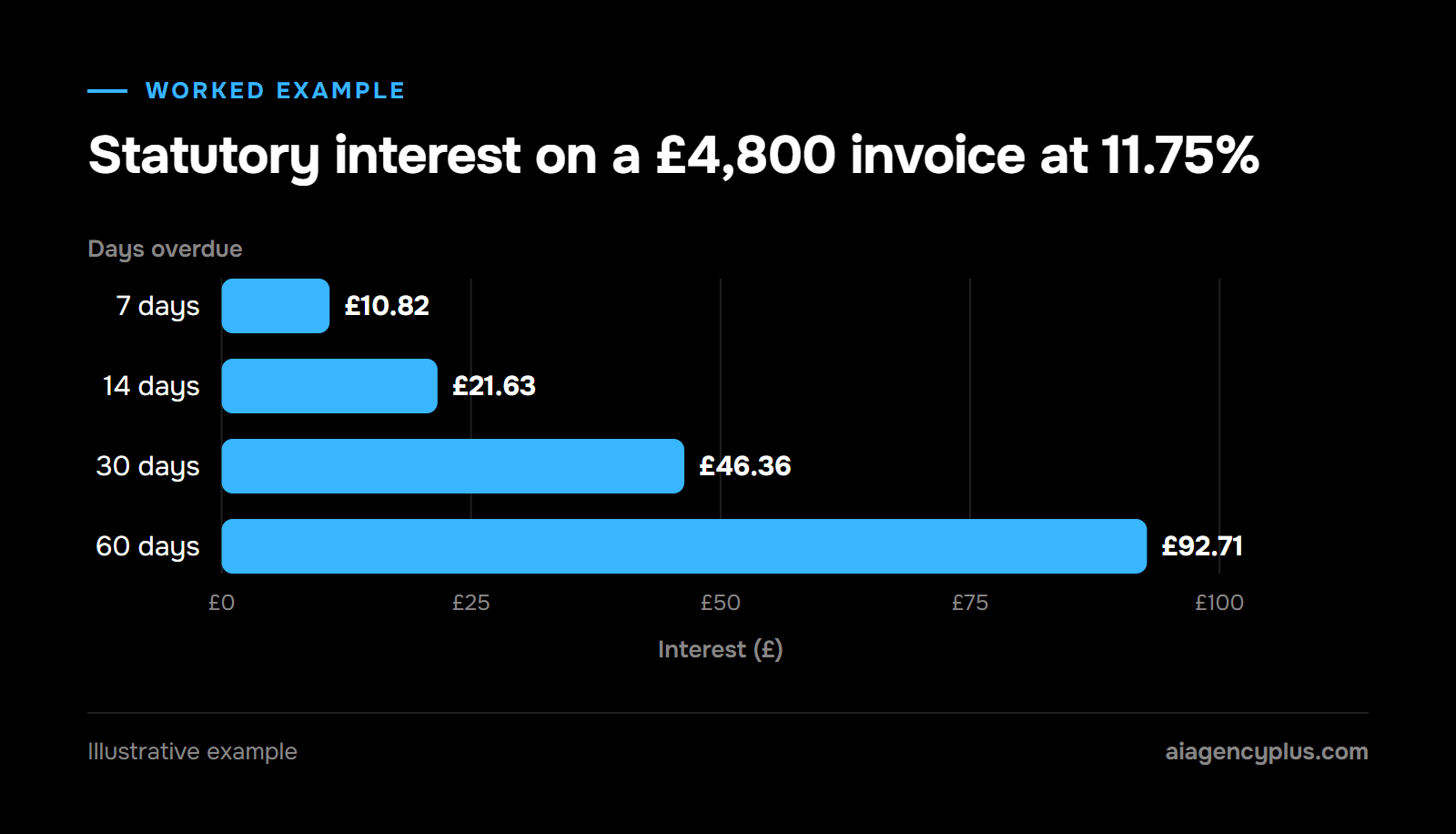
Say a client owes £4,800 on an invoice that fell due in September 2026. The yearly interest at 11.75% is £564.00, which is about £1.55 a day (£564 ÷ 365).
After 7 days that is £10.82, and after 14 days £21.63. At 30 days late it comes to £46.36. Add the £70 fixed compensation for a debt between £1,000 and £9,999.99, and you can claim £116.36 on top of the £4,800.
At 60 days late the interest is £92.71, so the claim becomes £162.71. Useful money, and small next to a client relationship worth years of invoices.
How to raise it and keep the client
- Name it first in email four, with the exact figures.
- Offer to waive it if payment arrives by a named date, and keep your word either way.
- Charge it to customers who are late repeatedly, and tell them in advance that it will apply next time.
What if the reminder emails don't work?
If five emails haven't worked, stop emailing and phone the person who approves payments. Ask what is holding the invoice, agree a date or a payment plan on the call, then confirm it in writing the same day. After that, your options are a formal letter before action, a debt collection agency or a court claim.
Check who you're dealing with
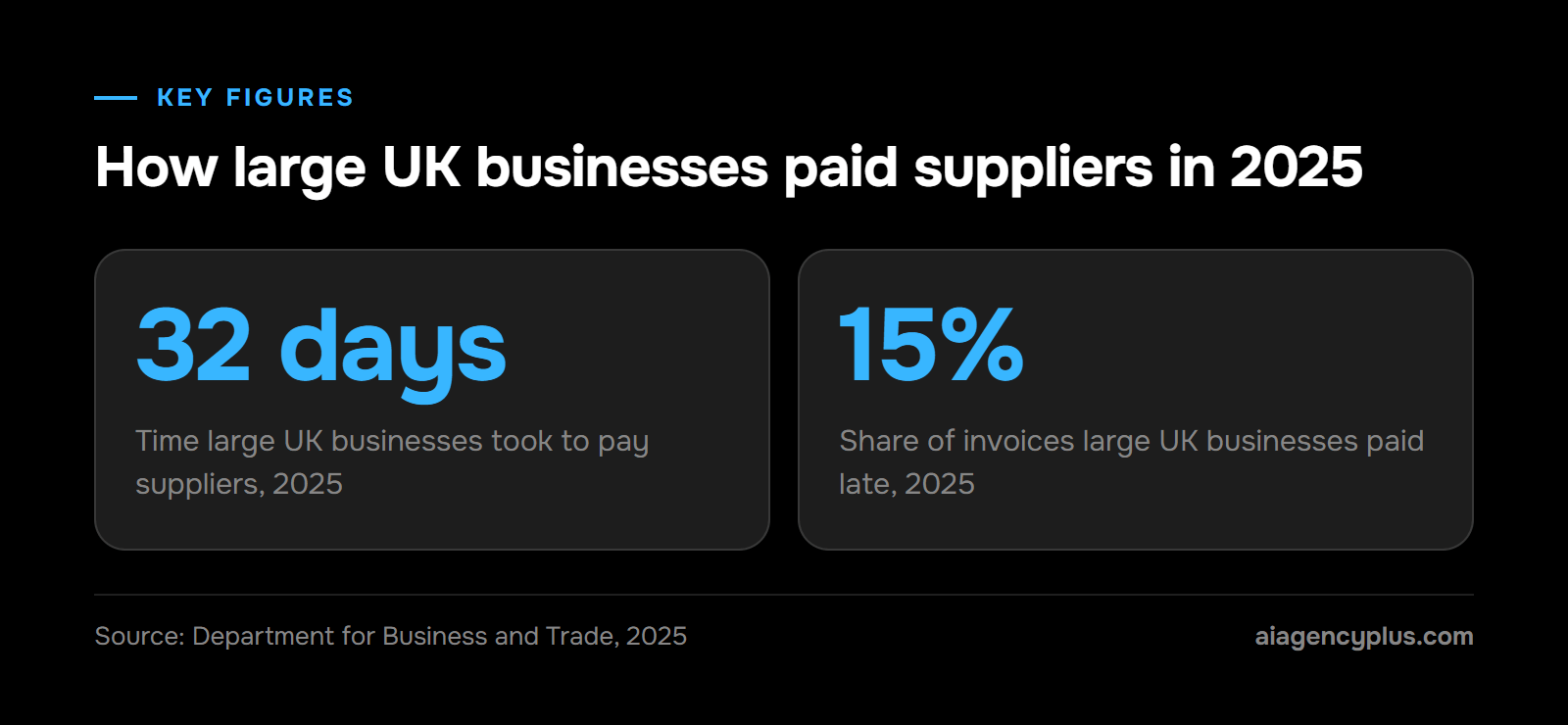
In 2025, large UK businesses paid their suppliers in 32 days and paid 15% of invoices late, according to Department for Business and Trade statistics published 14/07/2026. So a late payment from a big customer is not unusual, and it is worth asking where the invoice is stuck before assuming the worst.
Large UK businesses must publish payment practice reports at least twice a year, and you can search them on GOV.UK to see a customer's average time to pay and share of invoices paid late. If a customer routinely runs well past its terms, you'll know before the next contract.
Companies House shows a company's registered address, officers, filed documents and any insolvency information free of charge. Check it before you spend money on recovery, because a company in insolvency needs a different route.
Your next steps, in order
- Phone the accounts contact, then the person who signed off the work.
- Pause further work or deliveries, if your terms allow it.
- Send a formal letter before action with a final deadline. If the customer is a sole trader or an individual, the letter must follow the Pre-Action Protocol for Debt Claims, with its information sheet and reply form, and allow 30 days for a reply.
- Instruct a debt collection agency or a solicitor, or make a court claim.
Take advice before step 4 on larger sums. Court fees and time add up, and a judgment against a business with no money doesn't pay your invoice.
How do you automate invoice chasing?
You automate invoice chasing by connecting your accounting data to a workflow that sends the right reminder on the right day, stops when payment lands and passes any reply to a person. Set up well, overdue invoice reminders go out on schedule using the figures in your accounting system, so nobody has to remember to send them.
What a chasing workflow does
This is the shape of the build I'd scope as part of business process automation:
- Each morning, it reads unpaid invoices and their due dates from your accounting system.
- It works out each invoice's stage: before due, due today, 7, 14 to 21 or about 30 days overdue.
- It sends that stage's template from your own mailbox, filled in with that invoice's number, amount and dates and, from email four, the interest calculated to the day.
- When a customer replies, it pauses the sequence for that invoice and hands the email to a named person.
- When a payment matches the invoice, it stops chasing and marks it paid.
- Once a week, it sends you a list of what is overdue, by how much, and what has gone out.
The workflow handles the routine. Your team keeps the judgement calls: disputes, payment plans and the phone calls described above.
When it's worth it, and when it isn't
If you raise a handful of invoices a month, the templates above and a calendar reminder are enough. Automation earns its cost when chasing eats hours each week, or reminders slip because nobody owns the job.
At AI Agency Plus, the cost of a build like this depends on scope. My guide to what AI automation costs in the UK breaks down where that money goes, and what business process automation is covers the basics.
If you're on the paying side, accounts payable automation covers that process. If you want reminders, chasing and reconciliation run by a workflow, Book a Discovery Call and I'll tell you plainly whether it's worth building for your volume.
Frequently asked questions
How do you write a payment reminder email?
Put the invoice number, the sum owed and the status in the subject line, then repeat them in the first sentence with the due date. Attach the invoice, give the bank details or a payment link, and ask one clear question, such as when payment is scheduled. Sign off with your name and a direct phone number, and keep the whole email short enough to read at a glance.
How do you politely ask for payment of an overdue invoice?
State the facts, assume a mistake and ask for a date: "I can't see payment yet for invoice [number] (£[amount]), which was due on [date]. Could you tell me when it's scheduled?" Offer to fix any problem with the invoice or the work. Being specific is what keeps it polite, because the customer has nothing to look up or guess.
Should you mention late payment interest in a reminder?
Yes, for business customers, from the second overdue reminder at around 14 to 21 days. State the statutory rate (11.75% a year for payments late between 01/07/2026 and 31/12/2026) and the fixed compensation of £40, £70 or £100. Offering to waive both if payment arrives by a set date helps keep the relationship intact.
Can I charge late payment interest to a sole trader?
Yes, if the sole trader bought from you for their business. Statutory interest and fixed compensation apply to business-to-business debts, whatever the customer's legal structure. They don't apply to consumers buying for personal use, and you can't claim statutory interest if your contract sets its own late payment rate.
Is there a legal maximum payment term in the UK?
Between businesses, agreed payment terms are usually capped at 60 days unless a longer period is fair to both sides, and public authorities normally pay within 30 days, according to GOV.UK. With no agreed date, payment is late after 30 days. The Commercial Payments Bill would set a firmer 60-day cap, but it is not law as of 08/11/2026.