

A professional voicemail greeting gives your business name, confirms the caller has reached the right place, says when someone is available, and asks for their name, number and reason for calling. Keep most greetings under 25 seconds. Never promise a call-back time you can't keep, and give an emergency route if your callers may need one.
What should a professional voicemail greeting say?
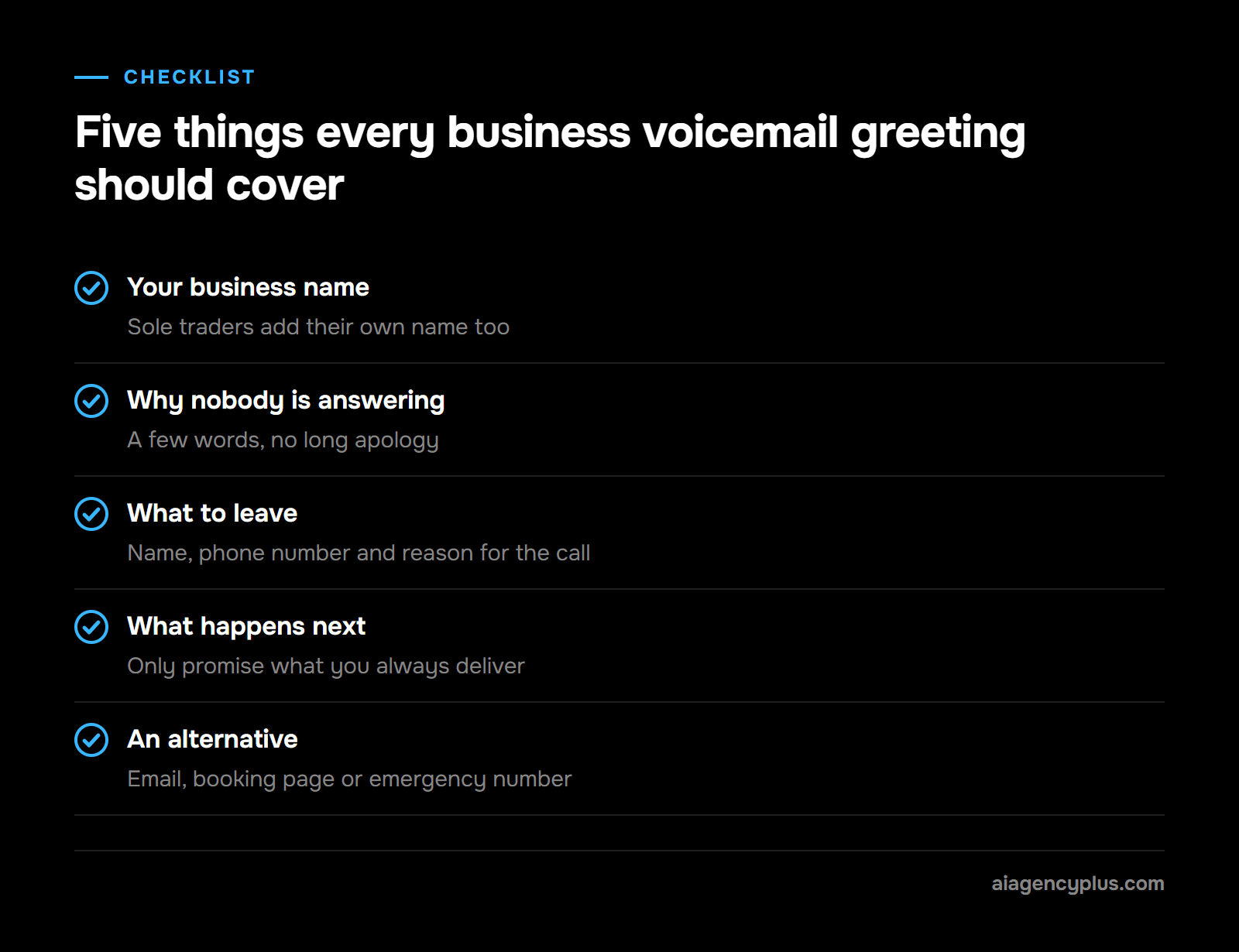
A professional voicemail greeting should say five things: who the caller has reached, that nobody can answer right now, what to leave, what happens next, and where to go if it can't wait. Everything else is optional. If a line doesn't help the caller do something, cut it.
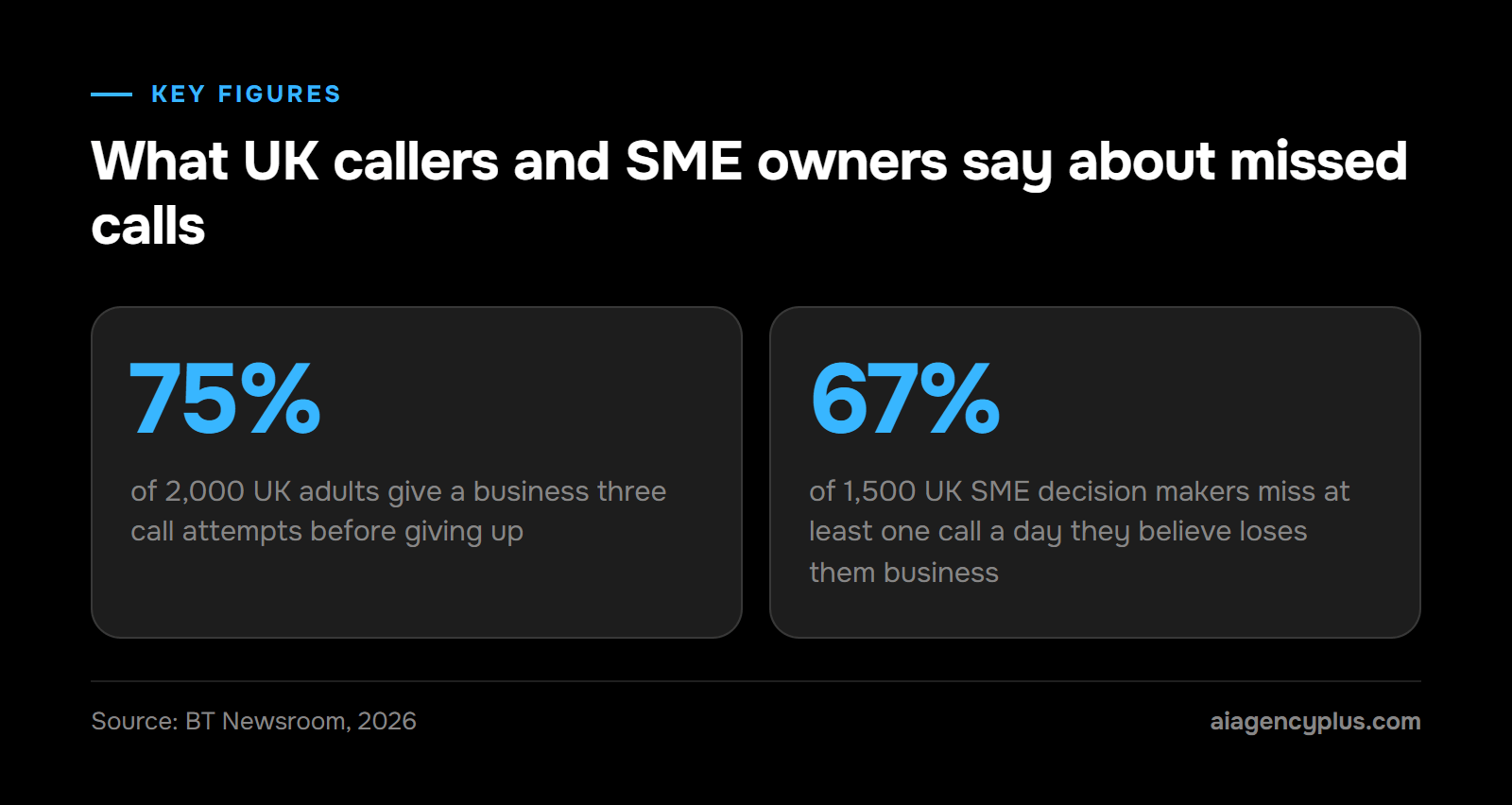
Why it matters: in a BT Business/Censuswide survey of 2,000 UK adults (September 2026), 75% said they give a business three call attempts before giving up, and 58% said they would tell others to avoid businesses that failed to pick up. That is what people say in a survey, not measured behaviour, and I come back to it under when to replace voicemail.
The five parts
- Your business name. Sole traders should add their own name too. It confirms the caller dialled the right number.
- Why nobody is answering, in a few words. 'We're on other calls' or 'the office is closed' is enough.
- What to leave. Ask for their name, phone number and the reason for the call. The reason lets you decide which messages to return first.
- What happens next, honestly. Only say 'within the hour' if every message gets a reply within the hour. 'When we open' or 'on the next working day' is safer, provided it's true.
- An alternative. An email address, a web page for bookings, or an emergency number for calls that can't wait.
What to leave out
- 'Your call is important to us'. Callers have heard it too often for it to mean anything.
- Long apologies and options menus. Every extra second is time before the tone.
- Casual openers such as 'Hey'. They suit a personal mobile, not a business line.
- Sales messages. A caller who reached voicemail wants to leave a message.
- Anything that will go out of date, such as an old promotion or a closure that ended weeks ago.
Professional voicemail greeting examples you can copy
Here are six everyday scripts, with five more for closures and emergencies in the next section. Each is in UK English, asks callers who they are, how to reach them and why they rang, and avoids call-back promises you may not keep. Swap the square-bracket parts for your own details, then read the script aloud before you record it.
1. General office
Use this as your default greeting for a small office.
> Hello, you've reached [business name]. We can't take your call at the moment. Please leave your name, your phone number and a short reason for your call after the tone, and we'll get back to you. You can also email us at [email address]. Thank you for calling.
2. Sole trader
Use this if you're the only person who answers and you're often on a job.
> Hi, this is [your name] from [business name]. I'm probably on a job and can't get to the phone. Tell me who you are, your number and what you need, and I'll call you back when I'm free. If it's about a quote, mention your postcode so I know where you are.
3. Busy line during opening hours
Use this when everyone is on another call and the line overflows to voicemail.
> Thank you for calling [business name]. Everyone is on another call just now. Leave your details and the reason for your call after the tone, and the first person free will pick it up. If you'd rather speak to someone, try again in a few minutes.
4. Team member away
Use this on a direct line when someone is on leave.
> Hello, you've reached [name], [job title] at [business name]. I'm out of the office until [day and date]. For anything that can't wait, please call [colleague's name] on [number]. Otherwise, leave your name, number and a short message, and I'll reply when I'm back.
5. Direct line or work mobile
Use this as the everyday greeting on a staff member's direct line or work mobile. Keep script 4 for when they're on leave.
> Hello, you've reached [name], [job title] at [business name]. I can't take your call right now. After the tone, give me your name, your number and what you're calling about, and I'll get back to you. If it's urgent, you can reach [colleague or main office] on [number].
6. Customer service or department line
Use this on a line that goes to one team, such as orders, accounts or support.
> Thank you for calling the [department name] team at [business name]. We can't take your call just now. After the tone, give us your name, your number and your order or account reference, and we'll get back to you. For help sooner, email [email address] or visit [help page web address].
Which one to use
| Script | Use it when | Check before recording |
|---|---|---|
| 1. General office | Calls go unanswered in normal hours | The email address is monitored |
| 2. Sole trader | You answer every call yourself | You can call back the same day |
| 3. Busy line | Calls overflow while staff are busy | Someone checks messages between calls |
| 4. Team member away | A person is on leave | The colleague named has agreed to cover |
| 5. Direct line or work mobile | A staff member can't answer their own line | The colleague or number named will pick up |
| 6. Customer service or department line | Calls go to one team, such as orders or accounts | The email and help page are current and monitored |
What should out-of-hours, holiday and emergency greetings say?
Out-of-hours greetings need two extra facts: when you reopen and what to do if it can't wait. Holiday greetings need exact dates. Emergency greetings put the safety instruction first, before anything about leaving a message, because a caller with a gas leak shouldn't sit through your opening hours to find out what to do.
7. Out of hours
> Thank you for calling [business name]. We're closed now and open again at [opening time] on [next working day]. Leave your name, number and what it's about after the tone, and we'll call you back when we open.
8. Bank holiday
> Thank you for calling [business name]. We're closed today for the bank holiday and back on [day and date]. If you leave your details and the reason for your call, we'll work through messages when we reopen.
9. Christmas or annual closure
> Thank you for calling [business name]. We're closed until [date]. Leave a message and we'll pick it up when we're back. For anything urgent, email [email address], which we'll check on [dates].
Only keep the urgent-email line if someone really will check it on those dates. If nobody will, delete it.
10. Trades out of hours, with an emergency route
> You've reached [business name] out of hours. If you smell gas, don't touch any switches, leave the property and call the National Gas Emergency Service on 0800 111 999 from outside. For a heating or plumbing emergency, call our out-of-hours line on [number]. Otherwise, leave your name, number, address and the problem, and we'll call you when we open.
The gas line comes first because it's the one instruction that can't wait. 0800 111 999 covers Great Britain. In Northern Ireland, the Northern Ireland Gas Emergency Service number is 0800 002 001.
For a Northern Ireland business, use this first sentence instead:
> If you smell gas, don't touch any switches, leave the property and call the Northern Ireland Gas Emergency Service on 0800 002 001 from outside.
11. Service outage or unexpected closure
> Thank you for calling [business name]. [Our phone system / The office] is affected by [a technical problem / severe weather] today, so we can't answer calls as usual. We'll post updates on [web address] and by email. Messages left now will be picked up [when the problem is fixed / on day and date].
Say what is affected in plain words, so callers know whether to try another route. If you don't know when you'll be back, 'when the problem is fixed' is honest; a guessed time isn't.
Keep closure greetings current
A greeting that says 'back on Monday' three weeks after the break tells callers nobody listens to the line. Put a reminder in your calendar the day before each closure and the morning you reopen. Switching greetings takes a few minutes; forgetting to switch back can put callers off for days.
How do you record a greeting that sounds professional?
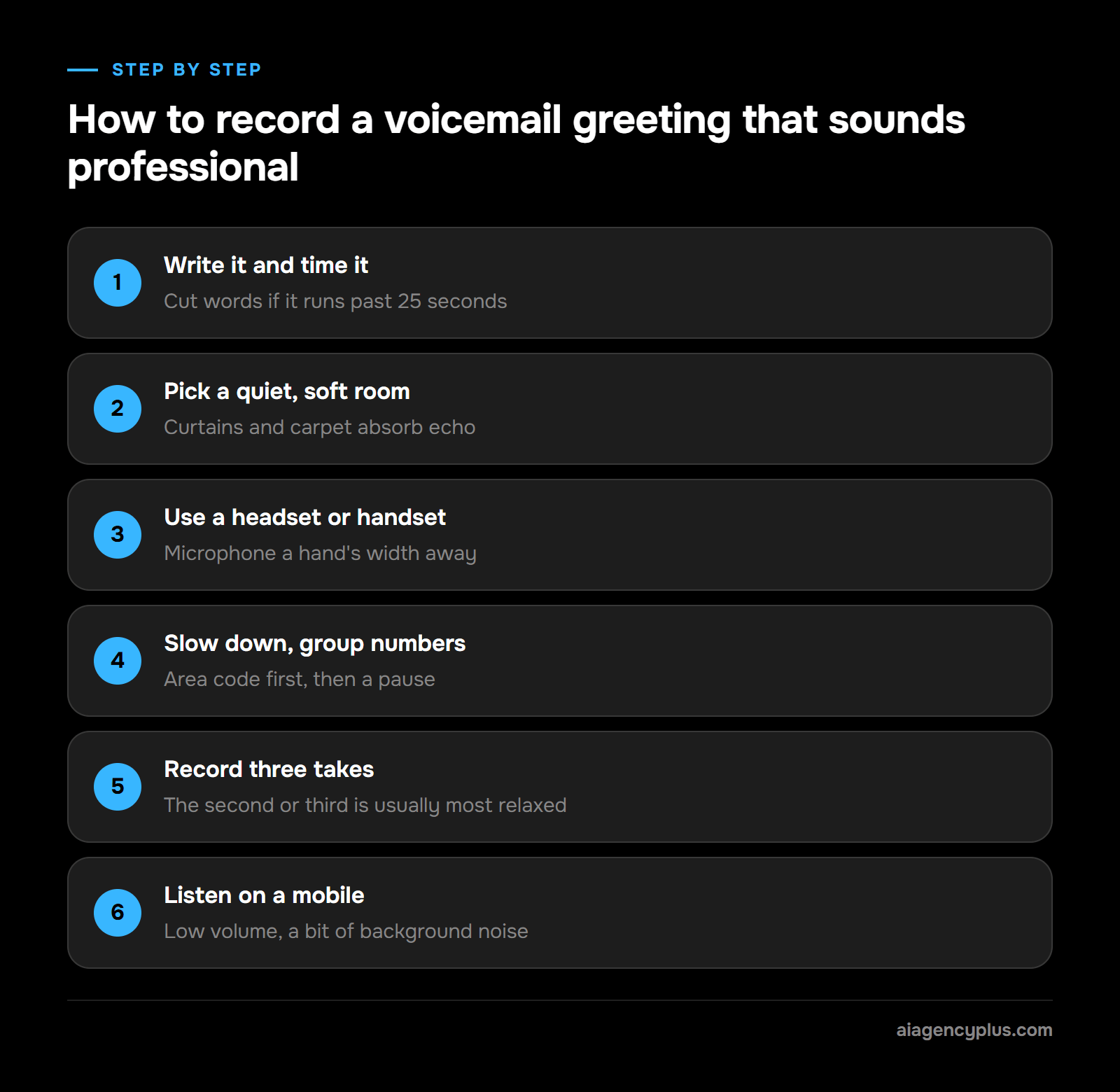
Write the script first, record it in a quiet room with soft furnishings, speak a little slower than feels natural, and listen back on a mobile before you publish it. The faults to listen for on playback are background noise, a rushed pace and mumbled phone numbers. All three are cheap to fix.
Six steps
- Script and timing. Read the script aloud with a stopwatch. If it runs past 25 seconds (30 for a trades emergency script), cut words before you record.
- A quiet, soft room. Curtains, carpet and furniture absorb echo. An empty meeting room with hard walls sounds like a stairwell.
- Headset or handset. Keep the microphone a hand's width from your mouth and switch off fans and notifications.
- Pace and numbers. Read a phone number the way people write it, area code first, with a short pause between groups. Spell out an email address if it's unusual.
- Three takes. The second or third is usually the most relaxed. Many people find that standing up and smiling makes their voice sound warmer.
- A mobile playback. Play it back through a phone speaker, at low volume, somewhere a bit noisy. If you miss a word, so will your callers.
Your voice, a colleague's or a voice artist?
For a sole trader, your own voice is best: callers expect to hear you. For an office, pick one clear speaker and use them for every greeting so the line sounds consistent.
A voice artist is worth it if your phone system plays the same greeting thousands of times a year. Many phone systems also offer text-to-speech; listen to it first, because some voices still sound flat on numbers and names.
If you're reading this because voicemail is already losing you work, skip to the last two sections. Or Book a Discovery Call and I'll tell you honestly whether a better greeting is enough on its own.
How long should a voicemail greeting be?
Aim for 15 to 25 seconds. That is long enough for your business name, a reason, what to leave and one alternative, and short enough that callers aren't waiting for the tone.
Published business guides commonly recommend 20 to 30 seconds. Abby says a greeting should be kept short, "usually between 20-30 seconds", and Nuacom's advice is "Aim for a message that’s 20–30 seconds long."
I couldn't find a UK rule or a reliable study that sets a length, so treat my figures as working targets.
| Greeting type | Working target | What usually adds time |
|---|---|---|
| General office or sole trader | 15 to 20 seconds | An email address or web address |
| Out of hours or holiday | 20 to 25 seconds | Opening hours and reopening date |
| Trades emergency | Up to 30 seconds | The safety line and an emergency number |
How to cut a greeting that runs long
- Drop 'your call is important to us' and any apology.
- Give one alternative contact, not three.
- Say 'our website' instead of reading out a long web address, if your business name makes it easy to find.
- Merge 'we can't take your call' and 'please leave a message' into one sentence.
Some phone systems limit how long a greeting can run. Check yours before recording, so the last line isn't cut off mid-word.
When should you replace voicemail?
Replace voicemail when the calls reaching it are worth more than the cost of answering them: new enquiries, quotes, bookings and emergencies, especially out of hours. Keep it when most callers are existing clients with routine questions who are happy to wait. A good greeting fixes the second case. It can't fix the first.
What the numbers say
In a BT Business/Censuswide survey of 2,000 UK adults (September 2026), 75% said they give a business three call attempts before giving up, and 58% said they would tell friends and family to avoid businesses that failed to pick up.
In a separate BT Business/Censuswide survey of 1,500 UK SME decision makers (September 2026), 67% said they miss at least one call on an average day that they believe loses them business.
The caveat: both are what people say in a survey, not measured behaviour. I also couldn't find a recent independent UK figure for how many callers actually leave a voicemail, so be wary of any confident figure you see quoted on that.
Signs voicemail is costing you work
- You return a message and the caller has already booked someone else.
- Messages sit unheard until the afternoon because everyone is busy.
- Out-of-hours calls include emergencies you need to hear about that night.
- Your call logs show missed calls with no message left.
- Your mailbox fills up over a weekend or a bank holiday.
When voicemail is still fine
If you take a handful of calls a week, mostly from clients who know you, a clear greeting from this article is enough. Spend the money elsewhere.
A natural moment to decide
Openreach said on 30/10/2026 that "only three months remain until the permanent decommissioning of the Public Switched Telephone Network (PSTN) on 31 January 2027." If you're moving to a VoIP system (Voice over Internet Protocol, calls carried over your broadband), you'll be setting up greetings and call routing anyway. Check whether your old greetings carry over, and decide then whether voicemail should still be the last stop.
What can answer instead of voicemail?
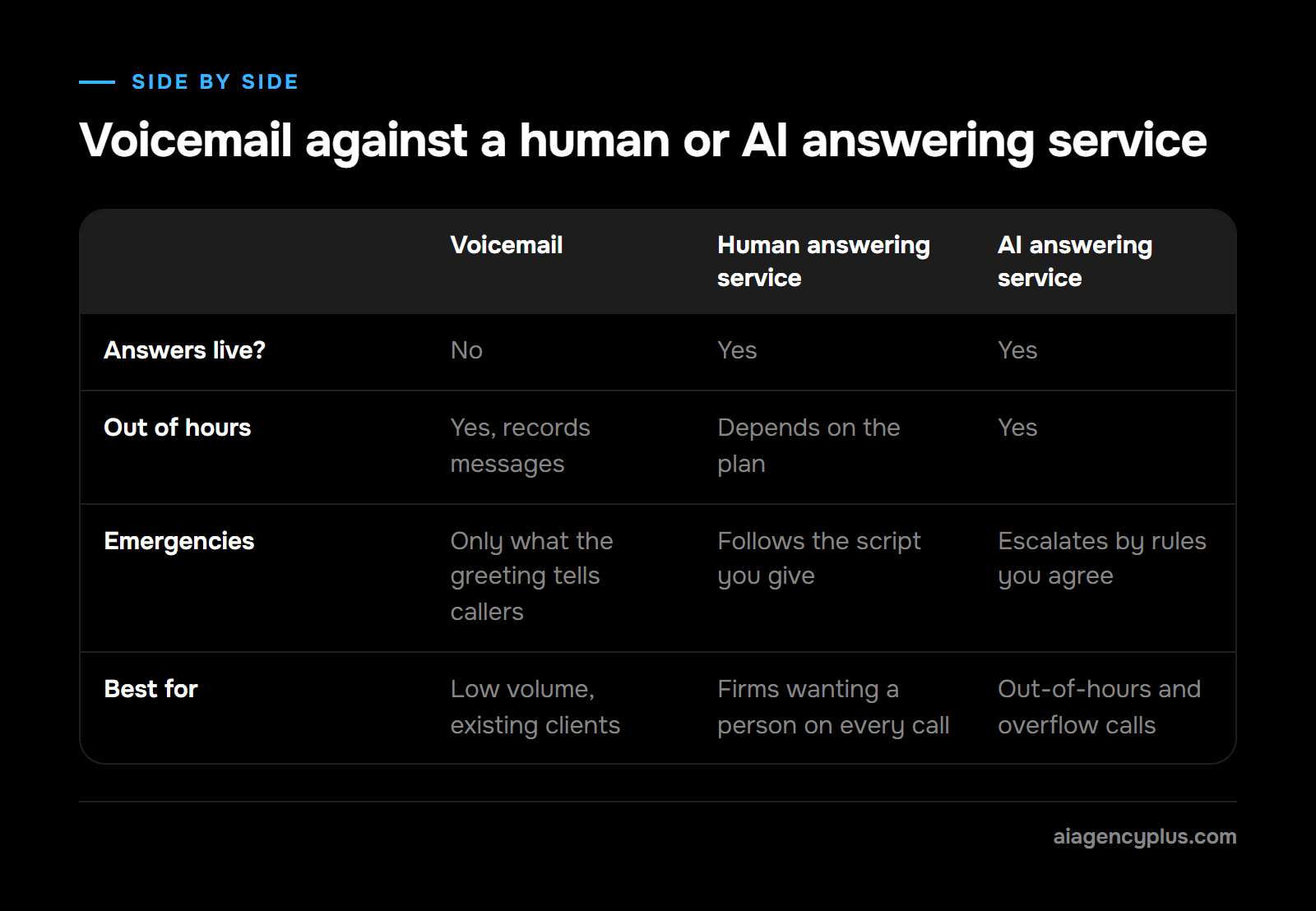
Five options can take a call your team can't: voicemail itself, forwarding to a mobile, a call queue across your team, a human answering service or an AI answering service. Each suits a different call pattern. The right one depends on when your calls arrive, how many there are and how urgent they get.
| Option | Answers live? | Out of hours | Emergencies | Best for |
|---|---|---|---|---|
| Voicemail | No | Yes, records messages | Only what the greeting tells callers | Low volume, existing clients |
| Forwarding to a mobile | Yes, if you pick up | Only if you're willing to answer | You judge each call | Sole traders with few calls |
| Call queue | Yes, during hours | No, unless someone is on call | Staff judge each call | Teams with several people free to answer |
| Human answering service | Yes | Depends on the plan | Follows the script you give | Firms wanting a person on every call |
| AI answering service | Yes | Yes | Escalates by rules you agree | Out-of-hours and overflow calls |
How our AI answering service handles an out-of-hours call
Our AI answering service answers when you can't. It escalates urgent calls by rules you agree, logs the routine ones and sends you a summary. Here's an illustrative example: a heating firm in Leeds, not a real client.
At 9.40pm on a Tuesday, a caller says her boiler has stopped and there's a newborn at home. Under the rules agreed with the firm, that's urgent. The agent escalates it to the on-call engineer and, if he doesn't answer, to the next person in the fallback chain.
At 10.15pm, another caller wants a quote for a new radiator. That can wait, so it's logged. As our service page puts it: "Captured properly, who called, what they wanted, what they expect to happen next, and waiting in your inbox at 8am rather than as a voicemail nobody transcribes."
What it does and doesn't do
It can book appointments into your calendar if you want it to. It says it's AI if a caller asks, and passes callers to a person on request. Your team still does the work and makes the return calls, with the summary in front of them.
If you're weighing it up, read what an AI virtual receptionist is, check whether it's legal to have AI answer your business calls in the UK, and see how much AI automation costs in the UK.
The short version
Write a greeting that names your business, asks callers for their details and what they need, and promises only what you'll deliver. Keep it short (the length targets above give a figure for each type), put emergency routes first and update it before every closure. If the calls hitting voicemail are new work or emergencies, Book a Discovery Call and I'll tell you which option fits, including when it's voicemail.
Frequently asked questions
What is a good professional voicemail greeting?
A good professional voicemail greeting is short, gives your business name, asks who is calling, how to reach them and what it's about, and says honestly what happens next. Most need well under half a minute and offer one alternative, such as an email address. If callers may have an emergency, the emergency instruction comes first.
What is an example of a professional voicemail greeting?
Here is one: 'Hello, you've reached [business name]. Please leave your name, number and a short reason for calling after the tone, and we'll get back to you.' The other scripts above cover sole traders, departments, closures and emergencies.
Should my greeting say when I'll call back?
Only if every message really gets a reply in that time. A promise of 'within the hour' that you miss does more harm than saying nothing. 'When we open' or 'on the next working day' is safer, as long as it's true.
How often should I update my voicemail greeting?
Update it whenever your hours, staff or contact details change, and before and after every closure. Set calendar reminders for bank holidays and the Christmas break. Listen to your own line once a month to check the greeting is still the right one.