

E-invoicing in the UK becomes mandatory on 01/04/2029. From then, the roadmap says, every VAT-registered business and public body must be able to send and receive VAT invoices as structured e-invoices over the Peppol network, unless an exemption applies. Sales to consumers and non-VAT-registered buyers are out of scope, and the 2029 rule, as the roadmap sets it out, doesn't include reporting invoice data to HMRC.
What is e-invoicing in the UK?
E-invoicing in the UK means sending a VAT invoice as structured data that your customer's software can read without anyone retyping it. From 01/04/2029, VAT-registered businesses must be able to issue and receive VAT invoices this way. The content of the invoice stays the same. The format and the route change. GOV.UK (HMRC and DBT).
The government's roadmap says the change "does not change the rules on when a VAT invoice must be issued or what it must contain" (HMRC and DBT, 28/10/2026). You still need the same VAT number, invoice date, amounts and VAT rate. You still issue the invoice at the same point you do now.
Is a PDF invoice an e-invoice?
No. A PDF is a picture of an invoice: a person or a scanning tool has to read it before the numbers reach anyone's accounts. An e-invoice is a data file in an agreed structure that software processes directly, so a PDF attached to an email will not meet the 2029 requirement.
If you want a second pair of eyes on how your invoices flow today, Book a Discovery Call.
Is e-invoicing mandatory in the UK?
Yes. E-invoicing becomes mandatory in the UK from 01/04/2029 for VAT invoices on transactions between VAT-registered businesses and public bodies. Until then the general requirement does not apply, though some public-sector customers already receive invoices over Peppol (see below). HMRC and the Department for Business and Trade (DBT) set the date and scope of the mandate in their E-invoicing implementation Roadmap, published on 28/10/2026.
Budget 2025, on 26/11/2025, announced that "all VAT invoices must be issued as an e-invoice from 2029". The roadmap that followed fixed the start date and the main design choices. GOV.UK.
The decision followed a public consultation. HMRC and DBT published 'Promoting electronic invoicing across UK businesses and the public sector' on 13/02/2025. It closed on 07/05/2025 after 12 weeks and received 342 responses. The government's response came out with Budget 2025.
Do any UK businesses have to e-invoice already?
The 2029 rule is the first general requirement for UK businesses to e-invoice each other. Public bodies covered by the Procurement Act 2023 must already accept e-invoices that meet the BS EN16931 standard, and NHS Supply Chain requires its suppliers to send e-invoices through Peppol (government consultation response, 26/11/2025).
If you invoice an NHS trust, a council or another public body, check your contract and the buyer's supplier guidance now. In the worked example below, the heating engineer's 10 monthly council invoices are the ones to check first.
Why is the government doing this?
HMRC's tax information note of 28/10/2026 says the measure "will primarily draw Exchequer benefits by helping to close the tax gap". It puts the Exchequer gain for 2029-30 at £140m, a figure certified by the Office for Budget Responsibility. GOV.UK (HMRC).
HMRC has not yet published its estimates of what the change will cost or save businesses; it says they will come with the secondary legislation, which may not be finished until Autumn 2028 or early 2029. Until it does, there is no official number for a firm your size, so treat any figure you see quoted as an estimate, not a fact.
What could e-invoicing save a small business?
For a finance team, the savings come from less retyping, fewer errors and faster payment. The roadmap cites three figures, none of which measured the 2029 rule itself:
- Time: industry research by Sage (2024) suggests the smallest businesses could save five hours and forty minutes a week by adopting e-invoicing.
- Chasing: Department for Business and Trade research (2025), cited in the roadmap, found UK businesses spend 86 hours a year on average chasing late payments.
- Payment speed: NHS Shared Business Services reports that electronic invoices are paid 26 days faster than paper or email invoices (2023 data).
Your own saving depends on how many invoices you handle and how much keying you do now. The worked example below is a better starting point than any average.
Who is in scope for e-invoicing in the UK, and who isn't?
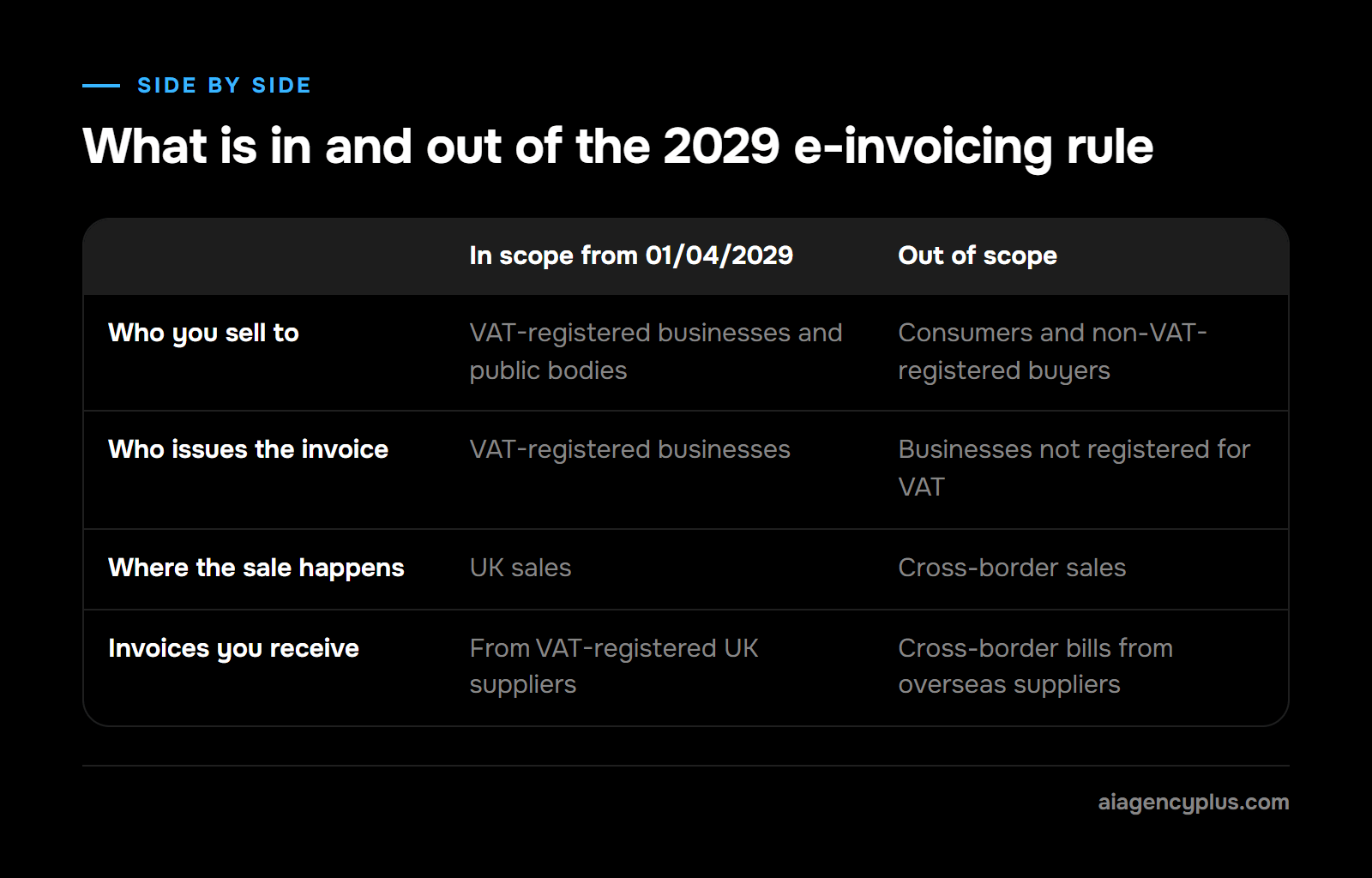
Every VAT-registered business and public body is in scope for the VAT invoices it issues and receives on business transactions. Sales to consumers, sales to businesses that are not VAT-registered, invoices from businesses that are not VAT-registered, and cross-border sales sit outside the 2029 requirement. Limited exemptions are expected, including for digitally excluded businesses, with the process due by April 2028.
In scope
- B2B VAT invoices: you sell to another VAT-registered business.
- B2G VAT invoices: you sell to a public body, such as a council or an NHS trust.
- Invoices you receive from VAT-registered UK suppliers: you must be able to receive them as e-invoices.
Out of scope
- Sales to consumers (B2C).
- Sales to anyone who is not VAT-registered, because no VAT invoice is required.
- Invoices issued by a business that is not registered for VAT.
- Cross-border sales.
If you are below the VAT registration threshold and not registered, the requirement does not cover the invoices you issue. If you register later, it will.
A worked example
Here is an illustrative firm, not a client. A VAT-registered heating engineer in Leeds sends 30 invoices a month to VAT-registered landlords and letting agents, 10 to the local council and 60 to households. It receives 25 bills a month from VAT-registered UK suppliers and 1 from a supplier in Ireland.
| Invoice | Per month | In the 2029 requirement? |
|---|---|---|
| To VAT-registered landlords and agents | 30 | Yes, issue as e-invoices |
| To the local council | 10 | Yes, issue as e-invoices |
| To households | 60 | No |
| From VAT-registered UK suppliers | 25 | Yes, must be able to receive |
| From the supplier in Ireland | 1 | No, cross-border |
So 65 of this firm's 126 monthly invoices fall inside the rule: 40 going out and 25 coming in. The 60 household invoices can carry on as they are. That split is the first thing I'd want any business to know about itself.
How will UK e-invoicing work?
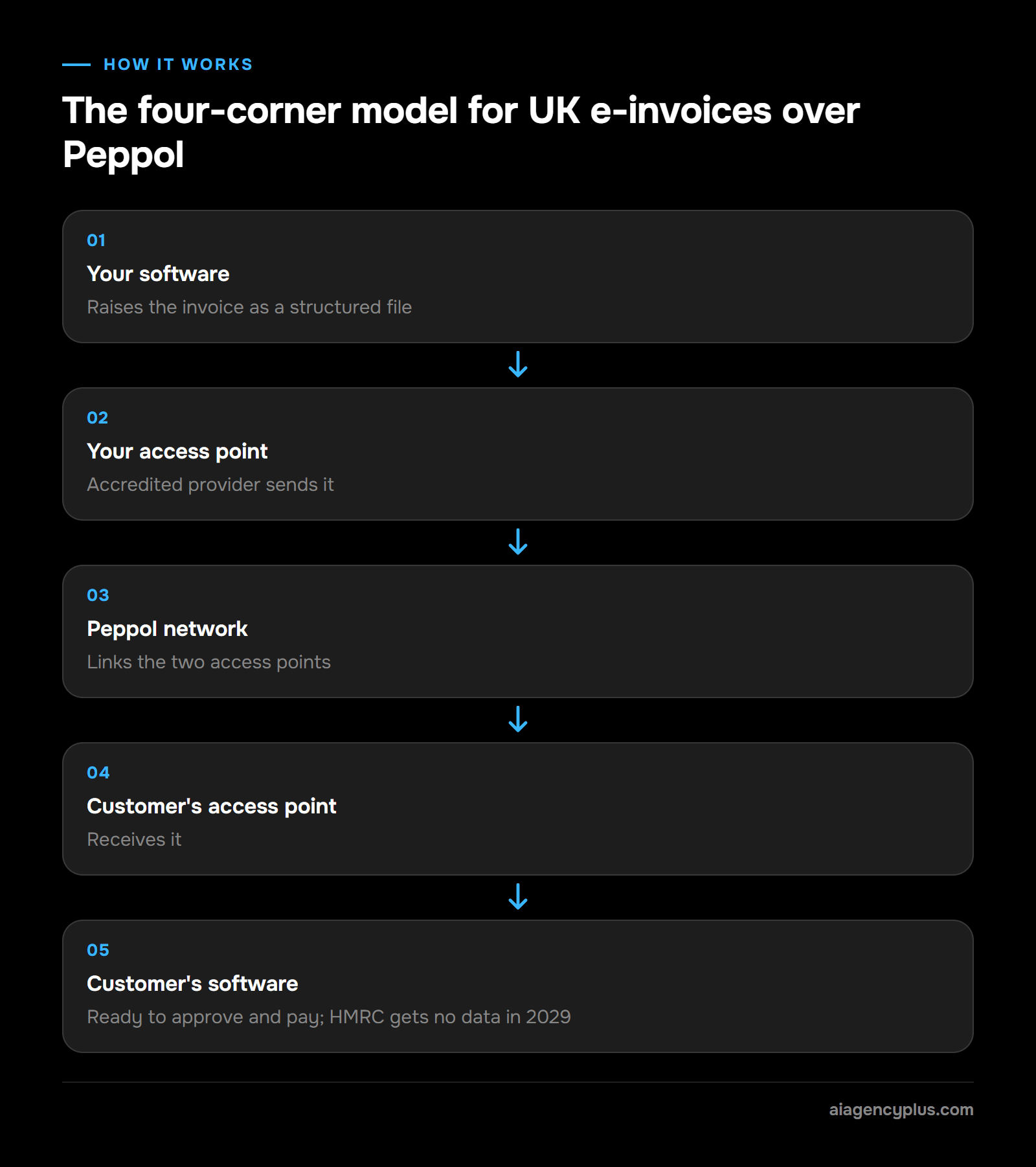
Your invoice leaves your software as a structured data file and travels over Peppol, an international network for exchanging business documents. It goes through an accredited service provider, known as an access point, to your customer's provider, which delivers it into their system. The government expects software providers to have completed any required accreditation with the UK Peppol Authority by 01/04/2029.
In practice, the route looks like this:
- You raise the invoice in your accounting or invoicing software, as now.
- The software produces a structured e-invoice file.
- Your access point sends it over the Peppol network.
- Your customer's access point receives it.
- It lands in your customer's system, ready to approve and pay.
This is often called the four-corner model: your software, your access point, your customer's access point and your customer's software, with Peppol linking the two access points. HMRC does not receive the invoice data under the 2029 rule. HMRC will become the UK Peppol Authority, which will not receive copies of business VAT invoices; the date of the handover isn't set yet.
For many firms the access point may come through the accounting software they already use. Whether yours will depends on your provider's plans, so ask rather than assume. The roadmap sets provider milestones: management requirements in Spring 2028, readiness testing in Summer 2028 and infrastructure live in Winter 2028.
Will HMRC see every invoice I send?
Not under the 2029 requirement as the roadmap sets it out: it doesn't include reporting invoice data to HMRC. HMRC opened an exploratory consultation, 'E-invoicing digital reporting', which runs from 28/10/2026 to 20/01/2027. GOV.UK (HMRC).
HMRC's own words: "No decision has been taken to introduce digital reporting and the government has not developed a preferred model." Reporting may come later, or it may not. Anyone telling you it is certain is ahead of the facts.
How does e-invoicing relate to Making Tax Digital?
If you are VAT-registered, Making Tax Digital (MTD) for VAT already requires you to keep digital VAT records and file VAT returns through compatible software. E-invoicing builds on those digital records.
The 2029 rule changes how invoices travel between businesses and leaves MTD filing as it is. Your VAT return still goes to HMRC the way it does now; the invoices behind it simply arrive and leave as structured data.
What is the UK e-invoicing timeline to April 2029?
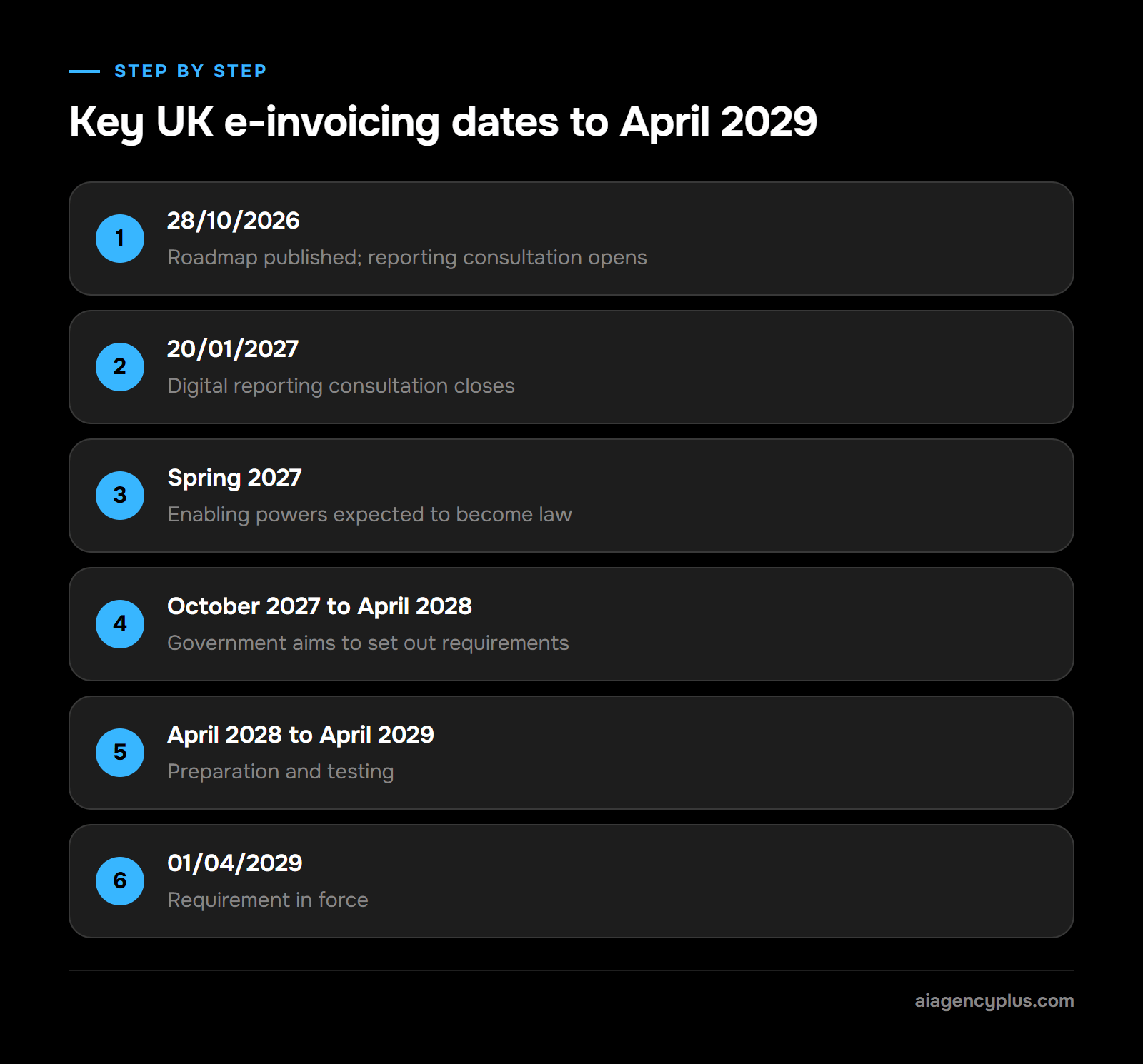
The start date is 01/04/2029, but most of the implementation detail arrives between now and then. The key window for small firms is October 2027 to April 2028, when the government aims to publish the compliance requirements. Preparation and testing then run from April 2028 to the start date.
| Date | Milestone |
|---|---|
| 13/02/2025 | Consultation published (closed 07/05/2025, 342 responses) |
| 26/11/2025 | Budget 2025 announces e-invoicing from 2029; consultation response published |
| 28/10/2026 | Roadmap published; digital reporting consultation opens |
| 20/01/2027 | Digital reporting consultation closes |
| Spring 2027 | Enabling powers expected to become law |
| Spring 2027 | Public technical consultation on the UK e-invoicing standards |
| To October 2027 | Detailed design work |
| October 2027 to April 2028 | Government aims to set out compliance requirements |
| Spring 2028 | Management requirements for software providers |
| April 2028 to April 2029 | Preparation and testing |
| Summer 2028 | Software provider readiness testing |
| Winter 2028 | Infrastructure live |
| Autumn 2028 or early 2029 | Detailed secondary legislation may be finished |
| 01/04/2029 | Requirement in force; providers expected to have completed accreditation with the UK Peppol Authority |
How I'd read it
2027 is for understanding your own invoice flows and cleaning your data. Once the requirements are published, from spring 2028, choosing or confirming software makes sense, because you will know the rules it must meet.
Note the gap at the end. The detailed secondary legislation may not be finished until Autumn 2028 or early 2029, so some fine print could arrive late.
What is decided about UK e-invoicing, and what is still open?
Decided: the start date, who is in scope, that invoices travel over Peppol, that invoice content rules stay the same and that the 2029 rule, as set out, doesn't include reporting to HMRC. Still open: specific exemptions, the technical standards, penalties, accreditation detail, business cost estimates and whether digital reporting ever arrives.
| Question | Status | What we know (28/10/2026) |
|---|---|---|
| Start date | Decided | 01/04/2029 |
| Who must comply | Decided | VAT-registered businesses and public bodies, unless an exemption applies |
| Network | Decided | Peppol, through accredited providers |
| Invoice content rules | Decided | Unchanged |
| Digital reporting to HMRC | Not in the 2029 rule as set out | Exploratory consultation to 20/01/2027; no decision taken |
| Exemptions | Open | Limited exemptions expected, including for digitally excluded businesses; process due by April 2028 |
| Technical standards | Open | Public technical consultation from Spring 2027 |
| Penalties | Open | Planned to build on the existing VAT invoice penalties |
| Accreditation process | Open | Detail to come; providers expected to be accredited by 01/04/2029 |
| Business costs and savings | Open | HMRC estimates not yet published |
So the position today is clear on the what and the when. It is not yet clear on the exact rules your software must meet, which exemptions exist or what happens if you miss the date.
That is why I'd be wary of any finished compliance product sold now. Plan with the decided items and keep the open ones on your watch list.
What should a small business do now?
Map your invoices, clean your customer data and ask your finance software provider about its compliance plans. Don't buy anything yet: the requirements software must meet are due between October 2027 and April 2028, and providers are expected to be accredited by 01/04/2029. Anything bought today is being chosen before its rules exist.
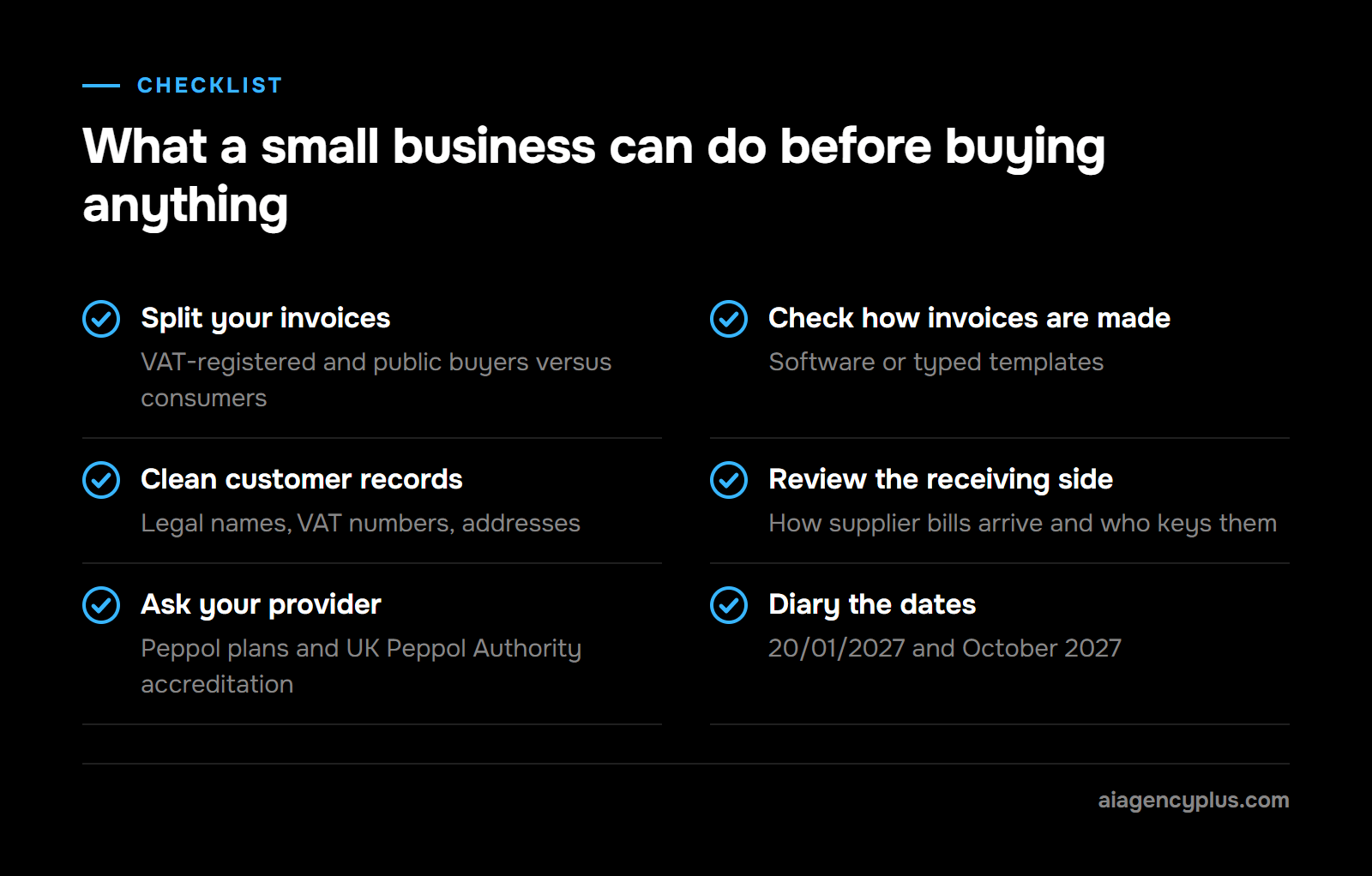
Six steps for the next twelve months
- Split your invoices: count how many go to VAT-registered businesses and public bodies, and how many go to consumers. The worked example above shows how.
- Check how invoices are made: invoices raised in accounting software are a better starting point than ones typed into Word or Excel templates.
- Clean customer records: correct legal names, VAT numbers and addresses now, because structured invoices depend on accurate data.
- Look at the receiving side: note how supplier bills arrive and who keys them in. Our guide to accounts payable automation covers the paying side.
- Ask your provider two questions: does it plan to offer Peppol e-invoicing, and does it expect accreditation with the UK Peppol Authority before 01/04/2029?
- Diary the dates: 20/01/2027 if you want a say in the digital reporting consultation; October 2027 for the published requirements.
When to do nothing yet
If you are not VAT-registered, the requirement does not apply to the invoices you issue. Keep an eye on it if you are close to the VAT registration threshold.
If retyping data between systems is your bigger problem today, start with my guide, what is business process automation.
Where does automation help around e-invoicing?
The mandate changes how an invoice travels between two systems. Chasing overdue invoices, matching payments to invoices and getting supplier bills approved still sit with you. That work is where a workflow helps, and it does not depend on the e-invoicing standards, so it can start well before 2029.
At AI Agency Plus I build business process automation for UK SMEs: invoices, approvals, reports and the rekeying between systems. Around invoicing, that means a workflow that sends payment reminders on a schedule, flags what is overdue and matches incoming payments against open invoices. A first build runs £1,500 to £5,000 plus VAT.
My advice on timing is plain. Build the chasing and reconciliation now if they cost you hours each week. Leave the e-invoicing connection itself until the requirements are published, and use an accredited provider for the Peppol side.
For a fuller view of what automation projects cost, see how much AI automation costs in the UK.
The short version
From 01/04/2029, VAT invoices between VAT-registered businesses and public bodies must go as e-invoices over Peppol. The rules your software must meet are expected from late 2027 into spring 2028, so map your invoices and clean your data now, and leave buying until then. If you want a second pair of eyes on your invoice flows, Book a Discovery Call.
Frequently asked questions
Do I already have to e-invoice public-sector customers?
Not under any general UK rule before 2029. NHS Supply Chain already requires its suppliers to send e-invoices through Peppol, and public bodies covered by the Procurement Act 2023 must accept e-invoices. Check your contract and the buyer's supplier guidance if you invoice a public body.
How does e-invoicing relate to Making Tax Digital?
MTD for VAT already means digital VAT records and compatible software. E-invoicing adds a structured format and the Peppol route for the invoices themselves. The 2029 rule leaves how you file VAT returns under MTD as it is.
Do I need new software for e-invoicing?
Possibly, but not yet. You will need software or a service that can send and receive e-invoices over Peppol through an accredited provider, and the government expects providers to have completed accreditation with the UK Peppol Authority by 01/04/2029. The requirements are expected from late 2027, so check your current provider's plans before you switch.
What if my business is not VAT-registered?
The 2029 requirement does not cover invoices issued by businesses that are not registered for VAT. Suppliers selling to you do not need to send you a VAT invoice either, because none is required for a supply to someone who is not VAT-registered. If you register for VAT later, the rule applies from then.
Are there penalties for not using e-invoicing?
The details have not been published yet. The roadmap says that, as far as possible, the government plans to use the existing VAT invoicing penalties framework as a basis, with obligations and guidance due by April 2028.