

Credit control is how a business decides who gets credit, on what terms, and how it makes sure it gets paid on time. For a UK small business it comes down to seven steps: check the customer, set written terms, invoice fast, send a reminder before payment is due, chase, escalate with statutory interest, then take formal action.
What is credit control?
Credit control is the checks and habits that decide who can buy from you on credit, how much they can owe, when they pay and what happens when they don't. In accounting, it means managing your sales ledger (accounts receivable): the money customers owe you for work already done. Some firms call the wider job credit management.
In a small business, credit control usually sits with the owner, a bookkeeper or the office manager. Larger organisations employ a credit controller, often in the finance team, to run it full time. The job is the same either way: get paid on time without losing good customers.
Effective credit control starts before the sale. Debt collection is only its last stage, when an invoice is already badly overdue.
This guide covers business-to-business credit in the UK: selling to companies, partnerships and sole traders on credit terms. It does not cover consumer debts, or the banking meaning of credit control, where a central bank manages lending across the economy.
Why does credit control matter for a small business?
Every invoice you send is an interest-free loan to your customer until they pay it. For a small business, two or three slow payers can leave you short of cash for wages, VAT and suppliers, even while the profit and loss account looks healthy. Credit control manages that financial risk and flags risky customers early.
How late payment hits your cash flow
Cash flow is the money moving in and out of your bank account each week. Late payment has its biggest impact here: the work is done and your costs are paid, but the customer's money has not arrived.
Good credit control does three jobs:
- Shortens the wait: clear terms and early reminders mean fewer invoices drift past their due date.
- Limits the damage: credit limits cap how much any one customer can owe you if they fail.
- Protects your rights: written terms, records and a timetable put you in a strong position if you need statutory interest or a court claim.
Published estimates of what late payment costs UK small businesses vary widely, so I am not quoting one. Your own aged debt report gives the figure that matters.
What are the steps in a credit control process?
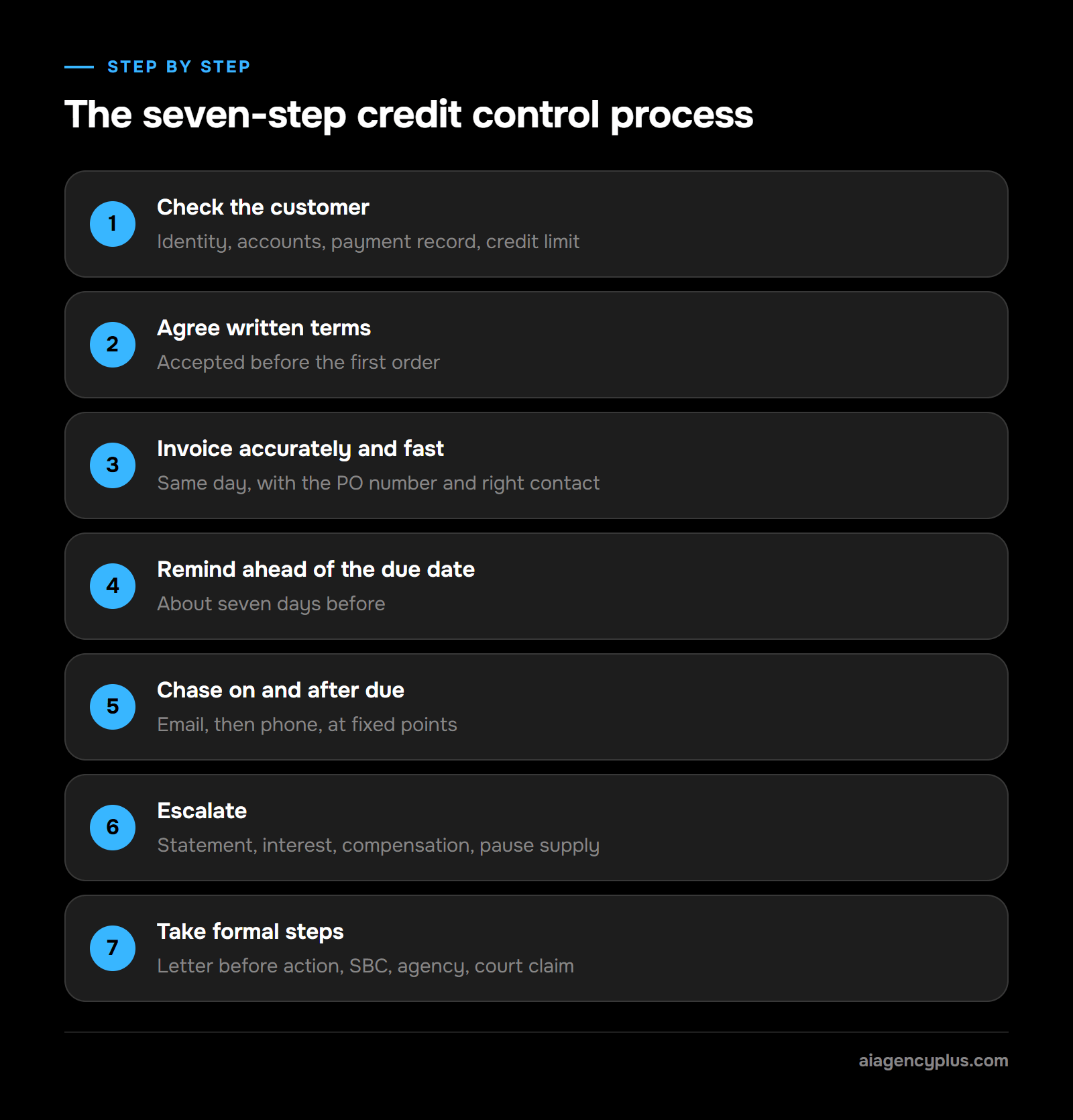
A workable credit control process for a UK small business has seven steps, in this order. Each one makes the next easier, and skipping the early ones is why chasing feels so hard later. You can run all seven with an accounting package, a calendar and a written set of terms.
- Check the customer: confirm who they are, look at their filed accounts and payment record, and set a credit limit.
- Agree terms in writing: payment period, interest, stop-supply rights and a deadline for queries, accepted before the first order.
- Invoice accurately and fast: send it the day the work is done or the goods ship, with the purchase order number, the right contact and your bank details.
- Remind ahead of the due date: a short, friendly email about seven days beforehand.
- Chase on and after the due date: email, then phone, at fixed points, a little firmer each time.
- Escalate: written warning of statutory interest and suspension, a pause on supply when the warning date passes, then a final notice.
- Take formal steps: letter before action, the Small Business Commissioner, a debt collection agency or a court claim, plus VAT bad debt relief once you qualify.
The written policy that ties these steps together is covered in its own section further down.
Who owns each step
Give every step a named owner, even if it is the same person. In a five-person firm, sales might own step 1, the owner signs off step 2, and the office manager runs steps 3 to 6. Step 7 is the owner's decision, because it can end the customer relationship.
Why step 3 matters more than it looks
Many late payments start with a fixable invoice issue: a missing purchase order number, the wrong contact or a total that does not match the quote. The customer's finance team cannot approve it, so it sits. Check every invoice against the order before it goes.
If you would rather talk through your own process with me, Book a Discovery Call.
How do you check a customer before giving credit?
Check a new business customer before credit is extended by confirming their legal identity, reading their filed accounts and payment record, and setting a credit limit you could afford to lose. A small one-off order needs a quick check. A large or repeat account justifies a paid credit report as well.
The aim is to judge credit risk: the chance that this customer pays late or not at all.
Free checks
- Companies House: search the register on GOV.UK for the company's exact name, number, status, directors and whether its accounts are overdue. Overdue filings are a warning sign.
- Payment practice reports: large UK businesses must publish these at least twice a year, showing "the average time it takes for a large business to pay its suppliers" and the share of invoices they paid late. You can search them on GOV.UK before you agree terms with a big customer. GOV.UK.
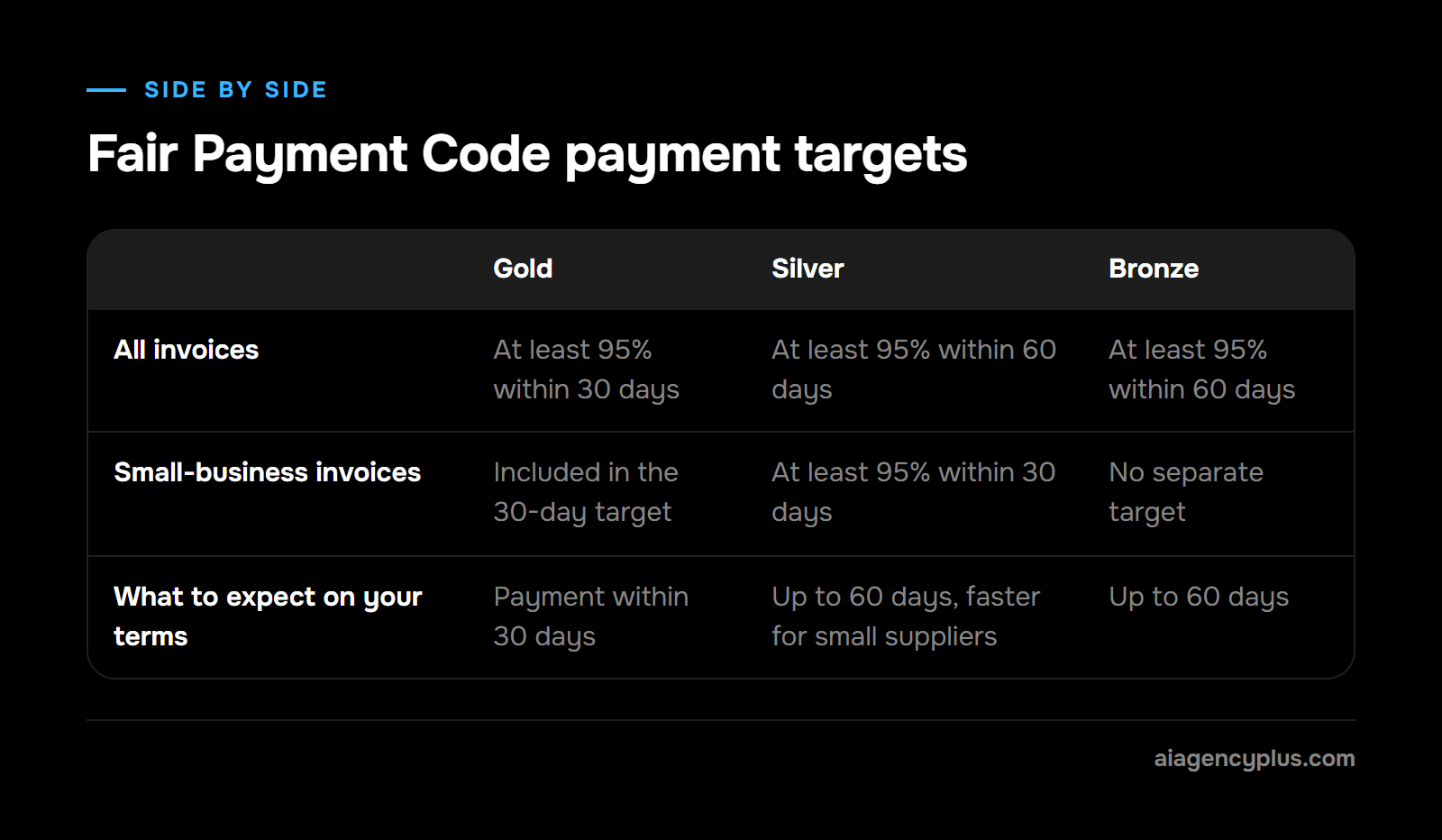
- The Fair Payment Code: the Office of the Small Business Commissioner runs this voluntary code. A signatory has publicly committed to one of the payment targets in the table below.
| Fair Payment Code award | Payment target |
|---|---|
| Gold | At least 95% of all invoices within 30 days |
| Silver | At least 95% of all invoices within 60 days, and 95% of small-business invoices within 30 days |
| Bronze | At least 95% of all invoices within 60 days |
Source: Small Business Commissioner, code criteria, read 08/11/2026.
Paid checks
Credit reference agencies such as Experian, Equifax and Creditsafe sell business credit reports with a score, filed accounts, county court judgments and a suggested limit. Hilton-Baird Collections notes that credit reports are available "for as little as £10 per report" (credit control tips page, undated, read 08/11/2026). Use one when the first order, or the limit you are considering, is more than you could absorb as a loss. Hilton-Baird Collections.
Credit application and limit
Ask new accounts for a short credit application: legal name, company number, invoice address, accounts payable contact, purchase order process and the date of their payment run. Set a limit, write it down and review it after three months.
If a new order exceeds the customer's limit, hold it until you have reviewed the account or taken part payment. For a new limited company with no filed accounts, consider a smaller limit, part payment upfront or a director's personal guarantee.
What should your payment terms say?
Your payment terms should state the exact payment period, the date it runs from, how to pay, the interest and fixed sums you will charge if payment is late, your right to pause supply, and the deadline for raising queries. Put them in writing and get them accepted before the first order, not after it.
What the law sets for credit terms
If you agree no payment date, GOV.UK puts it plainly: "If you do not agree a payment date, the law says the payment is late 30 days after either" the customer gets the invoice or the goods or service are delivered, whichever is later. An agreed payment date must usually be within 60 days for business-to-business deals and 30 days for public authorities, and can be longer than 60 days only if that is fair to both sides. GOV.UK.
What is planned, and what is not law yet
The Small Business Protections Bill (formally the Commercial Payments Bill [HL]), introduced in the House of Lords on 19/05/2026, would put a 60-day cap on payment terms for large firms paying smaller suppliers and make late payment interest mandatory. It completed its Lords stages on 20/10/2026 and is now in the House of Commons, according to the parliament.uk Bills page (read 08/11/2026). It is not yet law; write your terms to today's rules. GOV.UK. UK Parliament.
Clauses to include
| Clause | Example wording (illustrative) |
|---|---|
| Payment period | Payment is due 30 days from the invoice date. |
| How to pay | Bank transfer to the account on the invoice, quoting the invoice number. |
| Late payment | We may charge interest and compensation under the Late Payment of Commercial Debts (Interest) Act 1998. |
| Suspension | We may pause work or deliveries on any account more than 14 days overdue. |
| Queries | Raise any invoice query within 7 days of receipt. |
| Ownership of goods | Goods remain ours until paid for in full. |
Get the terms accepted on a signed quote, an order form or an acceptance email. Terms printed only on the invoice may arrive too late to form part of the contract.
When and how should you chase an overdue invoice?
Chase to a fixed timetable that begins before the invoice falls due. Send a friendly reminder about a week ahead, a note on the due date, then emails and phone calls at set points afterwards, each a little firmer. A timetable you follow every time beats chasing whenever someone remembers.
| When | Action | Tone |
|---|---|---|
| 7 days before due | Email reminder with the invoice attached | Friendly |
| Due date | Payment due today email | Neutral |
| 3 days overdue | Phone the accounts contact and ask for a payment date | Helpful |
| 7 days overdue | Second email and call, plus a statement of account | Firm |
| 14 days overdue | Call your main contact as well as accounts; give written warning of suspension and interest, with a date | Firm |
| Warning date passes | Pause supply, as your suspension clause allows | Firm |
| 30 days overdue | Final notice in writing with a deadline before formal steps | Formal |
The days in this table are an illustrative timetable: adjust them to your own payment period. The order matters more than the exact days. The pause supply section below sets out when stopping is safe.
Check the bank before you chase
Before each reminder or call, check your bank feed for the payment. Chasing an invoice that has already been paid annoys a good customer and wastes your time. Match payments to invoices daily if you can.
How to stay professional and still get paid on time
Keep the tone polite and professional at every stage, even when you are being firm. A customer who usually pays on time and slips once needs a reminder, not a warning letter. Thank customers who pay promptly: it costs nothing and keeps the relationship easy.
What to say on the phone
Ask three questions. Have you got the invoice? Is anything stopping it being approved? When is your next payment run?
Write down the answer, the person's name and the promised date. Confirm it by email the same day.
Common excuses and the answer
| Excuse | Your response |
|---|---|
| We never received it | Resend it during the call and confirm the address |
| There's no PO number | Ask for it, reissue the invoice and agree a date |
| It's in the next payment run | Ask for the date and log it |
| The person who signs is away | Ask who approves in their absence |
| There's a query | Find out what it is, fix it in writing and ask for the undisputed part now |
Keep a record of every contact
Log every reminder, call and promise against the invoice: the date, who you spoke to and what they said. If the debt ever reaches court, this record shows you acted reasonably.
What can you do when a customer still won't pay?
Escalate in order: give written warning of statutory interest and suspension, pause supply when the warning date passes if your terms allow, then send a final notice. After that comes a letter before action and, if needed, a court claim. Small businesses can also get free guidance from the Commissioner along the way.
Charge statutory interest and compensation
For business-to-business debts, statutory interest is "8% plus the Bank of England base rate". The base rate used is fixed twice a year: the rate in force on 30 June applies to interest that starts running between 1 July and 31 December, and the rate on 31 December covers interest starting between 1 January and 30 June. GOV.UK. legislation.gov.uk.
Bank of England figures (read 08/11/2026) show Bank Rate was 3.75% on 30/06/2026 and rose to 4% on 05/11/2026. Adding 8% to 3.75% gives a statutory rate of 11.75% for interest that starts running between 01/07/2026 and 31/12/2026. The rise to 4% only counts for interest starting from 01/01/2027, and only if Bank Rate is still 4% on 31/12/2026. Bank of England.
On top of interest, the Late Payment of Commercial Debts (Interest) Act 1998 lets you claim a fixed sum for each late invoice, set by the size of the debt, as the table below shows. You can also claim reasonable recovery costs above that fixed sum. legislation.gov.uk.
If your contract sets its own late payment interest rate, that rate normally applies instead, as long as it is a substantial remedy for late payment. A token rate can be set aside in favour of statutory interest.
| Size of debt | Fixed sum |
|---|---|
| Less than £1,000 | £40 |
| £1,000 or more, but less than £10,000 | £70 |
| £10,000 or more | £100 |
Worked example
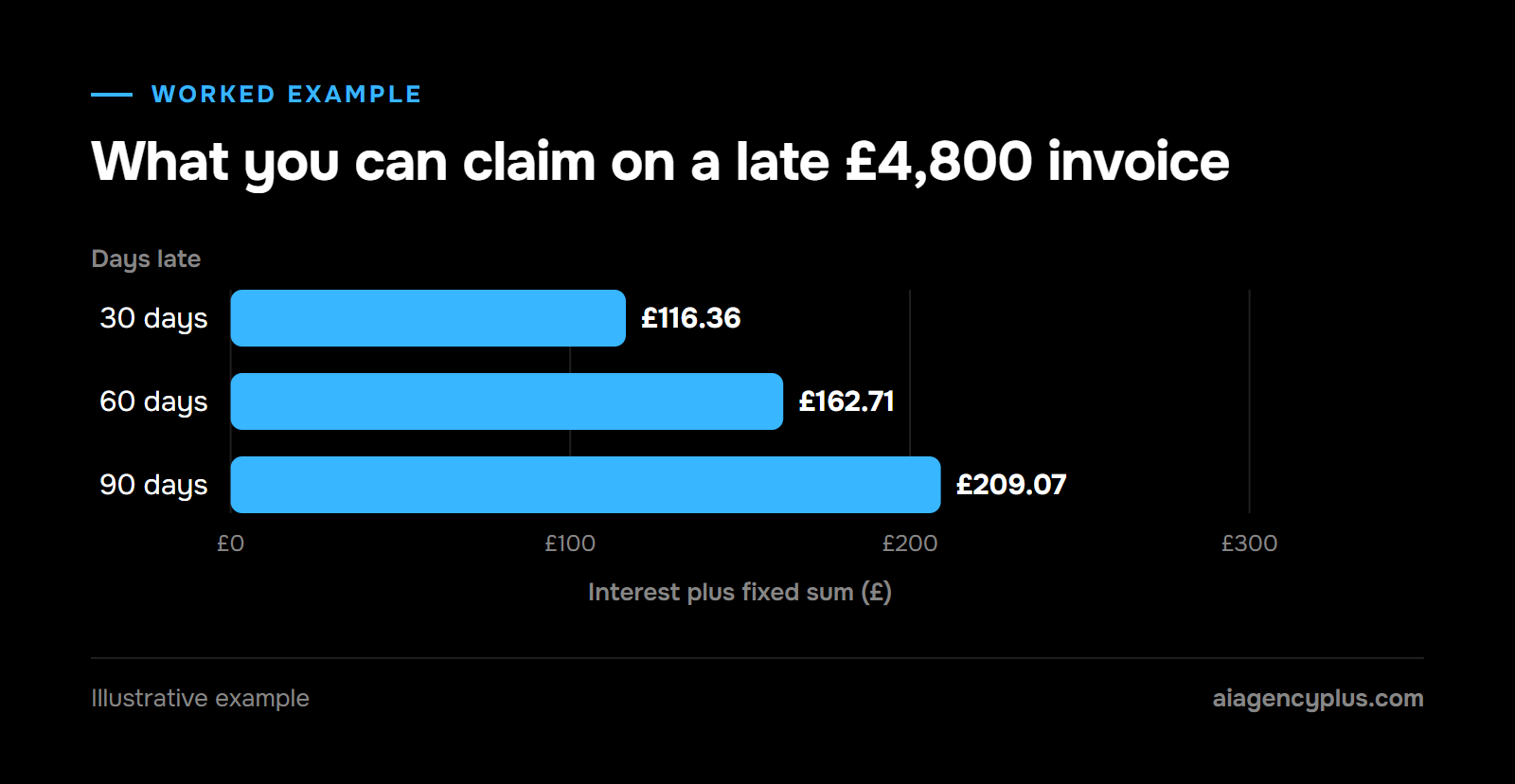
Say you invoice £4,000 plus VAT, so £4,800 in total, on 30-day terms. Interest starts running on 01/10/2026, at 11.75%.
- Daily interest: £4,800 × 11.75% ÷ 365 = £1.5452
- 30 days late: £46.36 interest plus £70 = £116.36
- 60 days late: £92.71 interest plus £70 = £162.71
- 90 days late: £139.07 interest plus £70 = £209.07
Whether you claim it is a commercial choice. One common approach is to state the figure in the final notice and waive it if payment arrives by the deadline.
Pause supply
Stop supplying when the date in your written warning passes, as your suspension clause allows. If the customer has gone into administration or another insolvency process, take advice before you stop supply.
Formal steps
- Letter before action: set out the debt, interest and fixed sum, and give a clear deadline, such as 14 days, before you go to court. If your customer is a sole trader, the Pre-Action Protocol for Debt Claims applies and gives them 30 days to reply.
- Small Business Commissioner: "Information, guidance, and our complaint scheme is free and available to all small businesses with fewer than 50 employees", according to the Commissioner's FAQs (read 08/11/2026). Small Business Commissioner.
- Debt collection agency: agencies charge fees or commission on what they recover, so get the terms in writing first.
- Court claim: use GOV.UK's Make a money claim service, or a solicitor for larger or disputed debts.
Reclaim the VAT on a bad debt
If you have paid VAT to HMRC on an invoice that is never paid, you can usually reclaim it as bad debt relief once the debt is more than six months overdue and you have written it off in your VAT records. HMRC's VAT Notice 700/18 sets out the full conditions, including the time limit for making the claim. HMRC.
Should you run credit control yourself, hire a credit controller or outsource it?
Run credit control yourself while your aged debt report is mostly current and chasing fits into a few hours a week. Hire a credit controller, or outsource, when chasing starts crowding out other work or debt over 60 days keeps growing. Indeed's salary page (updated 02/11/2026, read 08/11/2026) gives the average credit controller salary in the UK as £28,696 per year, based on 5.6k salaries reported in job postings on Indeed over the past 36 months. Indeed.
Signs you have outgrown doing it yourself
- Older bands are growing: more of your aged debt sits in the 61 to 90 and over 90 day bands each month.
- Chasing slips: reminders go out late or not at all because the person who sends them is busy elsewhere.
- Chasing eats the week: calls, queries and payment matching take up a large share of someone's working time.
| Option | When it fits | Cost to weigh |
|---|---|---|
| Run it yourself | Aged debt mostly current; chasing fits around other work | Your own time |
| Hire a credit controller | Chasing fills much of someone's week; debt over 60 days keeps growing | £28,696 per year average UK salary (Indeed, updated 02/11/2026, from 5.6k salaries in job postings) |
| Outsource | Too little volume for a full-time role, or nobody free to chase | Fees or commission; get the terms in writing |
Skills to look for in a credit controller
Look for someone comfortable on the phone, accurate with figures and at ease in your accounting software. Calm persistence gets more invoices paid than a hard tone.
Outsourced credit control usually chases current and recently overdue invoices on your behalf, earlier than the debt collection agency in the formal steps above. Ask whether they contact customers in your name or theirs, and what they charge.
Before hiring for the role, check whether automating the routine reminders closes the gap. The automation section below covers that option.
What should a credit control policy include?
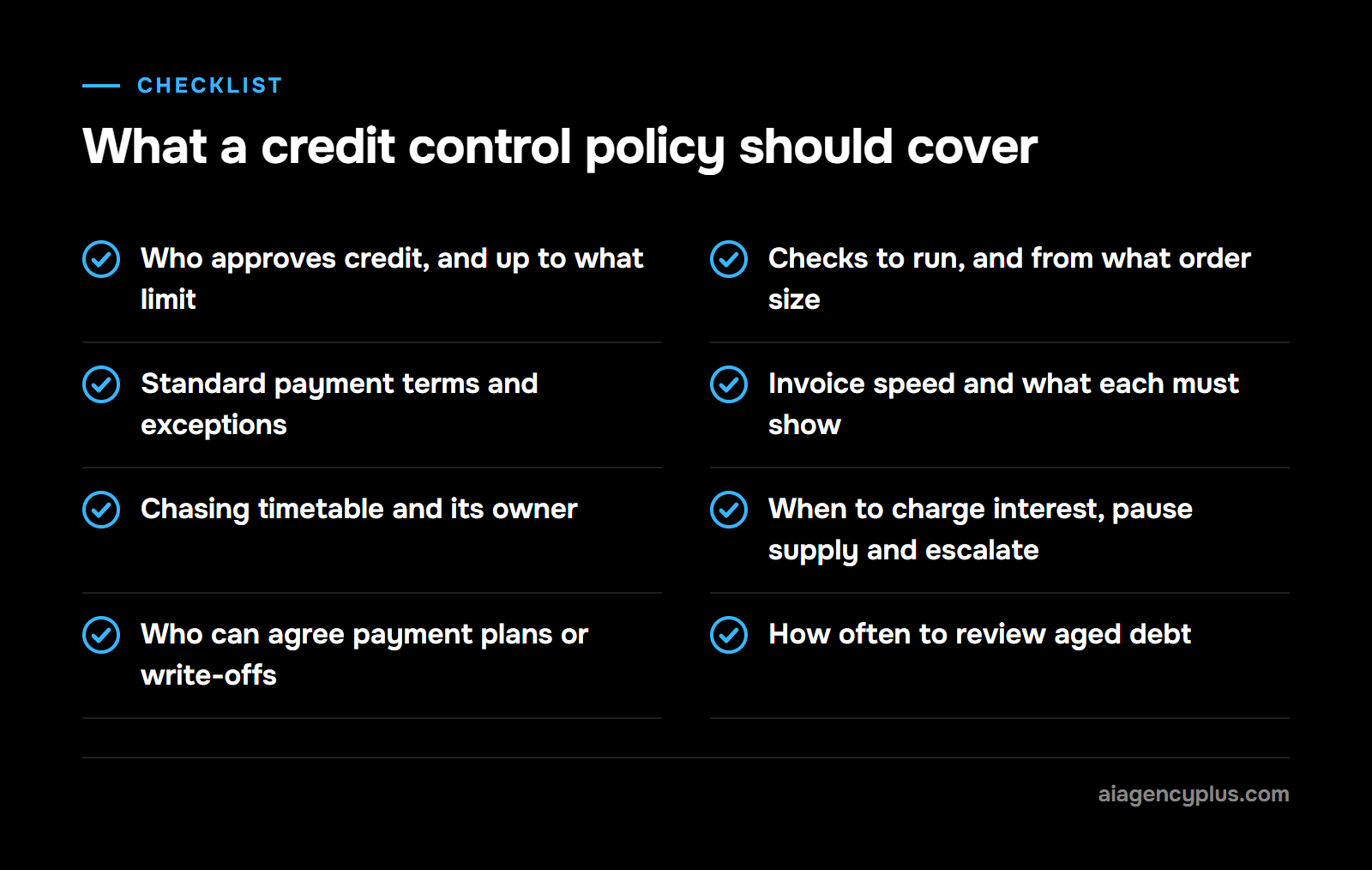
A credit control policy is a one or two page written procedure that says who gets credit, how much, on what terms and what happens at each stage of late payment. It means anyone in the team runs the process the same way, and every customer hears the same rules.
- Who can approve credit, and up to what limit
- What checks you run, and from what order size
- Your standard payment terms, and when you allow different ones
- How fast invoices go out, and what each must show
- Your chasing timetable and who owns it
- When you charge interest, pause supply and escalate
- Who can agree a payment plan or write off a debt
- How often you review the aged debt report
Review the sales ledger weekly
Group what you are owed in the sales ledger into bands: current, 1 to 30 days overdue, 31 to 60, 61 to 90 and over 90. Watch for customers moving into older bands. That movement usually shows trouble before a missed promise does.
Which parts of credit control can you automate?
Accounting packages such as Xero, QuickBooks and FreeAgent offer invoice reminder features; check what your plan includes. If you send a handful of invoices a month, that plus a weekly look at the aged debt report is enough. You do not need a custom build.
As volume grows, the gaps tend to sit between systems: bank payments nobody matches, replies to reminders lost in an inbox, promised dates nobody logs. That is where business process automation earns its place.
At AI Agency Plus we build workflows for UK SMEs that send reminders on your timetable, log responses, match payments to invoices and produce a weekly aged debt report. Phone calls, payment plans and stop-supply decisions stay with a person. A first build runs £1,500 to £5,000 plus VAT; my guide to AI automation costs in the UK explains what drives the price.
If automation is new to you, start with what business process automation is. For the paying side of your ledger, see accounts payable automation.
What matters most in credit control?
Most credit control is settled before the invoice goes out: check the customer, get your terms accepted in writing and invoice accurately the same day. After that, a fixed chasing timetable, statutory interest and clear escalation steps do the rest.
Frequently asked questions
What is credit control in accounting?
In accounting, credit control is the management of the sales ledger, also called accounts receivable. It covers setting credit limits, recording invoices, matching payments and tracking how old each unpaid debt is. Its main output is the aged debt report, which shows what each customer owes and for how long.
What does a credit controller do?
A credit controller makes sure customers pay on time without losing good accounts. Day to day, they check new customers, set credit limits, chase overdue invoices by email and phone, resolve invoice queries, agree payment plans and report on aged debt. In a small business the owner or office manager usually does this alongside other work.
When should you stop supplying a customer who hasn't paid?
Only stop if your payment terms include a suspension clause; without one, stopping could put you in breach of contract. Where you have one, act once the account passes its trigger and the customer has had written warning. If the customer is in an insolvency process, take advice first.
Can you charge interest on late payments in the UK?
Yes. Between businesses you can charge statutory interest at 8% plus the Bank of England base rate, which is 11.75% for interest that starts running between 01/07/2026 and 31/12/2026. You can also claim a fixed sum of £40, £70 or £100 per invoice depending on its size, plus reasonable recovery costs. A late payment rate written into your contract normally applies instead, provided it is a substantial remedy.
When can you reclaim VAT on an invoice that was never paid?
You can usually claim relief when the debt is over six months overdue, you have already paid the VAT to HMRC and you have written the debt off in your VAT records. HMRC's VAT Notice 700/18 sets out the full conditions and time limits. If the customer pays later, you repay the relief.