

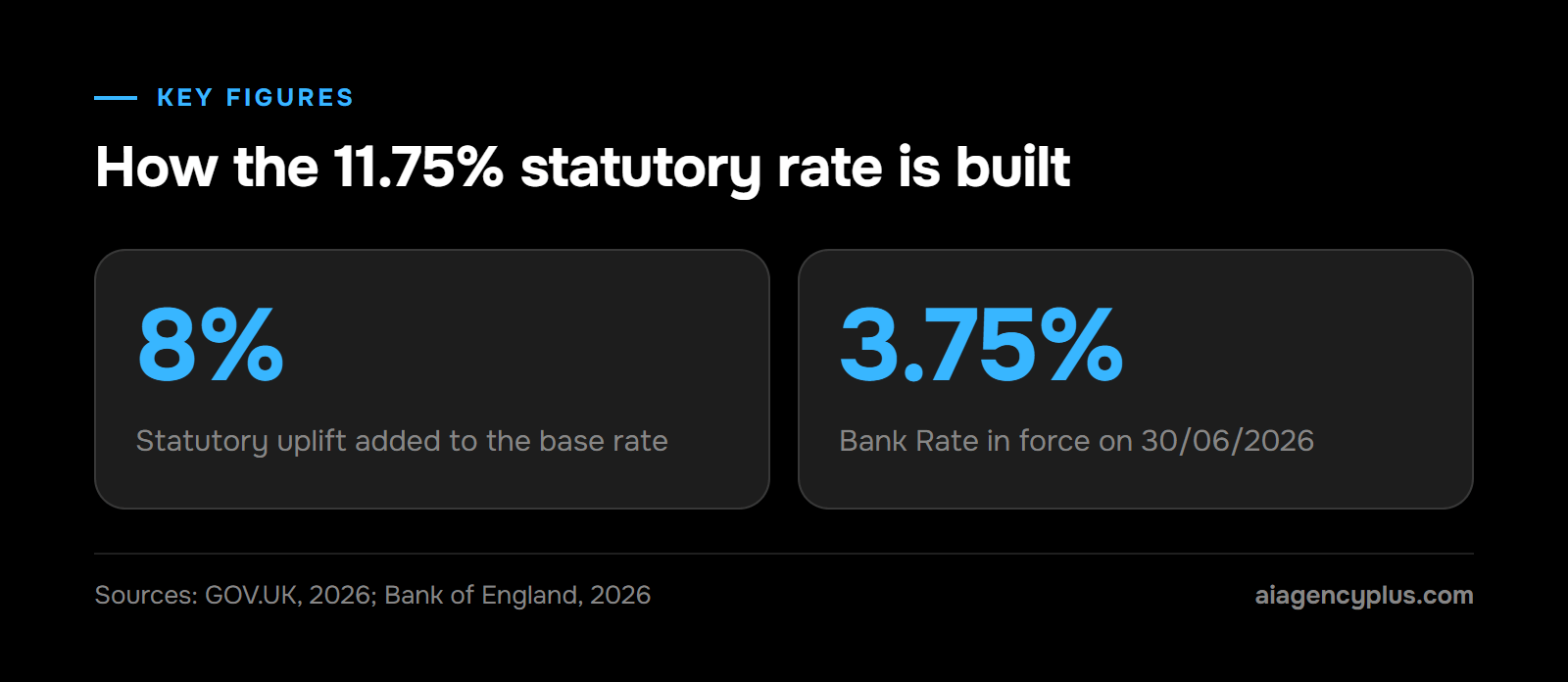
Late payment interest is the statutory interest a UK business can charge another business that pays an invoice late: 8% a year plus the Bank of England base rate. For debts that go late between 01/07/2026 and 31/12/2026, that is 8% plus the 3.75% Bank Rate (Bank of England) in force on 30/06/2026: 11.75% in total. You can also claim a fixed sum per late payment.
What late payment interest can a UK business charge?
A UK business can charge another business statutory interest of 8% a year plus the Bank of England base rate on a late invoice. For debts that go late in the second half of 2026, 8% plus the 3.75% Bank Rate (Bank of England, June 2026) in force on the 30/06/2026 reference date (SI 2002/1675) makes 11.75%. You do not need a clause in your terms to claim it. Bank of England.
GOV.UK puts the rule in one line: "this is 8% plus the Bank of England base rate for business to business transactions" (GOV.UK, read 08/11/2026). The right comes from the Late Payment of Commercial Debts (Interest) Act 1998. GOV.UK.
Which base rate counts?
The law fixes the base rate twice a year, on each 30/06 and 31/12. As a recurring rule, the rate in force on 30th June applies to interest that starts to run between 1st July and 31st December, and the rate in force on 31st December applies to interest that starts to run between 1st January and 30th June (SI 2002/1675). legislation.gov.uk.
That rate then stays with the debt. An invoice that went late in August 2026 carries 11.75% until it is paid, whatever Bank Rate does next.
| Debt goes late between | Reference Bank Rate | Statutory interest rate |
|---|---|---|
| 01/07/2026 and 31/12/2026 | 3.75% (in force on 30/06/2026) | 11.75% a year |
| 01/01/2027 and 30/06/2027 | Bank Rate in force on 31/12/2026 | 8% plus that rate |
The Bank of England raised Bank Rate to 4% on 05/11/2026 (Bank of England, November 2026). That does not change the rate on debts that went late in the second half of 2026. Bank of England.
Bank Rate can change again at the Bank of England's next decision on 17/12/2026, before the 31/12/2026 reference date. If it is still 4% on 31/12/2026, debts going late between 01/01/2027 and 30/06/2027 will carry 8% plus 4%. I will update this article after 31/12/2026.
Do you have to charge it?
No. Statutory interest is a right you can use or waive. Waiving it for a good customer who paid a few days late is often sensible. Using it on a customer who is months overdue and ignoring your emails is equally sensible.
If chasing late invoices is taking up your week, Book a Discovery Call.
How do you calculate late payment interest?
To calculate late payment interest, multiply the overdue amount by the statutory rate, divide by 365 to get a daily figure, then multiply by the number of days the payment is late. Statutory interest is simple interest under section 1 of the 1998 Act, so it does not compound. Under section 4 of the Act, it starts to run on the day after payment was due, and it runs until the day you are paid. legislation.gov.uk. legislation.gov.uk.
The formula has two lines:
- Daily interest = overdue amount × statutory rate ÷ 365
- Interest owed = daily interest × number of days late
Keep the daily figure unrounded until the end. Rounding to the penny every day adds small errors over a long debt.
Worked example: a £4,800 invoice paid 60 days late
This is an illustrative example. It uses the 11.75% rate that applies to debts going late from July to December 2026.
An invoice for £4,800 was due on 31/07/2026, so interest starts on 01/08/2026. The customer pays on 29/09/2026, which is 60 days late.
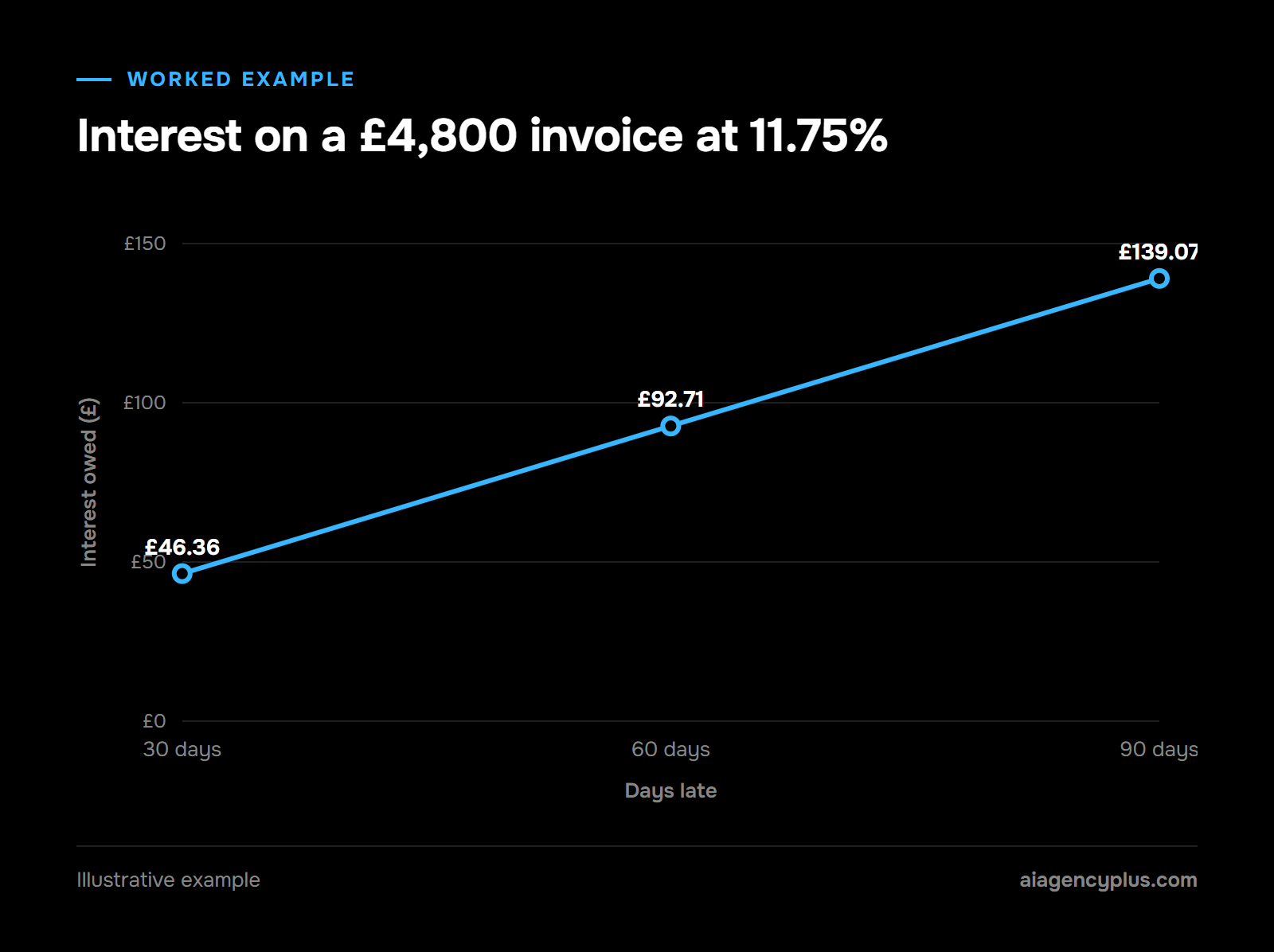
- Daily interest: £4,800 × 11.75% ÷ 365 = £1.5452 a day
- Interest for 60 days: £1.5452 × 60 = £92.71
- Fixed sum for a debt of £1,000 to £9,999.99: £70
- Total to claim: £4,800 + £92.71 + £70 = £4,962.71
| Days late | Interest at 11.75% | Fixed sum | Total owed |
|---|---|---|---|
| 30 | £46.36 | £70 | £4,916.36 |
| 60 | £92.71 | £70 | £4,962.71 |
| 90 | £139.07 | £70 | £5,009.07 |
Why the 90-day row matters
The court fee band depends on the amount unpaid, including interest, on the day you issue the claim. If the invoice were still unpaid at 90 days, £5,009.07 would put a claim in a higher fee band, covered in the step-by-step section below. If the customer has paid the £4,800, a claim for the interest and fixed sum alone falls in a much lower band.
If you track invoices in a spreadsheet, put the rate in its own cell and the formula in one row per invoice. When a new period starts, you change one cell for new debts and leave older ones on their original rate.
What fixed compensation can you claim on top?
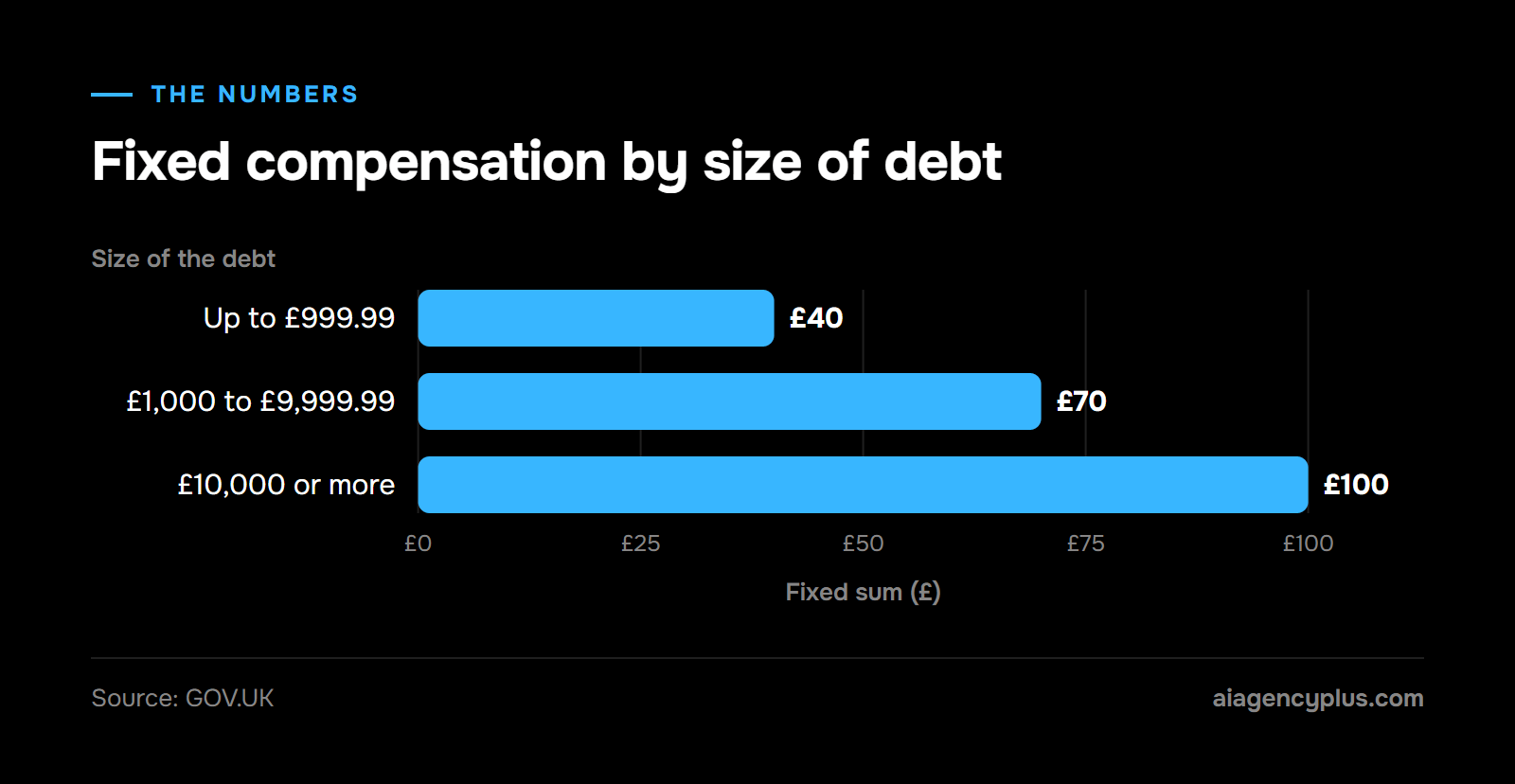
On top of interest, you can claim a fixed sum towards the cost of recovering the debt: £40 for debts up to £999.99, £70 for £1,000 to £9,999.99 and £100 for £10,000 or more. You charge it once per late payment, and you can also claim reasonable recovery costs above it. GOV.UK.
GOV.UK states: "You can also charge a business a fixed sum for the cost of recovering a late commercial payment on top of claiming interest from it". The entitlement sits in section 5A of the 1998 Act and starts once statutory interest begins to run. legislation.gov.uk.
| Size of the debt | Fixed sum you can claim |
|---|---|
| Up to £999.99 | £40 |
| £1,000 to £9,999.99 | £70 |
| £10,000 or more | £100 |
What counts as reasonable recovery costs?
GOV.UK also says: "If you're a supplier, you can also claim for reasonable costs each time you try to recover the debt". That can include, for example, a debt collection agency's fee or a solicitor's letter.
There is no set figure for "reasonable". Keep the invoice for every recovery cost you want to claim, and expect to justify it if the customer pushes back.
Where the fixed sum adds up
The fixed sum applies to each late payment. As an illustrative example, ten overdue invoices of £300 each from one customer could carry 10 × £40 = £400 in fixed sums before any interest.
If you send one statement covering several late invoices, list each invoice with its own due date, interest and fixed sum. That keeps every figure easy to check.
When does the late payment law apply, and when doesn't it?
The Late Payment of Commercial Debts (Interest) Act 1998 applies when the buyer and the supplier are both acting in the course of a business and the contract is for goods or services. It does not cover sales to consumers, and it steps aside where your contract sets its own interest rate. legislation.gov.uk.
Section 2 of the Act puts it this way: "This Act applies to a contract for the supply of goods or services where the purchaser and the supplier are each acting in the course of a business". That covers sole traders, partnerships and limited companies buying for their business.
When does a payment count as late?
- You agreed a date: the payment is late from the day after that date.
- No date was agreed: a payment is late 30 days after the customer receives the invoice or you deliver the goods or service, whichever is later (GOV.UK guidance).
- Long terms: Between businesses, payment terms longer than 60 days are allowed only where they are fair (GOV.UK).
When your contract or the customer changes the rules
- A contract rate: If your contract sets a different interest rate, you claim that rate instead of statutory interest (GOV.UK). That holds only if the contract rate is a substantial remedy for late payment. Under section 8, a contract term that confers a right to interest that is not a substantial remedy for late payment is void, and statutory interest applies instead (sections 8 and 9 of the 1998 Act). legislation.gov.uk.
- Public authorities: If you contract with a public authority, the contract cannot set a lower rate than the statutory one.
- Consumers: Sales to members of the public fall under different rules, outside this Act.
When I would hold off
If the customer genuinely disputes the work or the amount, settle the dispute first. Adding interest to a contested invoice tends to harden positions and slow payment.
Once the amount is agreed and still unpaid, statutory interest gives you a useful lever.
How do you claim late payment interest, step by step?
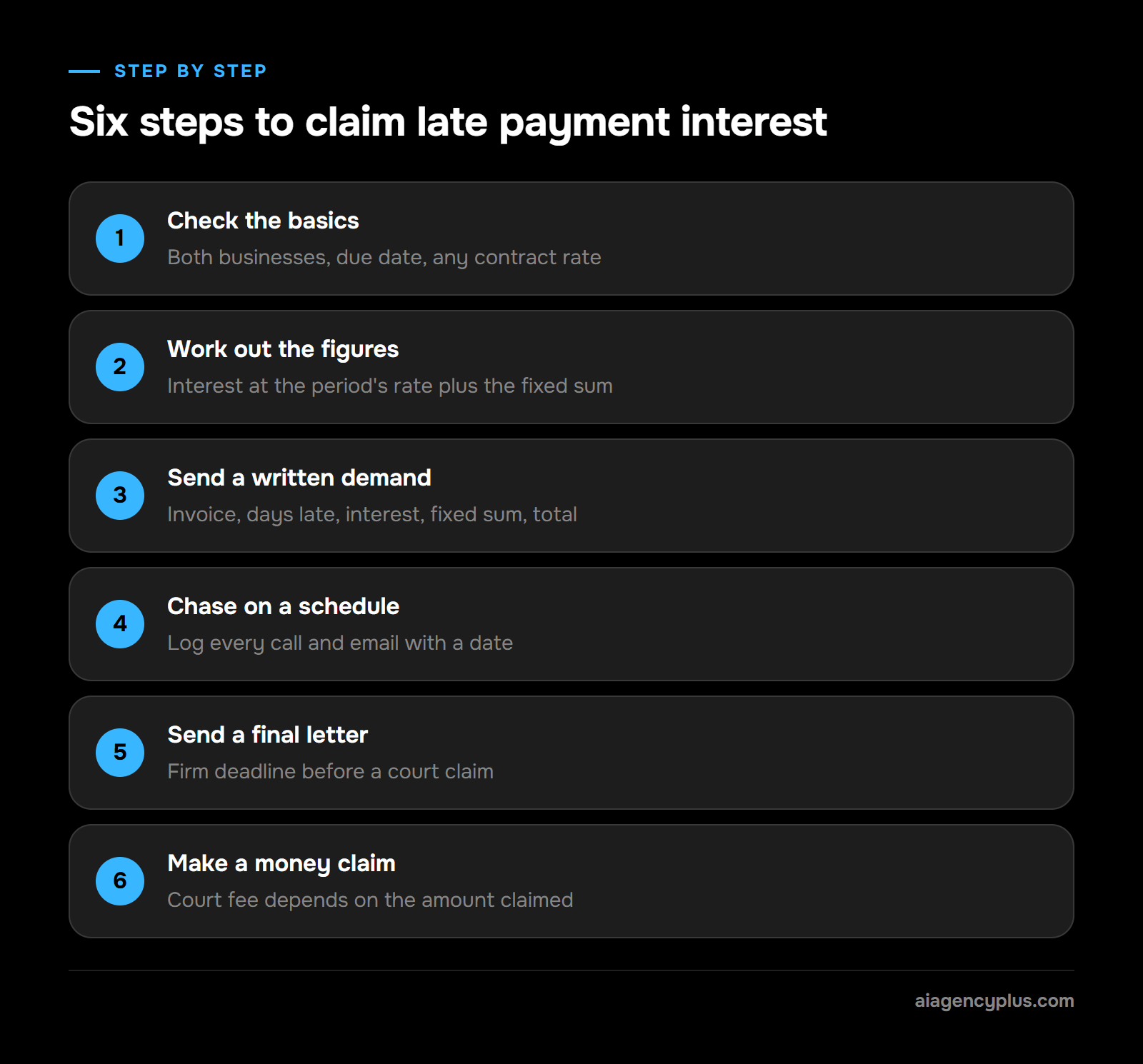
Claim late payment interest by checking the Act applies, working out the interest and fixed sum, then sending a written demand that shows the figures. If that fails, send a final letter with a firm deadline. If the debt is still unpaid, you can make a money claim through the court, where the fee rises with the amount claimed.
- Check the basics: confirm both parties are businesses, find the due date and check your contract for its own interest rate.
- Work out the figures: use the formula above with the rate for the period the debt went late, then add the fixed sum.
- Send a written demand: email or post a statement showing the original invoice, days late, interest, fixed sum and total.
- Chase on a schedule: log each call and email with a date. The log is your evidence if it goes further.
- Send a final letter before action: set a clear payment deadline and say you will start a court claim if it passes.
- Make a money claim: issue the claim online or on paper, paying the court fee for the amount you claim.
What the written demand can say
A short version I would use: "Invoice 1042 for £4,800 was due on 31/07/2026 and remains unpaid. Under the Late Payment of Commercial Debts (Interest) Act 1998 we are claiming interest at 11.75% a year (£1.5452 a day) and a fixed sum of £70. The total due as at 29/09/2026 is £4,962.71."
Keep the tone factual. The figures do the work.
What a money claim costs
GOV.UK says: "The fee is based on the amount you're claiming, including any interest". These fees are for money claims in England and Wales: a claim of £3,000.01 to £5,000 costs £205 to issue, and one of £5,000.01 to £10,000 costs £455 (GOV.UK court fees page). Scotland (simple procedure) and Northern Ireland have their own court routes and fees, so check those if your claim is there. GOV.UK.
| Amount you claim, including interest | Court fee |
|---|---|
| Up to £300 | £35 |
| £300.01 to £500 | £50 |
| £500.01 to £1,000 | £70 |
| £1,000.01 to £1,500 | £80 |
| £1,500.01 to £3,000 | £115 |
| £3,000.01 to £5,000 | £205 |
| £5,000.01 to £10,000 | £455 |
| £10,000.01 to £200,000 | 5% of the claim |
| More than £200,000 | £10,000 |
The band depends on the amount unpaid, including interest, on the day you issue the claim. If the worked example invoice were still unpaid, £4,962.71 at 60 days would fall in the £205 band and £5,009.07 at 90 days in the £455 band. For larger or contested debts, take advice from a solicitor before issuing.
If chasing overdue invoices is taking hours of your week, Book a Discovery Call and I will tell you honestly whether a workflow would help or whether the steps above are enough.
What is changing in the late payment rules?
Nothing has changed in law yet. On 30/07/2025 the government announced plans for maximum payment terms of 60 days, reducing to 45 days, "mandatory interest charges for those who pay late" and stronger powers for the Small Business Commissioner "to wield fines" against the biggest firms. GOV.UK.
The Commercial Payments Bill that followed sets a 60-day cap; the move to 45 days was in the 2025 announcement, not the Bill. It is still going through Parliament, so the current rules above still apply.
The announcement put it plainly: "The upcoming legislation will also introduce maximum payment terms of 60 days, reducing to 45 days" (GOV.UK, 30/07/2025).
Where the Bill stands (as of 21/10/2026)
- It completed its House of Lords stages on 20/10/2026.
- It had its first reading in the House of Commons on 21/10/2026 (UK Parliament Bills, Commercial Payments Bill stages). UK Parliament Bills.
- It has not received Royal Assent, so none of its measures apply to invoices today.
What is not known yet
The final wording and the start date are not settled, and the Bill as it stands has no 45-day step. Amendments in the Commons could still change the detail.
What to do in the meantime
Use the statutory rate and fixed sums as they stand.
The Fair Payment Code, run by the Office of the Small Business Commissioner, is a separate code. Signing it is voluntary: a public commitment to how you pay your suppliers.
How do you cut late payments before they happen?
It is worth trying to prevent late payments before you have to chase them. Invoice promptly, agree payment terms in writing, check a new customer's credit, send a reminder before the due date and chase on a fixed schedule. Each of these works with a spreadsheet and a calendar, before any software comes into it.
What should your invoices and terms say?
You don't need a clause to claim statutory interest, but stating it on your invoices and terms removes any argument about what was agreed. Each invoice should show:
- The invoice date and the payment due date
- Your payment terms, for example 30 days from the invoice date
- A statement that statutory interest and fixed compensation apply to late payment under the Late Payment of Commercial Debts (Interest) Act 1998
- Your bank details and how to pay
Put the same payment terms in your contract or terms and conditions, and get them agreed before work starts. If you set your own interest rate instead, the substantial remedy point above applies.
Habits that reduce late payment
- Invoice promptly, on the day the work is delivered
- Agree payment terms in writing before you start
- Check a new customer's credit before offering terms
- Send a reminder a few days before the due date
- Chase on a fixed schedule after it, and log every contact
None of this needs software. The next section covers what changes when a workflow does it for you.
Can an automated workflow chase late payments for you?
Yes, if you send enough invoices for chasing to take real time. A workflow can watch due dates in your accounting software, send reminders on a schedule, work out statutory interest and the fixed sum, and pass the case to a person before anything formal goes out. With a handful of invoices a month, a calendar reminder and the formula above will do.
At AI Agency Plus I build business process automation for UK SMEs: invoices, approvals, reports and the rekeying between systems. My guide to AI automation costs in the UK sets out what affects the price.
What a chasing workflow can cover
- A polite reminder before the due date, and dated reminders after it
- Interest worked out with the right rate for the period each debt went late
- The fixed sum added once per late payment, by debt size
- A drafted demand held for a person to approve and send
- Payments matched to invoices, so chasing stops once the payment is recorded
I keep a person in charge of anything with legal weight, such as the final letter and any decision to go to court. The workflow does the counting and the reminding.
If you want the background first, read what is business process automation. If your own team is the one paying late, accounts payable automation covers that side.
What should you do about an overdue invoice today?
Check the due date, confirm the customer is a business and look for an interest clause in your contract. If there is none, apply 8% plus the base rate fixed for the period the debt went late, which is 11.75% for debts that went late in the second half of 2026, and add the £40, £70 or £100 fixed sum.
Send the figures in writing, chase on a schedule and keep a log. If the debt still goes unpaid, the court fee table above tells you what a claim will cost before you decide.
If you would rather a workflow handled the reminders, interest sums and reconciliation, Book a Discovery Call. I will tell you whether it is worth building for your volume of invoices.
Frequently asked questions
What is late payment interest?
Late payment interest is interest a business can charge another business that pays an invoice after the due date. In the UK, the Late Payment of Commercial Debts (Interest) Act 1998 sets a statutory rate of 8% a year plus the Bank of England base rate. It runs from the day after payment was due until the day you are paid.
What is the late payment interest rate in the UK?
For debts that go late from 01/07/2026 to 31/12/2026, the statutory rate is 11.75% a year: 8% plus the 3.75% Bank Rate in force on 30/06/2026. For debts going late between 01/01/2027 and 30/06/2027, it will be 8% plus the Bank Rate in force on 31/12/2026.
How do you calculate late payment interest in the UK?
Multiply the overdue amount by the statutory rate and divide by 365 to get the daily interest. Multiply that by the number of days late. For example, £4,800 at 11.75% is £1.5452 a day, so 60 days late comes to £92.71 before the fixed sum.
Can you charge late payment interest if it isn't in your terms?
Yes. Statutory interest applies to business-to-business contracts for goods or services under the 1998 Act, whether or not your terms mention it. The exception is where your contract sets its own interest rate, in which case you claim that rate instead, provided it passes the substantial remedy test explained in the section on when the late payment law applies.
What if the customer pays the invoice but refuses the interest?
The interest and fixed sum are still owed. Both are owed under the 1998 Act, which treats statutory interest as an implied term of the contract and gives a right to the fixed sum, so you can include them in a written demand and, if that fails, in a money claim, following the step-by-step section above. Whether a small balance is worth the court fee and the customer relationship is a judgement call.