

My recommended quote follow up: send the quote the same day, check it arrived a day or two later, answer the likely question within a week and give a clear decision point before it expires. Call warm leads, email the detail and text only where ICO rules allow. Stop after five follow-ups at most, the last one closing the quote politely.
Is it worth following up on a quote?
Usually, yes, because a quiet customer often has not decided yet. They may be comparing quotes, waiting on a partner, checking a budget or simply busy. You have already paid for the site visit and the pricing time, so a short, well-timed follow-up costs little compared with what you have already spent.
Comparing quotes is normal, especially for bigger jobs. I haven't found a credible UK figure for how many quotes go unanswered, so I won't quote one. What I can say is that someone who asked you to price a job had a real job in mind. Silence often means timing or doubt, and a conversation can deal with both.
Follow-up also buys you information. A customer who says no and tells you why (price, timing, scope) helps your next quote more than one who never replies.
What this guide gives you
- A follow-up timeline you can copy, labelled as my recommendation
- Message templates for email, text and phone
- When to call, email or text
- The ICO rules on follow-up emails and texts
- What to automate, and what to keep personal
- A simple way to track which quotes become jobs
If you would rather have this built and running for you, Book a Discovery Call.
When should you follow up on a quote?
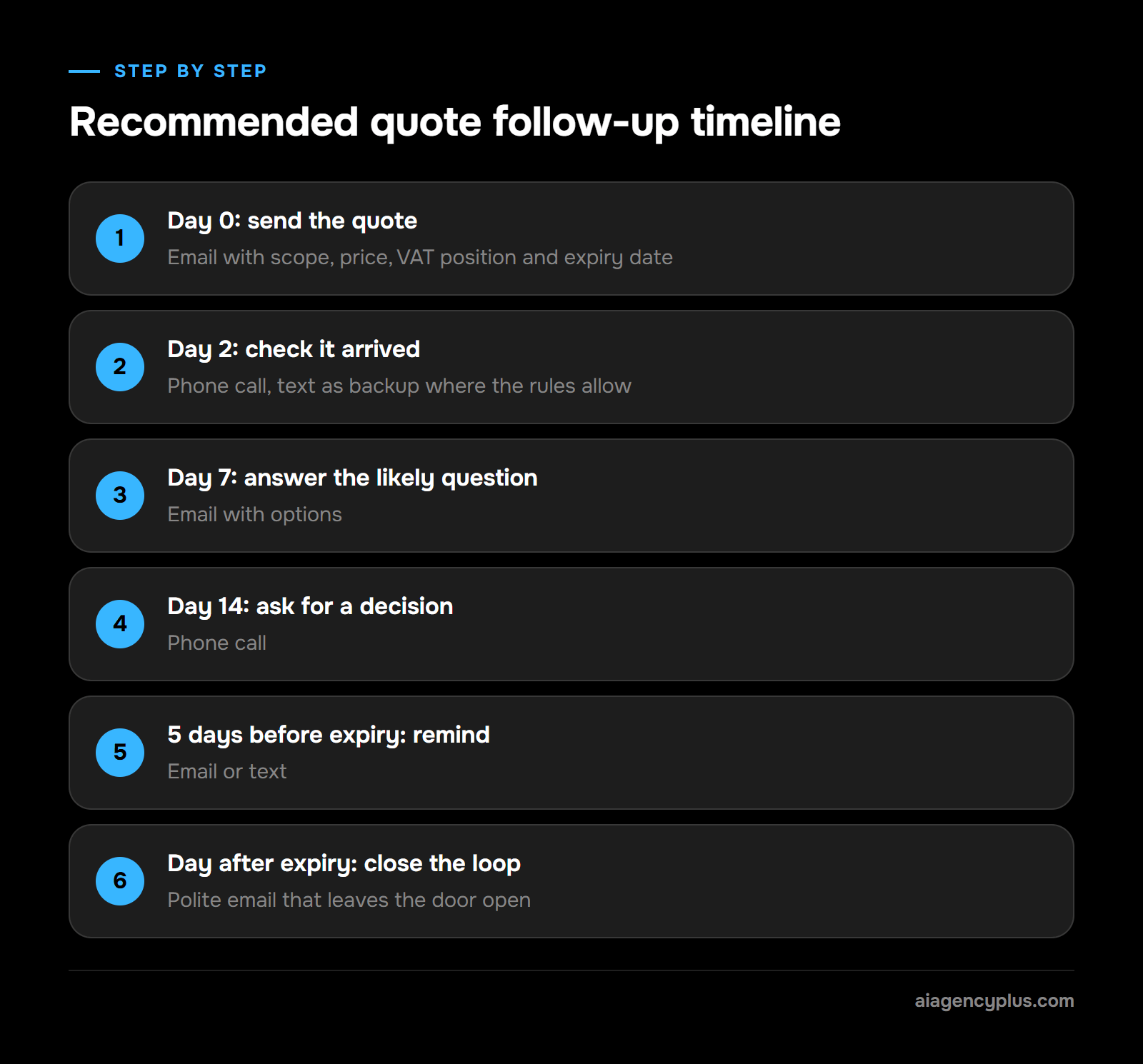
My recommendation is to follow up within two working days of sending the quote, then around day 7 and day 14, with a reminder about five days before it expires. These timings are my working recommendation for small UK service firms, not measured results. Adjust them to how quickly your customers usually decide.
Put an expiry date on every quote, such as 30 days. It protects you if material prices move. It also gives you an honest reason to get in touch later.
| Day | Channel | Message purpose |
|---|---|---|
| Day 0 | Email with the quote attached | Send the quote: scope, price, VAT position, expiry date, how to accept |
| Day 2 | Phone call (text as backup where the rules allow) | Check it arrived and answer first questions |
| Day 7 | Answer the question most customers ask, offer options | |
| Day 14 | Phone call | Ask where the decision stands and what date they need |
| 5 days before expiry | Email or text | Remind them of the expiry date, offer to hold the price if you can |
| Day after expiry | Close the loop politely and leave the door open |
That is five follow-ups after the quote itself. The sequence ends at the first reply, booking or no.
Stretch or shrink it to fit the job
An emergency repair quote needs a call the same day, because the customer may book whoever answers first. A kitchen fit, a solar install or a 12-month maintenance contract can take weeks, so space the steps out.
For B2B work, ask for the decision date when you send the quote. Then work the timeline back from their date.
When to stop
Stop the moment a customer replies, books, declines or asks you to stop. After the close-the-loop email, stop chasing. If they come back later, you will be the firm that was polite about it.
What to say in a quote follow up: messages that get replies
Give the customer something new each time: a check that the quote arrived, an answer to a likely question, a choice of options or a clear expiry date. Use their name and the job, keep the message under 100 words and end with one easy next step, such as replying or booking a call.
Copy these and change the bracketed parts. Each one matches a row in the timeline above.
Day 0: sending the quote
Subject: Your quote for [job] at [address], ref [Q-123]

Hi [Name],

Thanks for having me round on [date]. Your quote for [job] is attached.

In short: [one-line scope], £[price] [including VAT / plus VAT], about [X] days on site.

It's valid until [expiry date]. To go ahead, reply to this email or call me on [number] and we'll agree a start date.

[Your name]
[Company name] | [phone] | [website]
Say clearly whether the price includes VAT. Put a direct mobile number in the signature.
Day 2: the check-in call or text
Call: "Hi [Name], it's [Your name] from [Company name]. I sent your quote for [job] on [day]. Did it come through, and is there anything in it you'd like me to explain?"

Text (only where the ICO rules below allow it):
Hi [Name], it's [Your name] from [Company name]. Just checking the quote for [job] reached you. Any questions, reply here or call [number]. Reply STOP to opt out.
Day 7: the helpful email
Subject: A quick answer on [the question most customers ask]

Hi [Name],

Customers often ask me [common question, e.g. how long the work takes / whether you need to be in]. For your job: [short answer].

If the price is the sticking point, I can also quote [Option B: smaller scope or different spec] at £[price].

Happy to talk it through on [number].
If you would rather I did not follow up again, just reply and say so.

[Your name]
Day 14: the decision call
"Hi [Name], it's [Your name] from [Company name]. Where are you up to with the [job]? Is there a date you need it done by, and is there anything that would make the decision easier?"If they say they are going with someone else, thank them and ask what tipped it. Write the answer in your quote log.
Five days before expiry
Subject: Your quote for [job] is valid until [expiry date]

Hi [Name],

A short reminder that your quote is valid until [expiry date]. After that I'll need to recheck material prices before I can confirm the figure.

If you need a bit longer, reply and I'll see whether I can hold it.
If you would rather I did not follow up again, just reply and say so.

[Your name]
Day after expiry: closing the loop
Subject: Shall I close off your quote for [job]?

Hi [Name],

I haven't heard back, so I'll take it the timing isn't right and close this one off for now.

If anything changes, reply to this email and I'll pick it up.
If you would rather I did not follow up again, just reply and say so.

Thanks again for asking me to quote.
[Your name]
If they say it's too expensive
Ask what they are comparing against before you answer. Another quote may leave out something yours includes, such as waste removal, making good or a guarantee. Price is often the reason given, but not always the real one.
Then explain what your price includes, line by line if it helps. If the budget really is fixed, offer a smaller scope or a different spec rather than a discount on the same job.
If the scope changes, or the customer asks for changes, send a revised quote in writing. Both sides then know exactly what was agreed and at what price.
What to leave out
- "Just checking in" with nothing new to say
- A discount nobody asked for, which can suggest your first price was padded
- Fake urgency, such as a deadline you don't intend to keep
- Long paragraphs about your company history
If you would rather have the reminders run themselves, Book a Discovery Call. I'll tell you plainly whether it is worth automating at your volume.
Calls, emails or texts: which channel when?
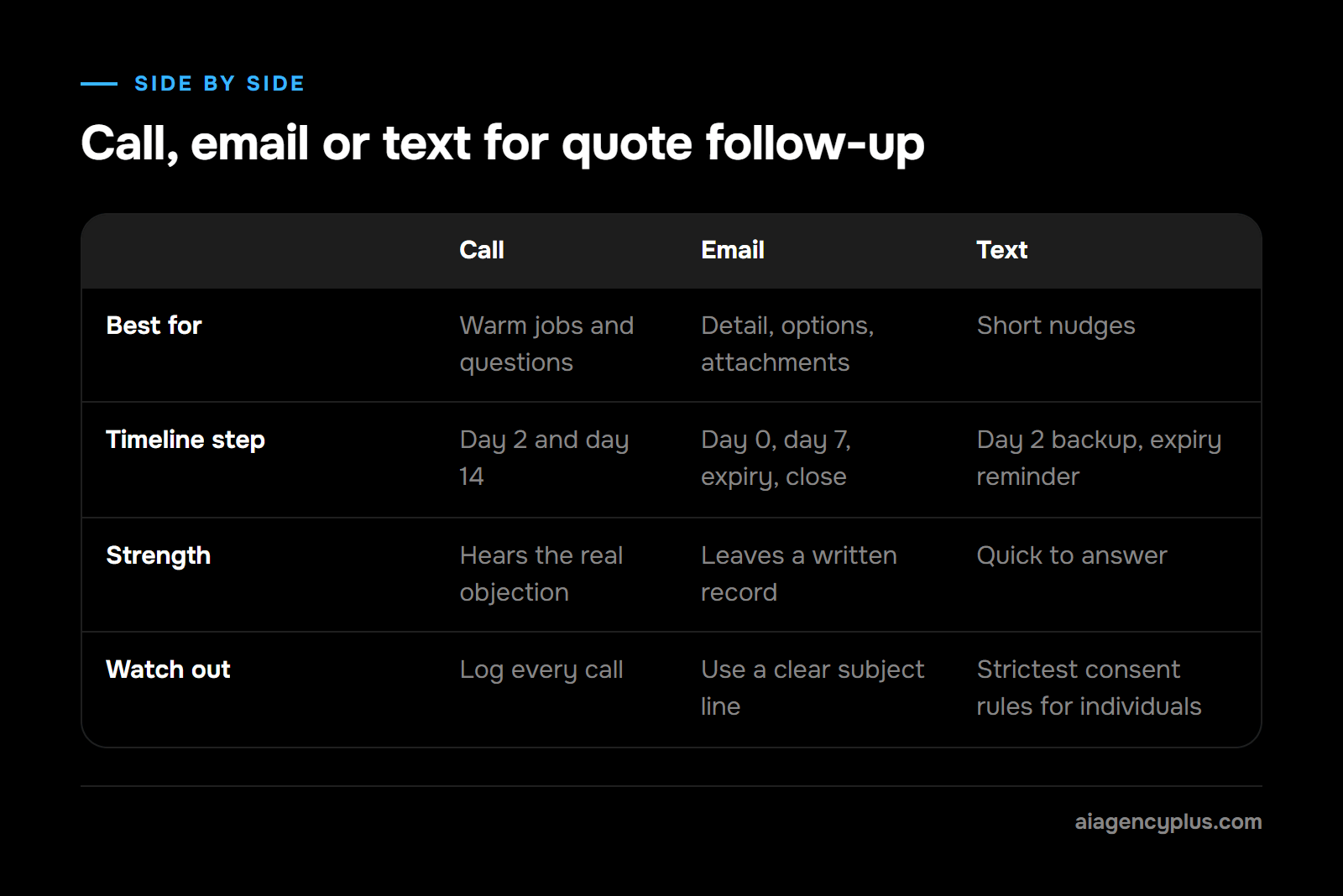
Call when the job is warm and the customer is likely to have questions. Email when they need detail they can reread or forward to a partner or manager. Text only for short nudges, and only where the ICO rules allow. My default is a call first, email for anything written and a text if the call goes unanswered.
In my recommended timeline, that means calls on day 2 and day 14. Emails go on day 0, day 7, before expiry and after it. Texts are a day 2 backup or the expiry reminder.
Calls
A call often brings out the real objection quickly. You hear "my partner thinks it's too much" or "we're waiting on the landlord" and can answer it there and then. Keep a short note of every call in your quote log.
If the customer rings back and you miss it, the job can go cold fast. My guide to call handling for small businesses covers how to catch those calls, and missed call text back explains a simple safety net.
Emails
Email suits anything with numbers, options or attachments. A clear subject line with the job and quote reference helps the customer find it later. It also leaves a written record if there is ever a dispute about scope.
Texts
Texts are short and quick to answer. They also carry the strictest consent rules when sent to individuals, so read the next section before you add them to your process.
Can you email or text customers about a quote under UK rules?
Yes, if you meet the ICO's rules. Marketing texts and emails to individuals need consent or the soft opt-in, and the ICO says requesting a quote counts as negotiations for a sale. Emails and texts to limited companies have lighter rules, and live calls have their own. I treat any follow-up that encourages a purchase as marketing, to be safe.
The rules sit in the Privacy and Electronic Communications Regulations (PECR), which the Information Commissioner's Office (ICO) enforces. A purely factual message, such as confirming an appointment time, may not count as marketing. A quote chaser written to persuade someone to buy is the one to treat as marketing.
Individuals: consent or the soft opt-in
Marketing texts or emails to individual subscribers, including sole traders and ordinary partnerships, need consent or a full soft opt-in, according to the ICO's electronic mail marketing guidance (read 08/11/2026). The ICO's key concepts page explains who counts as an individual subscriber. Homeowners and many small trade customers fall into this group.
The soft opt-in is the route a quoting firm is most likely to use. The ICO says negotiations for a sale cover quotes: "This includes signing up to a free trial of your product or service, requesting a quote or asking for more details about what you offer."
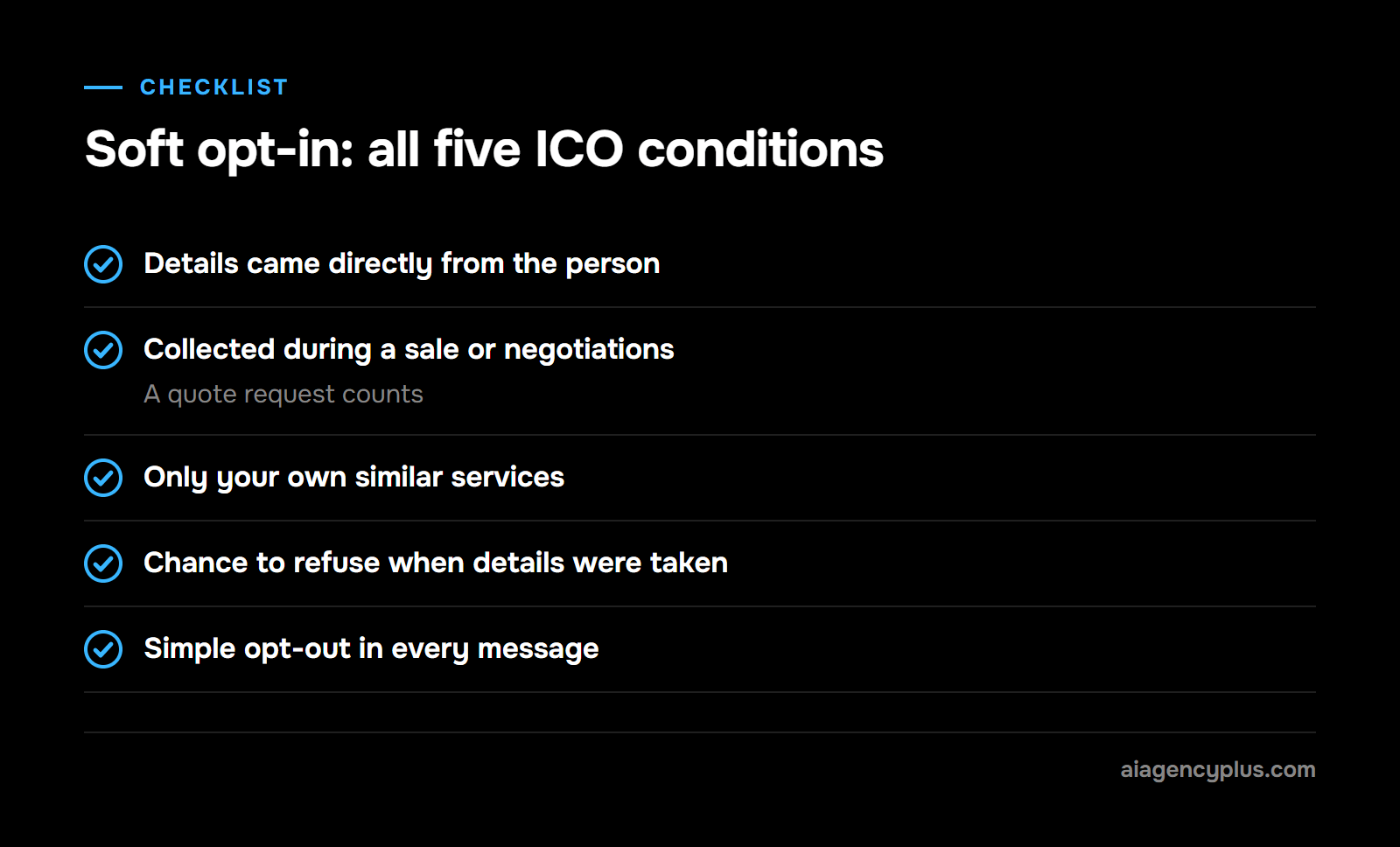
All five conditions must be met to send marketing texts or emails without consent:
- You got the contact details directly from the person.
- You got them during a sale or negotiations for a sale (a quote request counts).
- You only market your own similar products or services.
- You gave a clear chance to refuse marketing when you collected the details.
- You give a simple way to opt out in every message.
Limited companies: lighter rules for emails and texts
Unsolicited marketing emails and texts can go to corporate subscribers, such as limited companies, without consent or the soft opt-in. The same corporate-subscriber rule covers both, because PECR treats texts as electronic mail. You must not disguise or hide your identity, and you must give a valid contact address for opting out, per the same ICO guidance.
A named person's work email is still personal data under UK GDPR, so store it with care.
Calls
Live marketing calls follow separate PECR rules, including screening numbers against the Telephone Preference Service (TPS), set out in the ICO's guidance on live marketing calls. If you treat a persuasive follow-up as marketing, as I do above, the day 2 and day 14 calls come under them too.
Tell customers when they ask for a quote that you will call to follow up, and check the ICO guidance for your own case.
Set it up once
- Add a line to your quote request form or first email saying you will follow up about the quote and they can opt out at any time.
- Put "Reply STOP to opt out" on every text and an unsubscribe line on every email.
- Record opt-outs in your quote log and stop all follow-up straight away.
- Only market your own similar services to soft opt-in contacts.
This is a summary to help you act, not legal advice. Check the ICO guidance for your own case.
Automating quote follow-up without losing the personal touch
Automate the reminders, the record-keeping and the stop rules, and keep the real conversations with you. A system can send the day 7 email and remind you to call on day 14, but it must stop the moment a customer replies, books or opts out. My rule of thumb: below about five quotes a month, a calendar reminder is enough.
Follow-ups get missed in busy weeks, usually because nobody owns the list. A system that tells you what is due today fixes that before it costs you a job.
What to automate
- Logging each quote with its sent date and expiry date
- Scheduling the next follow-up from the timeline
- Sending the written templates with the customer's name, job and quote reference filled in
- Stopping the sequence when a reply, booking, decline or opt-out arrives
- Reminding you which calls are due today
What to keep personal
Keep the day 2 and day 14 calls, and any reply to a real question. A merge field reads very differently from a person who remembers the customer's kitchen. Automation's job is to make sure those calls happen on time.
How a simple sequence runs
- Quote marked as sent: the system records the date and the expiry date.
- Schedule: it plans the follow-up steps from the timeline.
- Check before each step: has the customer replied, booked, declined or opted out?
- Send or stop: if nothing has changed, it sends the next message or sets a call task. If anything has, it stops.
- Log the outcome: won, lost with a reason, or no reply.
Step 3 is the part that matters. A sequence that keeps chasing someone who has already booked looks careless. Test it with your own email address and phone before it goes near a customer.
For the background, my guide to what business process automation is covers the basics.
Where AI Agency Plus fits
AI Agency Plus builds business process automation for UK SMEs, and a follow-up sequence like the one above is the kind of workflow it covers. A first build runs £1,500 to £5,000 plus VAT and takes one to three weeks. For a full breakdown of build and running costs, see AI automation cost in the UK.
How do you track which quotes turn into jobs?
Keep a quote log with one row per quote: who, what, value, date sent, expiry date, next action and outcome. Each month, work out your win rate by count and by value, and look hard at the quotes that never got a reply. That tells you whether your follow-up or your pricing needs work.
What to record
- Quote reference and date sent
- Customer name, contact route and marketing preference
- Job and quote value (excluding VAT)
- Expiry date and next action date
- Status: open, won, lost or no reply
- Reason lost, in the customer's own words
A worked example (illustrative)
These figures are made up to show the method. They are not a benchmark or a result from any business.
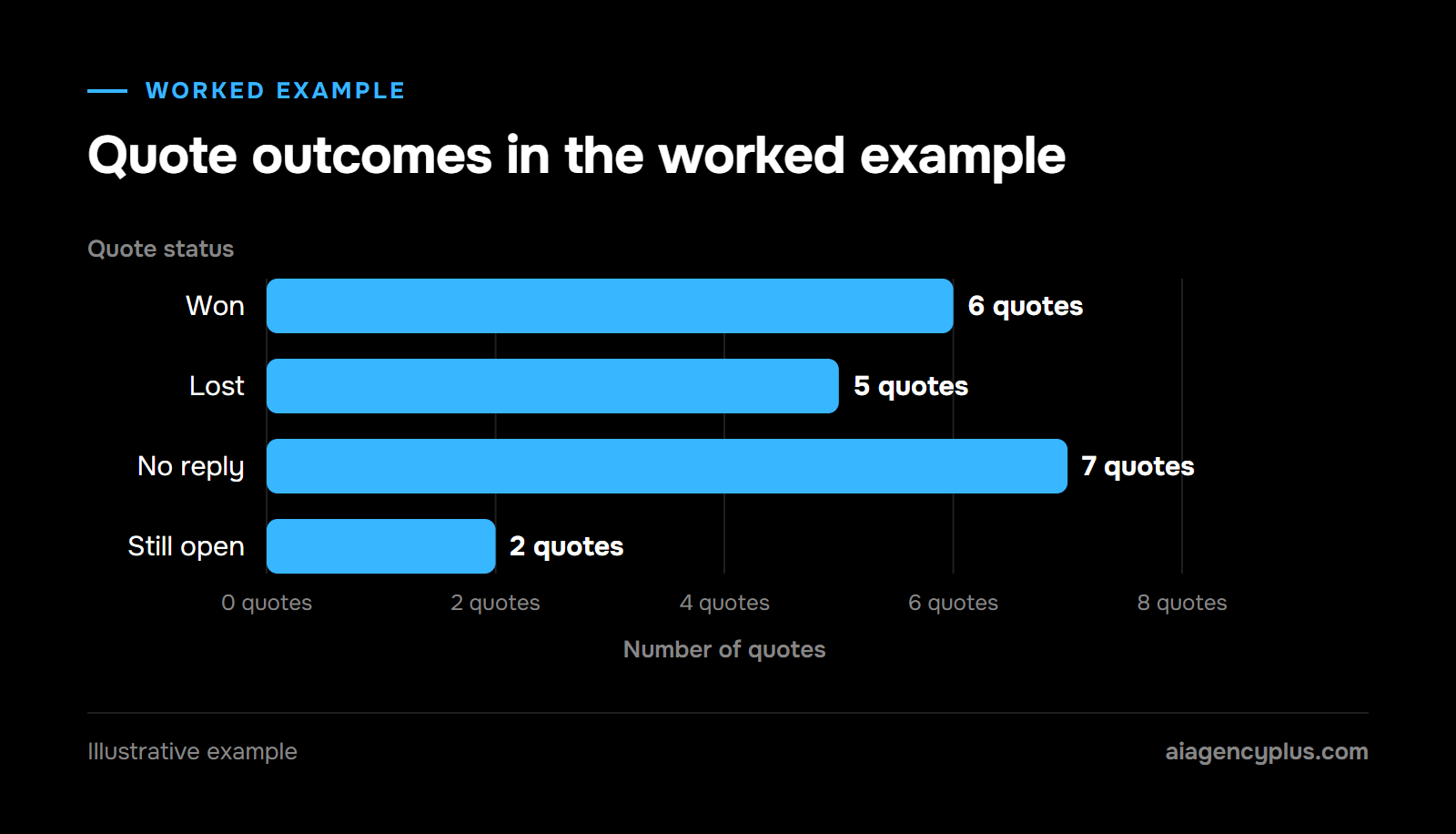
Say you sent 20 quotes in September 2026, worth £48,000 in total, excluding VAT. By 31/10/2026, 6 were won (£12,600), 5 were lost, 7 got no reply and 2 are still open.
- Win rate by count: 6 ÷ 20 = 30%
- Win rate by value: £12,600 ÷ £48,000 = 26.25%
A value rate below the count rate means the jobs you win are smaller than your average quote. That is worth a look at how you price or present the bigger jobs.
How to read it
The 7 no-reply quotes are where follow-up matters most. If they all had five follow-ups and still went quiet, look at price, speed or fit. If some only had the day 0 email, the gap is in the process.
Check your sums each month: won, lost, no reply and open should add up to quotes sent. Here, 6 + 5 + 7 + 2 = 20.
What should you do next with your quotes?
Put an expiry date on every quote, check in a couple of days after sending it, send one useful message around day 7, call around day 14, remind before expiry and close the loop politely. Get your ICO basics right before you text anyone, and keep a quote log so you can see what is working. Automate the reminders when your volume justifies it.
If you would like a straight answer on whether that is worth building for your firm, Book a Discovery Call.
Frequently asked questions
How do you follow up on a quote?
Send the quote the same day with a clear expiry date, then phone a day or two later to check it arrived. Follow with a useful email around day 7, a decision call around day 14 and a reminder before expiry. Close the loop politely the day after it expires.
How long should you wait to follow up on a quote?
My recommendation is no more than two working days, to check the quote arrived and answer first questions while the visit is fresh. For urgent repair work, follow up the same day, because the customer may book whoever answers first. These timings are my working recommendation, not measured results.
Can I text a customer about their quote without consent?
Yes, if you meet all five conditions of the ICO's soft opt-in, and the ICO says requesting a quote counts as negotiations for a sale. That includes giving them a chance to opt out when you took their number and in every text. Without consent or the full soft opt-in, don't send marketing texts to individuals, including sole traders.
Should quote follow-up be automated?
Automate the reminders, logging and stop rules once you send more than a handful of quotes a month. Keep the calls and the replies to real questions personal. Any automation must stop as soon as there is a reply, a booking or an opt-out.
How many times should you follow up on a quote?
My recommendation is up to five follow-ups after the quote: a check-in, a helpful email, a decision call, an expiry reminder and a close-the-loop message. Stop sooner if they reply, book or say no. After the final message, leave it with them.